
South Luangwa National Park is one of a handful of locations in Africa where there is an excellent chance of seeing Painted Wolves or African Wild Dogs so we headed into Zambia from Malawi to stay at Robin Pope’s Safari House with a sense of eager anticipation.
Zambia is one of only six countries left from an original wild dog range of 39 with a viable wild dog population comprising around 600 individuals known to the Zambian Carnivore Programme with 350 of these in South Luangwa. Tragically there are as few as 6,600 wild dogs left in total in the wild so Zambia’s and South Luangwa’s populations are fundamental to this amazing animal’s survival. (See my earlier post on the conservation of wild dogs https://travelogues.uk/2024/04/11/last-chance-to-see-african-wild-dog/)
We were in South Luangwa in the emerald season, but the rains were late in arriving making movement around the park still very easy. Much of the still dry floodplain of the Luangwa river was presenting itself as swathes of bright green parkland but enough rain had fallen to bring the bush to life, lush and vibrant.
This is a wonderful park that visitors frequently rank among the finest in Africa but it remains comparatively undiscovered with just 30,000 visitors a year; compared with around a million in Kruger or 350,000 in the Maasai Mara. We saw other safari jeeps around but we were alone for all of our most memorable sightings including the day of the painted wolves.
© Steve Middlehurst
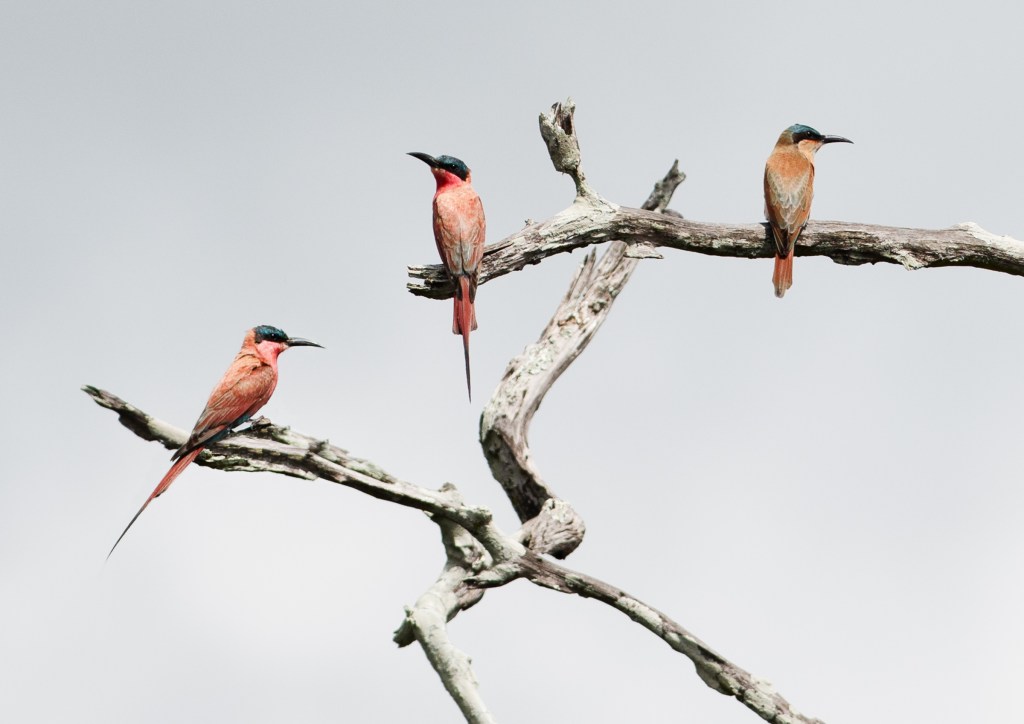
A bright sunny day, our third day in the park, soon became very hot and sticky. Our first few hours had been interesting enough with a small herd of elephants including emerald season babies, a few grumpy buffalo, a crowned hornbill, a collared pratincole, a warthog family running tail-high for cover, a Goliath heron fishing in the Luangwa River, an African fish eagle drying its wings like a cormorant and some young southern carmine bee-eaters left in the park when the adults migrated a few weeks ago.

© Steve Middlehurst
Mid-morning saw us winding our way along a narrow track fringed with dense bush as the temperature rapidly climbed and the world quietened as every living creature began to retreat into the shade. We slowly rounded a slight bend in the track and the bush retreated to reveal an muddy open space networked with khaki-coloured pools and there, straight ahead, was a pack of seven wild dogs cooling off in and around the largest pool.
This pack was clearly habituated towards the safari vehicle and we were able to roll to a halt a respectful distance from the pack and settle down to watch. This was obviously a rest and recuperation period within their day, cooling down, socialising, dozing and sleeping. Wild dogs hunt at sunrise and at dusk, night-time being the kingdom of the lion, leopard and spotted hyena although there is obviously some overlap as hyena remain active early morning and late afternoon and often track wild dog hunts with kleptoparasitism1 in mind and lions will move around in daylight.

© Steve Middlehurst
Every wild dog’s coat is unique and that was as true in this small pack as it is for the whole wild dog population. There is a wide range of colours and patterns from a palette of white, yellow, orange, brown and black that enables them to exhibit the most varied coat colours among all the mammals. It is believed that they can recognise each other at distances up to 100 metres and these extreme pattern variations may help them in that regard. The dominant female in “our” pack had a very pale, practically grey background to her coat, whereas others had more variations on a brown theme.

© Steve Middlehurst
There is some regional variation in colour mixtures that might correspond to differences in habitat and camouflage requirements but there is only one species of wild dog.
After much wallowing and soaking the dogs slowly drift away from the water and into the shade of the shrubbery alongside the track. At first glance this may appear a disorganised process but it is the dominate female who moves first and she is quickly followed by the rest of the pack.

© Steve Middlehurst
This is another of Africa’s matriarchal societies2 with the alpha female making the decisions of when to hunt, where to den and who gets to join the pack. Perhaps it was a coincidence but it seemed that she decided it was time for everyone to get into the shade and they did. A pack is made up of an alpha pair who are monogamous and mate for life, they are the only breeders in the pack and the other dogs are there as helpers, babysitters, guards and hunters. Jonna Banda who has watched these dogs for many years believes that the alpha pair remain in control as long as they are making good decisions but that a succession of poor decisions can lead to either dispersal of the lower status wild dogs or overthrow of the alphas.
The procession that follows her allows us to see the common features of these beautiful animals.
Prominent are the famously large teeth with the proportionately large pre-molars that are the largest relative to body size in any carnivore other than the hyena.
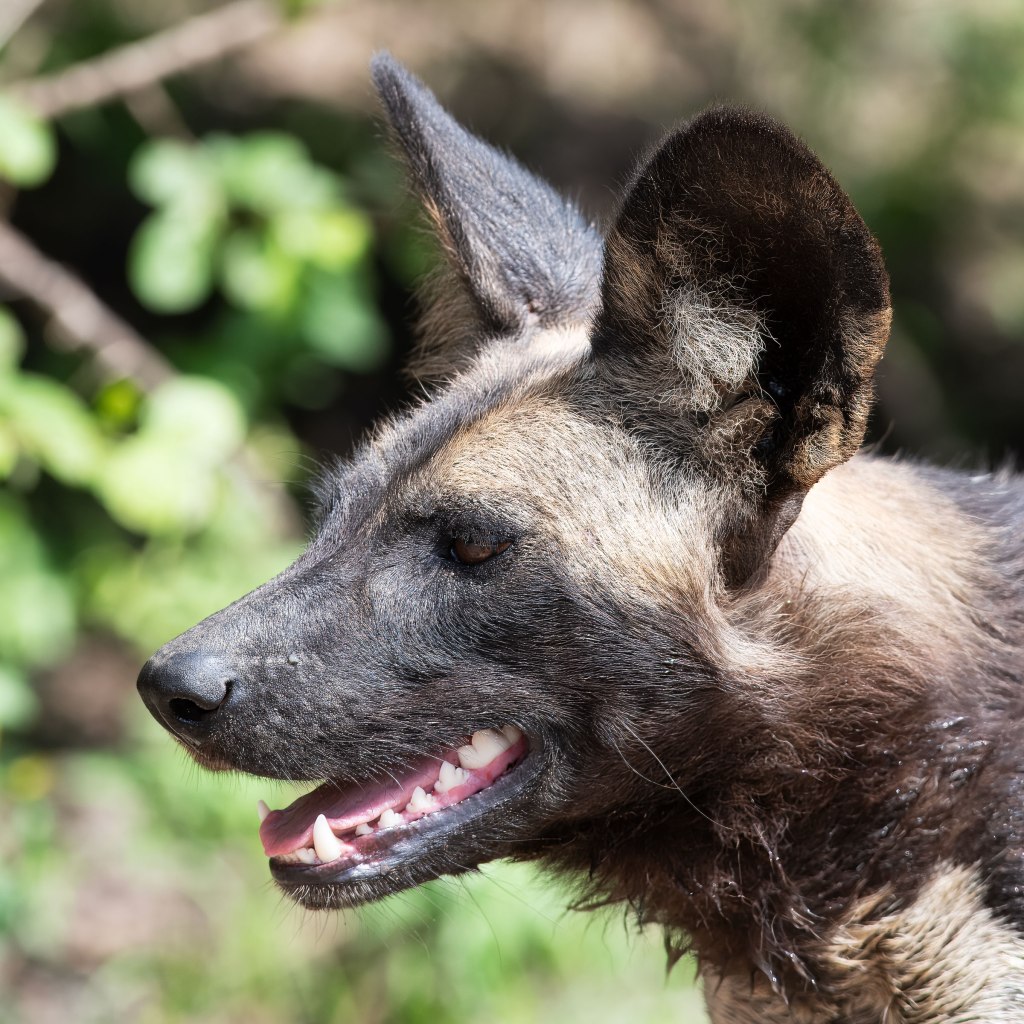
Nearly at the back of their mouth are the carnassials (the last tooth that can been seen in the picture above), an upper and lower pair of self sharpening shears for slicing through meat. The power of a wild dog’s bite compared with its size (BFQ3) puts it at the top of the league of African carnivores.
© Steve Middlehurst
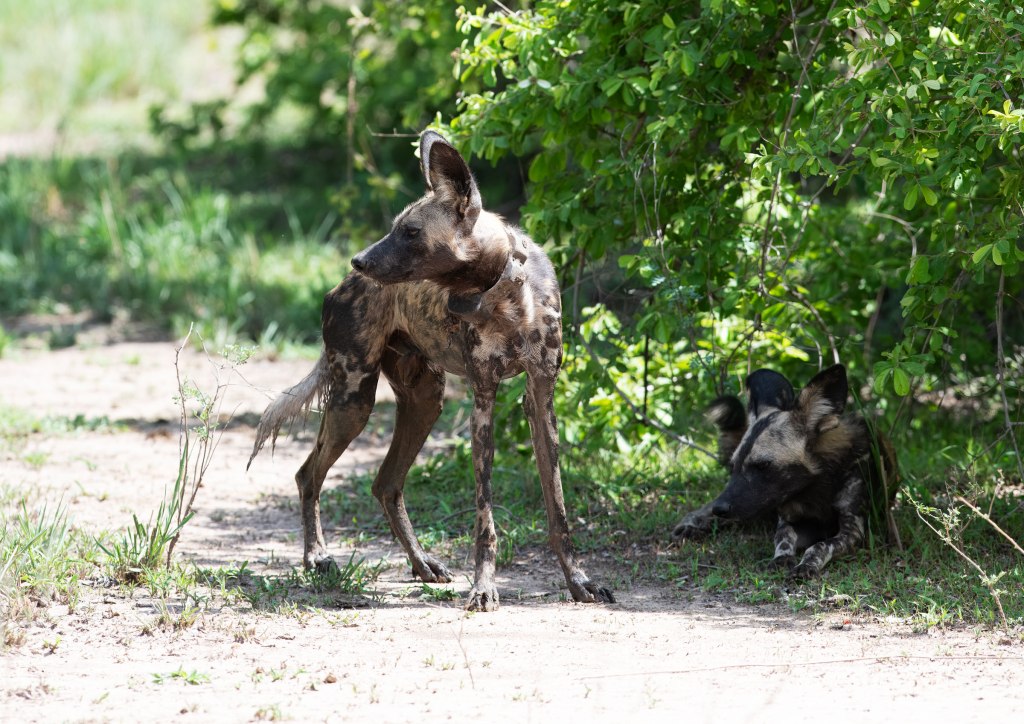
Other common features include their white tail tips which probably help them to stay in touch when hunting and they all have a dark muzzle with a black stripe4 that runs back over their head and between their disproportionately large rounded ears.
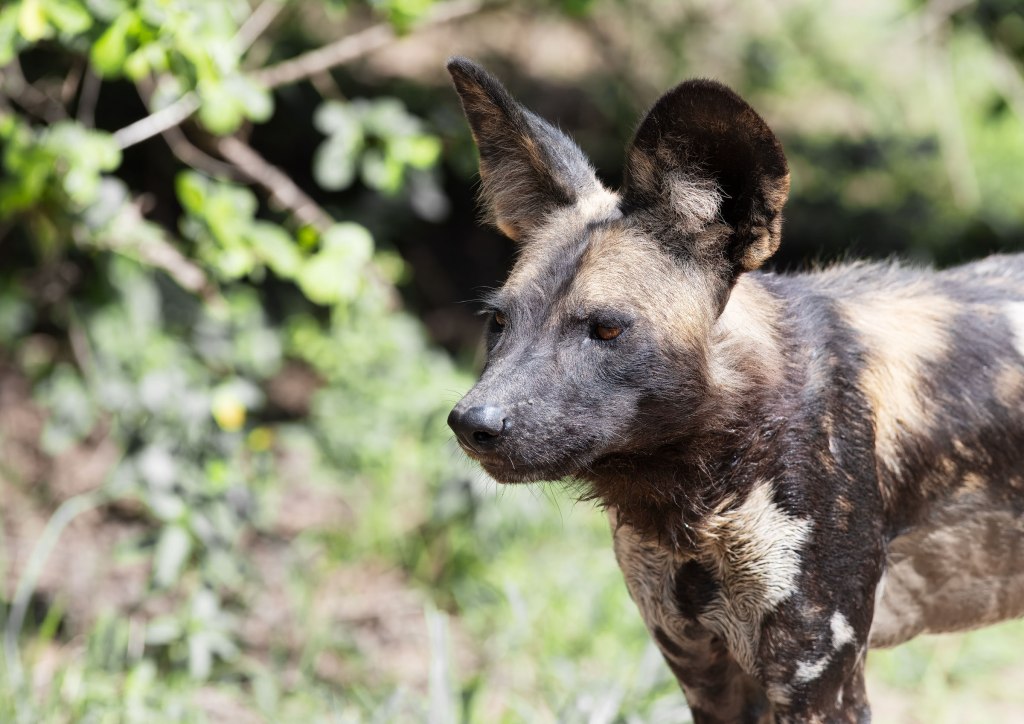
When talking about the wild dogs with friends the most common questions are about their size. They are about the size of an English Setter but with longer legs and a more slender body or a German Shepard but taller and less heavily built; they weigh between 18 and 36 kilos, stand between 60 and 75 cm tall and are about a 1 metre in length.
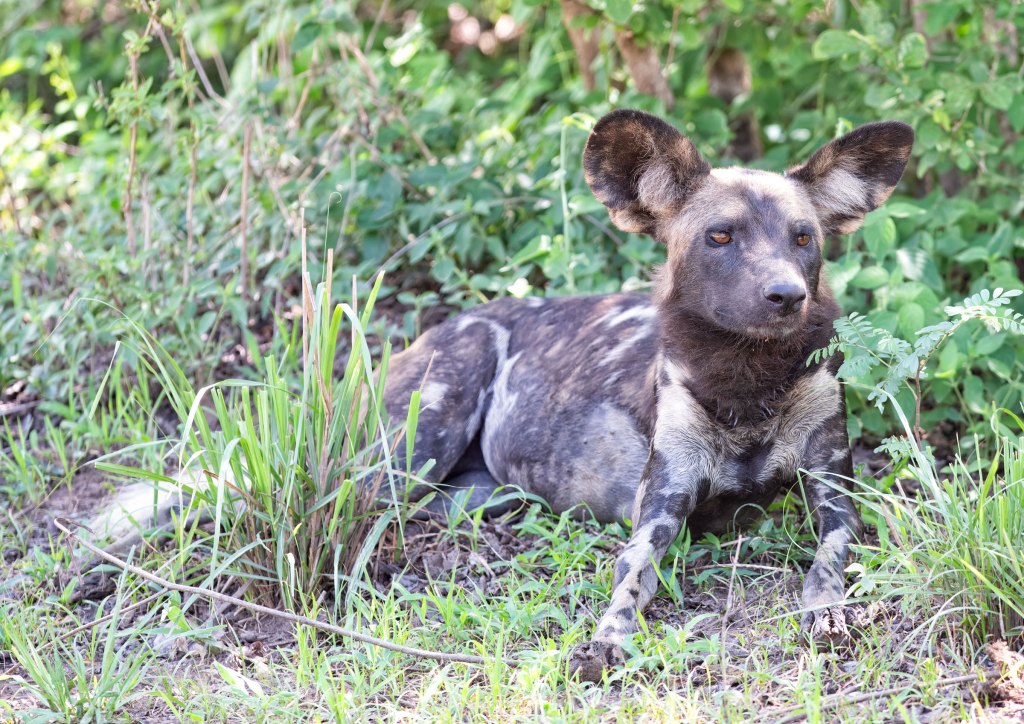
© Steve Middlehurst

© Steve Middlehurst
Once the pack are in the shade there always a few with pricked up ears and bright eyes scanning the surroundings for any threats. Apart from the odd glance we are ignored despite the pack having drifted nearer to us as they moved into the shade. Despite having branched off the family tree that would eventually evolve into foxes, grey wolves and domestic dogs 2.5 million years ago (mya) their every gesture, body position and look reminds us of our dogs at home, no doubt sleeping on the sofa.

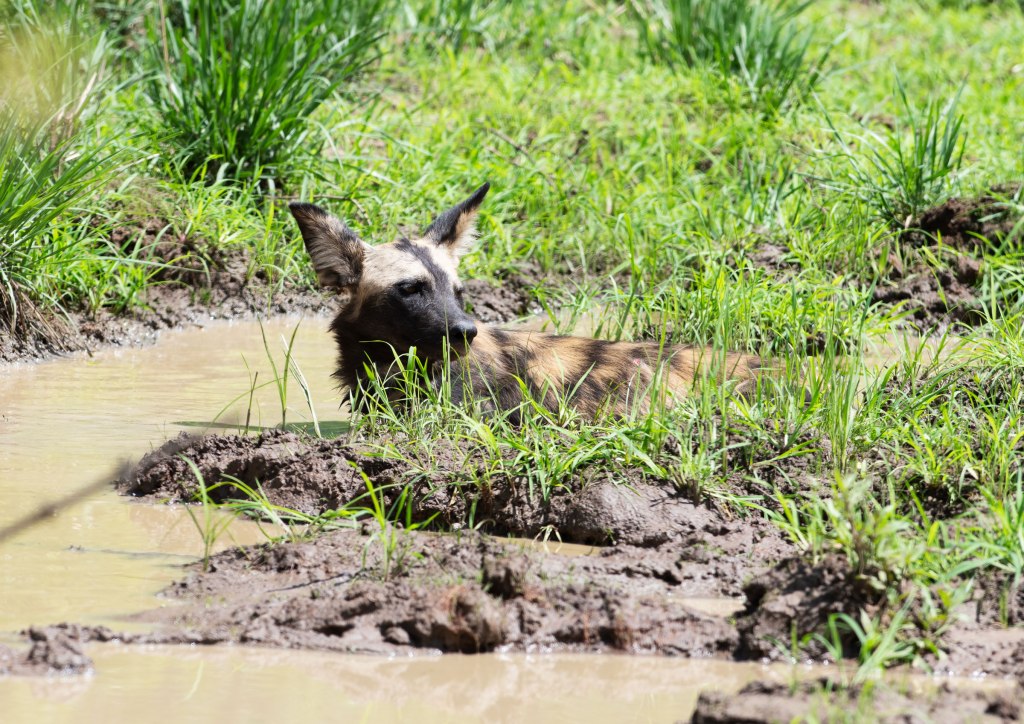
One male finds the ever growing heat of the day too much and heads back from another dip in the muddy pool. We cannot sensibly get close enough to test the water but we have watched a lot of urinating and potentially defecating in this pool so the pack’s combined sent must be well and truly on the bathers.
Strangely enough the African wild dog did not evolve in Africa but in Asia 2.5 mya and moved into Africa between 2.0 and 1.8 mya which is much the same time that Homo erectus, one of the early hominins, was spreading out of Africa. Fossil evidence shows that they crossed paths and co-habited in the Dmanisi area of Georgia.

However, this early hominin and the ancestor of wild dogs have a far more important characteristic in common. Fossils found in Spain show that the wild dog’s ancestors cared for a crippled member of their pack over several years, allowing it to feed despite having not been able to join the hunt. Homo erectus fossils of a similar date in Dmanisi, show that an aged and toothless individual survived presumably by being helped to feed by a family group. This behaviour is not found in wolves or other African predators, although it has been observed in dwarf mongoose; and it continues to be seen in African wild dogs and humans.
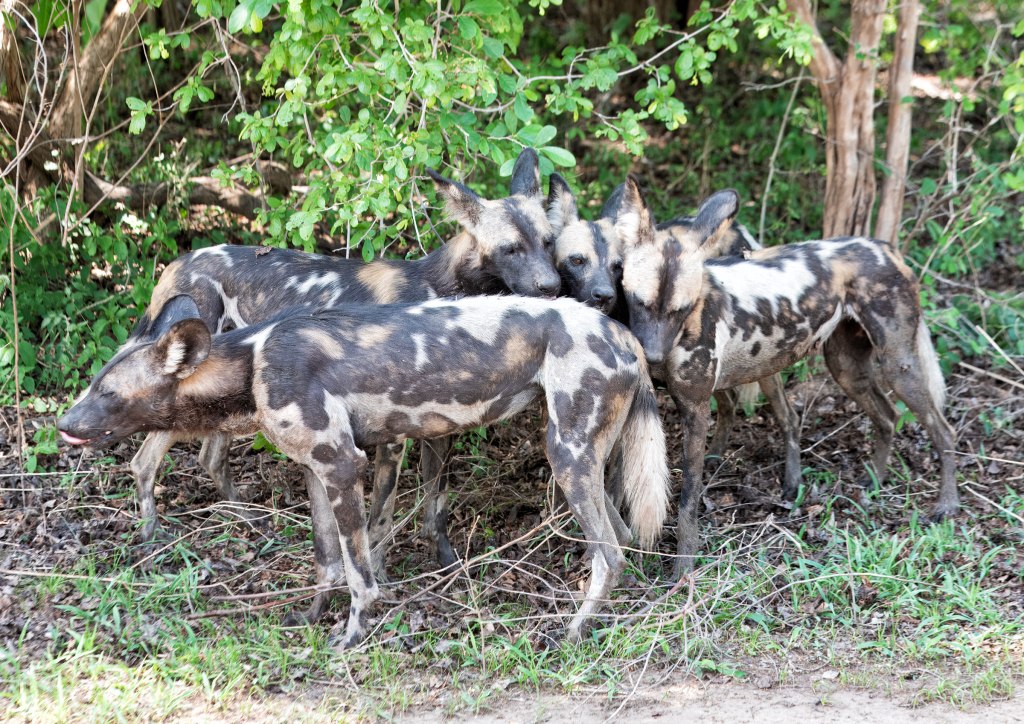
Eventually our pack starts to become restless. Waking up, even from a short doze is obviously an event worth celebrating in the wild dog world; we watch a lengthy period of rolling in each others’ scent, scratching, urinating, bottom sniffing and close physical contact. Complex social structures in the animal kingdom appear to need constant reconfirmation. Elephants greet each other in elaborate and highly tactile ways, primates groom each other when resting as a group, wild dogs constantly touch each other, play biting, sniffing, rubbing against each other, grooming and even “kissing” each other on the lips. Anyone who has owned domestic dogs will know of their urge to lick each others’ and their owners’ mouths, a behaviour designed to trigger the regurgitation of food and a trait shared with their very distance cousin.

And, then they are on the move. One after another they slowly move out of the shade and across the track, eventually disappearing into the bush. We too head back to base and without the local knowledge of Jonna Banda the legendary Zambian guide and Robin Pope’s Country Manager that would probably have been the end of our day of the painted wolves. However, based on where we saw the wild dogs in the morning Jonna thinks he knows where they will have spent the hottest part of the day and that as evening approaches they will hunt so later that afternoon we head back into the park;

Late afternoon we notice a line of nine marabou storks standing at the end of a rugby-pitch-sized dry lagoon bed; looking to our right towards the other end of the field there are more storks, a hooded and a white-backed vulture and there, amongst the birds, we can see the ears of one wild dog just showing above the grass.

© Steve Middlehurst
Our timing is perfect, as we move down the edge of the lagoon and pull up nearer to the pack more heads pop up out of the grass, suddenly alert, probably not disturbed by our engine but from a natural sound towards the other end of the lagoon. Six wild dogs are together in a group and one other lies in the grass away to their left. This is clearly “our” pack from the morning just waking up after a lazy afternoon.

© Steve Middlehurst
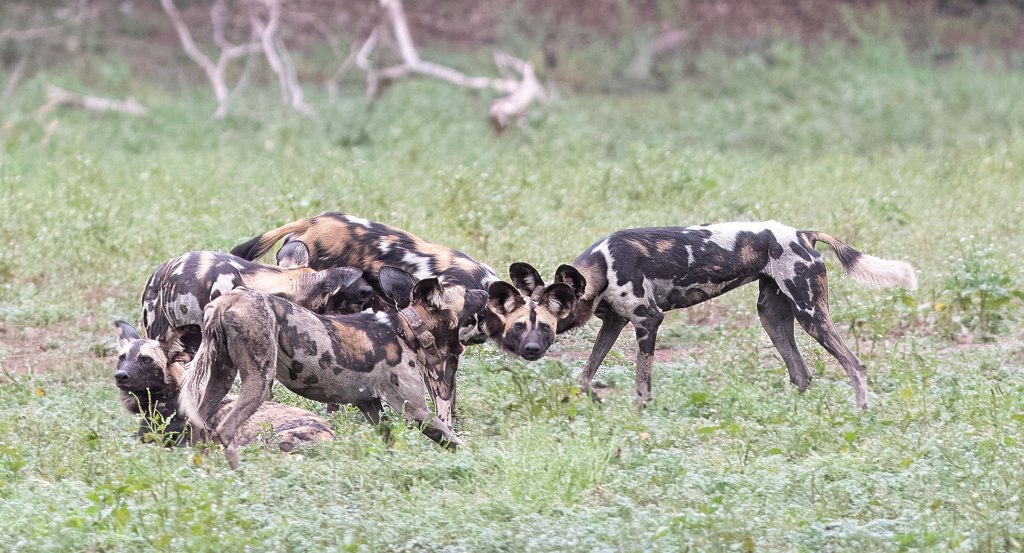
© Steve Middlehurst
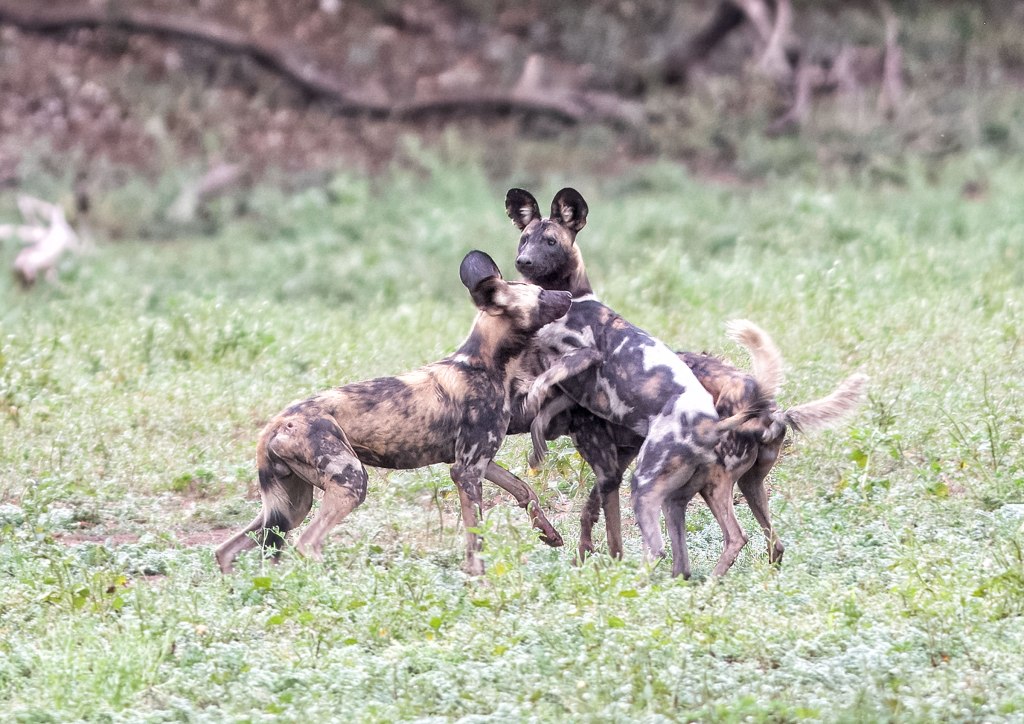
It’s time to celebrate waking up and they start an extended period of getting to know each other all over again. Yawning, sniffing, rubbing and play fighting. Unfortunately the light is fading as heavy cloud starts to move in and we are silently urging them to get organised and get hunting but the pack continues to muck around in the middle of the lagoon, it is clear that pack bonding can’t be rushed. Jonna explains that they are waiting for the alpha dogs to make a decision and the junior members of the pack will not move until that decision is made.
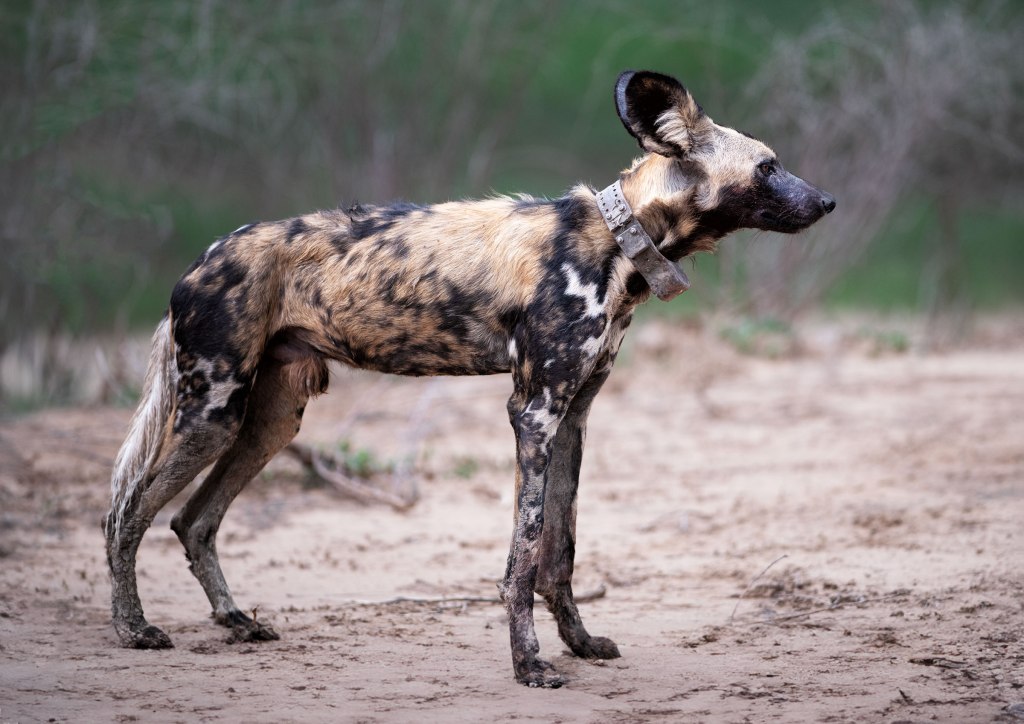
We can’t know what fires the starter’s pistol but without warning, an hour after we first spotted them, the alpha male leaves the group in a determined manner trotting towards the edge of the lagoon and everyone immediately follows.
© Steve Middlehurst
He stops on the track at the edge of the lagoon, just ahead of us, and I manage to capture my favourite photo of the day despite the fast fading light. Close up and visibly alert he is a beautiful animal, now we can see the long legs that set his kind apart from both wolves and domestic dogs. The long-distance-runners legs, powerful bite and large sharp teeth make this, like all the carnivores, a highly efficient killing machine but their super power is their intelligence and collaborative nature. Within a minute he is joined by the rest of the pack and they cross the track into another area of grassland.

As they begin to gather speed it becomes clear that once the decision to hunt has been made there is no order of play, they constantly swap positions but the general direction appears to have been decided. This helps us as Jonna can predict which track they will cross next so, as they cut across country, we reenact the Kenya Rally and hurtle along the tracks and round tight bends to complete three side of a square in the time it takes them to get from one side to another.
Most profiles of wild dogs describe them as collaborative, endurance hunters who run down their prey over long-distances at high speeds, the ability to reach 65 kph and maintain 45 kph over 5 kms are typical statistics. However, at least one major study suggests that this approach to hunting holds true for wild dogs operating in the wide-open spaces of East Africa’s grasslands but in practice most wild dogs now live in mixed woodland savannah and, here, they adopt different strategies.

In this type of terrain the pack head out to hunt together but once prey animals such as impala or puku are in range the pack disperses into multiple short, sharp chases; one dog or a small group will head for the nearest antelope and if they succeed in bringing it down will call the rest of the pack to feed. Dr. Tatjana Hubel, the lead author of this study in Botswana, believes that this approach is successful because the wild dogs are focussing on medium sized prey rather than chasing down a larger animal that would take several dogs to bring down.
South Luangwa is 9,000 sq. km of woodland savannah so “our” pack, and the other 50 or so packs operating in the Luangwa valley fit this new profile.

© Steve Middlehurst
By now the light has nearly gone, I’m using ISO 2,000 and only managing a shutter speed of 1/100 which, with a heavy lens is a bit hopeless for a fast moving animal; the cloud cover is getting lower and as the wild dogs reform at a three-way junction of the track it begins to spit with rain. They pick a new direction and race away, we start to cross to where Jonna believes they will next appear and the heavens open. We are trapped in a torrential, emerald season, tropical downpour, the rain that gets into every opening and soaks you as if you are in a bath and a cold bath at that. It is the usual frantic panic to get cameras under ponchos before trying to cover oneself.
We unfortunately didn’t see the end of the hunt on this trip but Dr. Hubel’s study provides a real insight into how it might have finally played out. We head back to the Safari house for a hot shower and dinner.

Early the next morning we are out and about in the park and pass back through the area where the hunt was prematurely ended. There on the main track is the alpha male who must have become separated from his pack during the storm. He is alone and searching for his family intermittently calling with a “hoo” sound. This is a pulsed, monotonic, series of single syllables that a dog typically makes when separated from its pack. Because it is not very loud it sounds rather plaintive but a louder call might attract unwelcome attention from larger predators.5
And that is where our short story ends; just one very small pack across a single day but providing us with an unforgettable experience. South Luangwa National Park is vast and it was down to Jonna’s skills as a tracker and his intimate knowledge of the parks’ wildlife that we were able to have such an experience and for that we are very grateful to him and to Robin Pope Safaris.

Zambia still has huge areas that humans have not begun to farm or even settle in large numbers, its massive parks and game management areas that cover 30% of the country are unfenced so migration and the natural dispersal of genes can and does occur across the country. South and North Luangwa combined are almost 15,000km2 and animals can move unimpeded 400km south from here to the lower Zambezi. The infrastructure for nature based tourism is not fully developed but is recognised by the government as having a “vital role in the stimulation of national economic growth”. However, there are plenty of fantastic lodges and accommodation to suit most budgets and based not just on our experience but in the opinion of many experienced travellers the standard of guiding is second to none.
There are clearly a long list of challenges to surmount as there always will be when we ask humans and wild animals to share resources and the landscape but the country has endless potential and is full of good and dedicated people who are determined to make Zambia a premier safari destination known for much, much, more than Victoria Falls.
There is a comment box at the bottom of this post after Footnotes and Other Sources. Please let me know if you have any thoughts on this subject and whether you found this post useful.
Footnotes and References
- Kleptoparasitism is where an animal deliberately takes food from another predator. Hyena was often said to mostly kleptoparasites or scavengers but spotted hyenas are effective hunters and acquire most of their food by hunting but they are intelligent and opportunistic and will scavenge where animals have died of natural causes or where they can steal or clean-up other predators’ kills.
- Other matriarchal societies in Africa include the elephant, bees, lions, spotted hyenas, lemurs and bonobos. Don’t be fooled by big alpha males turning up and making a big fuss such as with elephants and lions, the alpha female is very much in charge of making all the big decisions and ensuring her pride, herd, clan or pack is fed and watered. For example the male lions job, apart from passing on his genes, is to protect the prides territory, the lionesses feed and bring up the cubs.
- BFQ is Bite Force Quotient and is calculated as the regression of the quotient of an animal’s bite force divided by its body mass. AWD comes in at 138, lion at 128, leopard at 98, cheetah at 119, spotted hyena at 134. Out of interest the Tiger’s is 139.
- The black stripe that runs up the wild dog’s head is called a “sagittal stripe”.
- Our observations confirm the accepted description of the wild dog as the most social of all canids and studies show that they have a rich array of vocalisations that enable them to communicate a wide range of information and what can surely only be described as emotions. There are at least ten different groups of sounds and in different ways they are used across different situations such as play, greetings, alarm, distress, submission and contact seeking, etc. I assume that this breadth of vocalisations is something only developed by highly social groups such as elephants who most recent studies suggest might even have sounds that represent individual names, and primates who typically have extensive ability to communicate through sound.
- Jocelin Kagan 2020 Africa’s Wild Dogs: A Survival Story. Ludlow: Merlin Unwin Books
- Zambian Carnivore Programme https://www.zambiacarnivores.org
- Oliver Höner, Marion East, Bettina Wachter, Herbert Hoffer 2002 The response of spotted hyaenas to long-term changes in prey populations: functional response and interspecific kleptoparasitism https://www.researchgate.net/figure/Hyaena-lion-ratio-percentage-of-lion-kills-in-hyaena-diet-and-relative-amount-of-food_tbl4_227576584
- Tatjana Hubel and Others 2016 New study reveals hunting strategy of remaining populations of endangered African wild dogs https://www.rvc.ac.uk/research/research-centres-and-facilities/structure-and-motion/news/new-study-reveals-hunting-strategy-of-remaining-populations-of-endangered-african-wild-dogs
- Tatjana Hubel 2016 The Thrill of the Hunt https://thubel.files.wordpress.com/2016/04/issue16cut-compressed.pdf
- Along Julia Kim 2017 African Wild Dog, Lycaon pictus, Coloration Patterns and Social Aggregation https://academicworks.cuny.edu/cgi/viewcontent.cgi?article=1193&context=hc_sas_etds#:~:text=The%20African%20wild%20dogs’%20coat,orange%2C%20brown%2C%20and%20black.
- Saverio Bartolini-Lucenti and Others 2021 The early hunting dog from Dmanisi with comments on the social behaviour in Canidae and hominins https://www.nature.com/articles/s41598-021-92818-4
- Josie Glausiusz, Sapiens 2021 What Drove Homo Erectus Out of Africa? https://www.smithsonianmag.com/science-nature/what-drove-homo-erectus-out-of-africa-180978881/
- Lynette Hart, Benjamin Hart 2021 How Does the Social Grouping of Animals in Nature Protect Against Sickness? A Perspective https://www.ncbi.nlm.nih.gov/pmc/articles/PMC8292637/
- Jocelin Kagan 2020 Africa’s Wild Dogs — A Survival Story https://www.conservationfrontlines.org/2020/10/africas-wild-dogs-a-survival-story/#:~:text=They%20are%20highly%20social%20and,feed%20their%20pups%20by%20regurgitating.
- Robert L. Robbins 2000 Vocal Communications in Free-ranging African Wild Dogs (Lycaon pictus) https://www.jstor.org/stable/4535774?read-now=1&seq=2#page_scan_tab_contents

 Travelogues and Other Memories
I would appreciate hearing your thoughts on this subject.