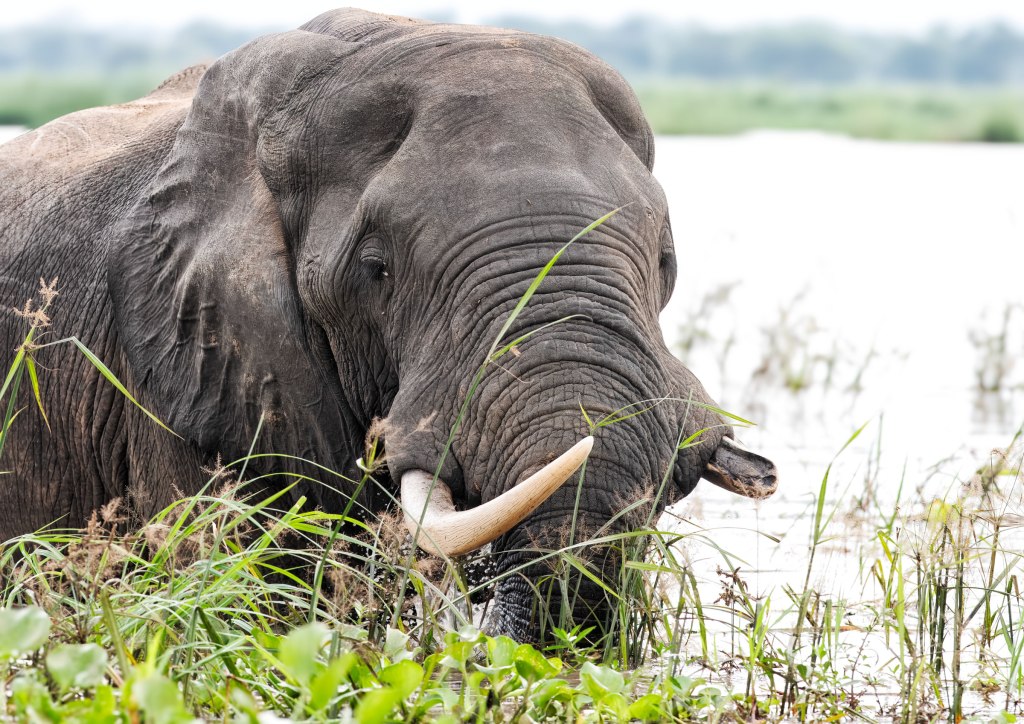
Malawi was once famous for its huge herds of elephants, described in the 18th century as an “elephant rich country” with the land between lake Malawi and the Luangwa River in Zambia “teeming with elephants”. A country where, in 1859, David Livingstone saw 800 elephants in a single herd. This is the story of how the great Malawian herds were reduced to a handful of angry and potentially murderous survivors in the Liwonde National Park where they were dodging 31,000 poachers’ snares and engaged in a deadly battle with local farmers.
©Steve Middlehurst
Across two posts I will try to explore how rapacious traders from across the world driven by an insatiable, international appetite for ivory reduced 26,000,000 African elephants at the beginning of the 18th century to 10,000,000 by the end of the 19th and then to 400,000 by the beginning of the 21st.
It is also the story of how Malawi escaped the worst of this slaughter for 300 years before Arab, Swahili and Yao traders, then white hunters and finally poachers very nearly killed every elephant in Malawi.
The Early Hunters

In antiquity, apart from in the driest deserts and on the highest mountains, elephants ranged across all of Africa but since the earliest humans evolved on the continent they have been hunted, initially for meat and hides and much, much later for their ivory.
Humans have included elephant meat in their diet ever since Homo erectus emerged in Africa some 2 millions years ago leading to the question of whether this was obtained by scavenging or hunting. However, recent studies of sites in Leipzig, Germany have revealed that Neanderthals congregated in large cooperative groups as long as 125,000 years ago to deliberately hunt European straight-tusked elephants, a practice they continued for 2,000 years so African humans must have learnt to do the same.
For hundreds of thousands of years humans were hunting elephants for food and although the tusks were useful as something to prop up the roof of a shelter or even as a raw material to carve it was never more than a byproduct.
It is estimated that there were 26 million elephants roaming Africa at the end of the 15th century, there would have been far more in pre-history, so millions of tusks would have been left on the ground every year by elephants dying of natural causes so ancient people had no need to engage in a highly dangerous hunt to more.
Ivory Becomes Valuable
The ancient Egyptians were carving elephant tusks and hippopotamus teeth into combs and hairpins before 3000 BC.
Later they developed skills in relief carving and ivory started to appear as inlays in caskets and furniture.
By between 2750 and 2000 BC the Libyan, upper Nile and the east and central Saharan herds were all extinct.

The Pharaoh Thothmes III (1479 BC to 1425 BC) killed 120 elephants for their ivory in a single great hunt in northern Syria which suggests the size of the Syrian herds, which were probably Indian elephants and locally extinct by 500 BC.

The ancient Phoenicians specialised in ivory inlays using ivory from Syria and the Cretans had small figures of acrobats carved from ivory by 1600 BC.
Horse harnesses in the Iliad are studded with ivory and the Odyssey refers to child bosses of ivory and roofs inlaid with the “spoils of elephants”.
By the 6th century BC the Greeks were creating chryselephantine1 statues from ivory including a 12 metre depiction of Athena for the Parthenon and a colossal Zeus for the temple at Olympia which was one of the seven wonders of the ancient world.

It remained valuable to the Roman elite having several uses connected to religion, wealth and power including as using ivory for the seats and benches in the Senate. Pliny described ivory as the most valuable of the products furnished by a living animal with one large tusk costing the equivalent of the annual salaries of three legionaries.
The market for ivory had been growing since around 1000 BC initially with the Egyptians and then the Chinese whose significant ivory carving industry had led to their domestic herds being extinct by the beginning of the first millennium and leading to the importation of ivory from all available sources.
Once local supply dried up Egyptian and then Roman demand was initially sourced from the Horn of Africa, Sudan and Syria and by long established trading routes across the Sahara and up the Nile Valley. This expanded with ivory and slaves from west Africa being traded on the Mediterranean coast and the development of trading posts on the Red Sea coast and the coasts of what are now Tanzania and Mozambique.
On the other side of the Indian ocean by, no later than, the 1st century AD the port of Barygaza in northwest India was trading with Egypt, the Roman Mediterranean, the Persian Gulf, Southern Arabia, East Africa and South Asia and becoming an Asia hub for ivory trading.
The East African Trading Ports
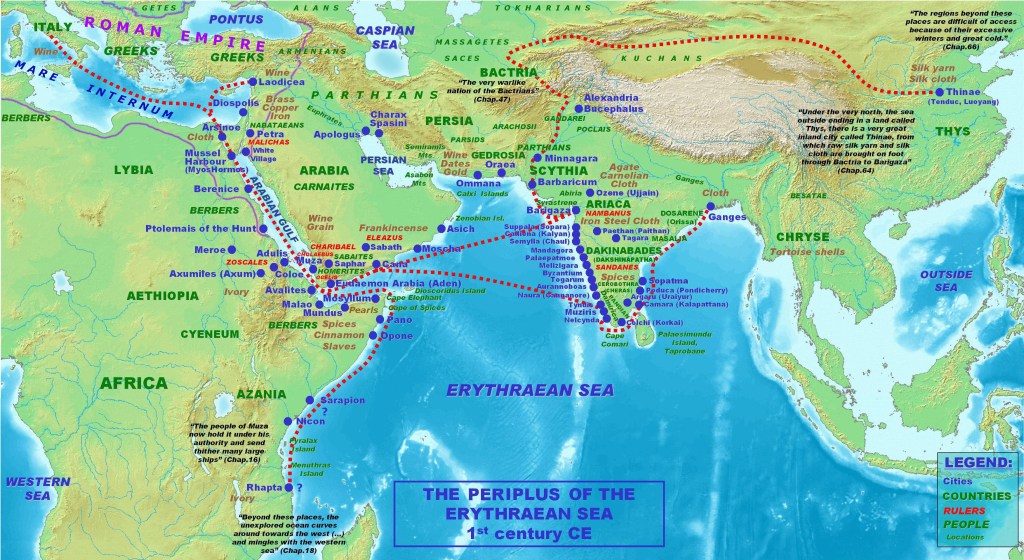
As early as 500 BC Mediterranean traders knew of the wealth of ivory, rhino horn and tortoise shell that was available to trade on the east African coast. A document called the Periplus of the Erythraean Sea which dates to around 60 AD describes trading ports on the east African coast as far south as present day northern Mozambique.
By the 8th century Arab traders began to ride the Indian Ocean monsoon winds to trade on this coast and finding the Bantu people of the region friendly they began to set up trading posts of which Kilwa, founded in 987 in modern day Tanzania, became the most important.

Many Arabs and later Shirazi people settled on this coast marrying local Bantu women and their descendants became known as the Swahili people who by the 9th century were the predominant residents of the coastal towns.
The Swahili were willing trading partners for the Arabs and a rich gold and ivory trade developed and soon evolved to include slave trading. Swahili traders were traveling deeper into the interior as elephant herds were depleted near the coast, they would trade for ivory with local chiefs bartering beads or cloth for tusks.

Male tusks generally weigh between 50 and 79 kg with exceptional specimens weighing as much as 100 kg. Without access to either pack animals or wheeled vehicles the only way to move the tusks back to the coast was for men or women to carry them and the most economic way of acquiring these porters was to trade for slaves who, once they had carried a tusk to the coast, could also be sold. Chiefs in the interior quickly learnt to have stocks of ivory and slaves available.
In the 10th century ivory was certainly passing through or close to northern Malawi on its way from present day Zambia and potentially further afield on its way to the Swahili coastal towns using well established trade routes.

In 1147 an Arab dhow was blown south by a storm and found the mouth of the Zambezi River which once discovered quickly became a route into the interior and access to more people with whom they could trade; they established a post at Seyouna, modern day Sena, close to where the modern road from Malawi meets the River Zambezi.
Ivory was leaving the coast and being imported into the Arab world through Oman and from there was traded on to India and China. In the 10th century 66 metric tons of ivory was passing through the port of Sofala 220 kms south of the Zambezi, modern day Nova Sofala, every year, which equates to the tusks of around 500 slaughtered elephants.
The Arrival of the Portuguese
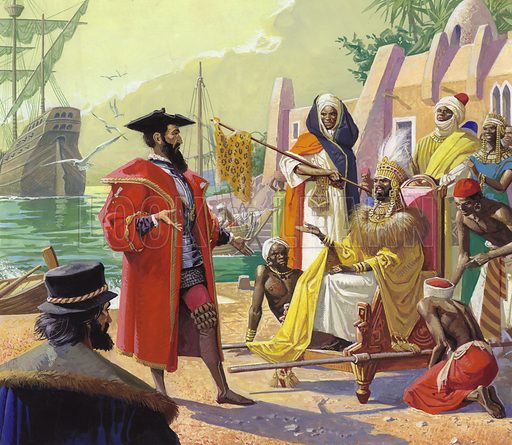
This remained the status quo until 1498 when Vasco da Gama arrived on his way to India.
Between 1500 and 1505 the Portuguese arrived on the coast equipped with canon and professional soldiers armed with the latest firearms.
They had arrived brimming with religious zeal, the Pope himself had instructed them to convert the heathens of Africa,; in 1452 and 1455 Pope Nicolas V issued series of papal bills that granted Portugal the right to enslave sub-Saharan Africans as the church believed that somehow slavery was a Christianising influence, the Pope instructed the Portuguese King:
“……to invade, search out, capture, vanquish, and subdue all Saracens and pagans whatsoever …[and] to reduce their persons to perpetual slavery, and to apply and appropriate to himself and his successors the kingdoms, dukedoms, counties, principalities, dominions, possessions, and goods, and to convert them to his and their use and profit . .”

Once they knew this coast offered access to ivory, gold and slaves they quickly put their missionary plans to one side and in a series of short-sharp conquests captured the Swahili trading towns. They began to trade for ivory by offering firearms and gunpowder as well as the then traditional slave goods. E.D. Moore in his seminal work, Ivory the Scourge of Africa, states that when the Portuguese arrived:
“….. the coasts swarmed with elephants” and “the natives had vast stores of ivory.”
The Portuguese eagerly traded for both the new and the old ivory and supply in the coastal areas was exhausted by the middle of the 17th century.

By 1531 the Portuguese realised that some of the gold and ivory that had historically arrived at Sofala at the southern end of the trading coast was now avoiding that route and instead coming down the Zambezi and escaping into the Indian Ocean so in 1531 they occupied Seyouna (Sena) and began trading with the Amaravi people of the Kalonga State who controlled the land to the west of Lake Malawi.
The Maravi Empire
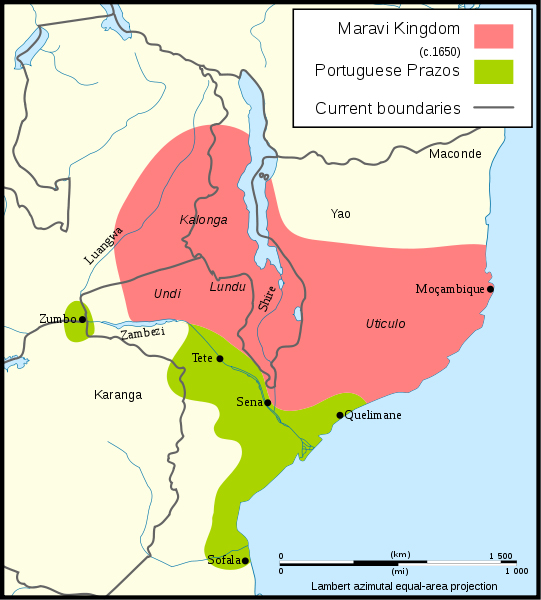
Sometime towards the end of the 14th century the Phiri clan arrived in the Luangwa Valley & Lake Malawi area. They subjugated the indigenous people and established the state of Kalonga centred on Manthimba which lies between Lilongwe and the Kasunga National Park. The head of state was the Karonga who ruled through the leaders of each clan.
The Kalonga state was a confederacy of the clans who had migrated into central and southern Malawi. Collectively the clans controlled elephant hunting and were trading ivory, iron and slaves with Swahili brokers on the coast and later with the Portuguese at Sena on the Zambezi.
Trading ivory for firearms made them the most powerful force in the region and by 1650 the Kalonga state has become the Maravi Empire covering a large part of east Zambia, central Malawi and southern Mozambique stretching from the Luangwa Valley to the Indian Ocean.
The Ngonde
In northern Malawi the area centred on Karonga was settled by the Ngonde people around the middle of the 15th century. Their oral histories say they arrived from the east to displace Simbobwe, an elephant hunter and possibly a hunter-gather who possessed large stocks of ivory.
The fact that the indigenous people in this area possessed large stocks of ivory in a territory at the top of Lake Malawi that was adjacent to an ancient coast-to-interior trade route suggests that ivory trading was established long before the Ngonde arrived.
The Mang’anja
In the early 16th century Arab traders on the Zambezi were mostly interested in gold but they were also trading for ivory in the Shire Valley. When the Portuguese drove the Arabs out of the Zambezi and established their fortified trading posts at Sena and Tete the people of the Shire Valley temporarily lost their trading relationships. A Malawian chief called Muzura attacked the Portuguese at Sena some time before 1590 but was repulsed.
The Portuguese were involved in a series of conflicts with warriors from the Malwian side of the Zambezi and this prevented the Malawian Chiefs in the lower Shire Valley to benefit from the trade on the Zambezi so it appears a settlement was reached between Muzura and the Portuguese. He is reported to have provided 1,000 warriors to support their attempts to control the upper Zambezi and by 1622 Muzura had become the dominant chief in the lower Shire Valley with military support from the Portuguese.
The Return of the Arabs
From 1622 onwards Arabs began to reclaim the east African ports from the Portuguese; Swahili Arabs in some of the occupied towns rose up against the Portuguese and Omani Arabs captured others and by 1698 north of Mozambique the Portuguese only held Mombassa and by 1730 they relinquished their claims to all the old trading ports, including Zanzibar and consolidated their interests in Mozambique.
The Swahili and Omani Arabs now commanded a trading Empire that stretched from the Horn of Africa to just north of Mozambique and as far inland as the great lakes.
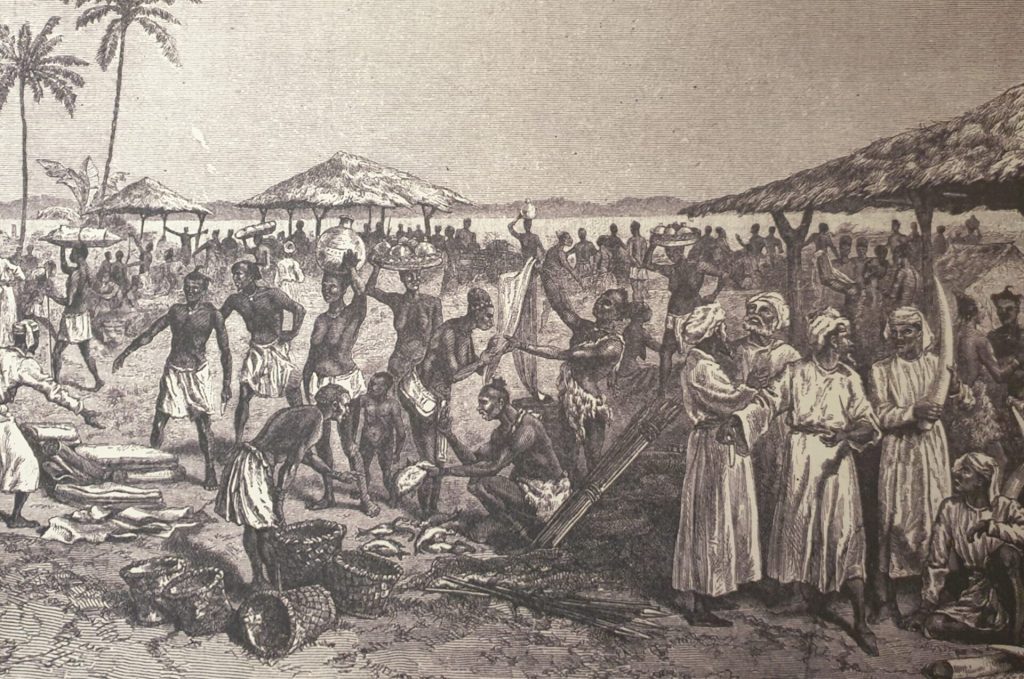
After 1730 Arab and Swahili power increased under the leadership of the Sultan of Zanzibar and Kilwa developed into a great port where the caravans from the interior arrived with their cargo of ivory carried by slaves. These caravans were organised and manned by the Yao who had originated in Mozambique and at first trading from the eastern shore of Lake Malawi to Kilwa but increasingly were working their way around the north of Lake Malawi to reach the Congo basin.
Meanwhile from the early 1630s the Portuguese on the Zambezi were riding a pendulum that swung from defending their trading posts at Sena, Tete and Quelimane from the Amaravi of southern Malawi and trading for ivory and slaves with them. In the end trade was the winner and ivory trade between the Portuguese and the Amaravi was well established by the mid 1600s. It is probable that the Amaravi were hunting elephants for Ivory in the area between the Luangwa Valley in the west and Lake Malawi in the East and using slaves to transport the tusks to Sena.
New Arrivals
The Tumbuka were another people to arrive in Malawi from the Congo basin in the 15th century; they settled in the area to the south of the Nyika plateau and the Ngondes and north of the Maravi Empire. They were an agricultural and pastoral people who were not organised either militarily or politically.
The Nkhamanga plain and the Henga Valley south of Nyika were still heavily populated by elephants and one source suggests that the elephants outnumbered people here and further north; another source says that the extensive country between the western shore of Lake Malawi to beyond the Luangwa River in modern day Zambia was “teeming with elephants”. The Tumbuka included elephant meat in their diet but saw no particular value in ivory which they used to make furniture. Bridglal Pachia says that “land was plentiful and outside threats were few.” It sounds an idyllic existence.
However in 1780, a small group of traders crossed the lake in a dhow landing at Chilumba which is about half way down the western shore. These people became known as Balowoka (which means those who crossed over) and they definitely knew the value of ivory. They headed for the Nkhamanga Plain, having no doubt learnt that this was an area where large numbers of elephant still roamed.
In the last decades of the 18th century ivory trading had seemingly crept into Malawi through the back door. The Ngonde around Karonga in the north, were trading with the coastal Swahili-Arabs originally by land and later across the lake, the Balowoka were exporting ivory back to Kilwa from the centre and the Mang’anja were trading ivory with the Portuguese at Sena on the Zambezi.
The storm was rising. See my next post – The Fall and Rise of Malawi’s Elephants: Part 2 – The Nightmare Years
Please let me know if you have any thoughts on this subject and whether you found this post useful.

 Travelogues and Other Memories
I would appreciate hearing your thoughts on this subject.