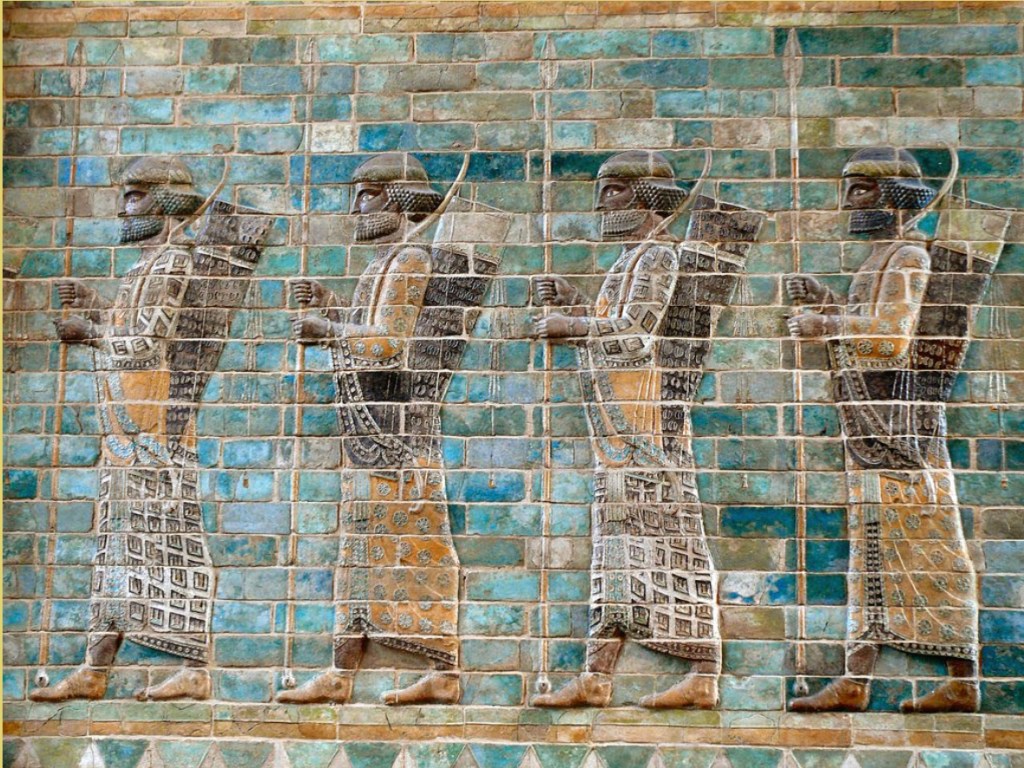
Footnotes
- Simeon Netchev (2022) The Achaemenid Persian Empire c. 500 BCE https://www.worldhistory.org/uploads/images/16107.png?v=1737866767-1706686944 ↩︎
- https://louvrebible.org.uk/oeuvre/125/louvre_departement_antiquites_orientales#carousel_listes ↩︎
- Sean Manning (2014) The Population of the Achaemenid Empire. https://www.bookandsword.com/2014/11/08/the-population-of-the-achemenid-empire/ ↩︎
- https://irangashttour.com/2022/06/09/persepolis-as-a-symbol-of-ancient-iran/ ↩︎
- Encyclopaedia Iranica – Bard and Bard-Dari in the Achaemenid Period. https://iranicaonline.org/articles/barda-i ↩︎
- Miroslave Izdimirski (2018) Deportations of Kurtaš Workers in the Achaemenid Empire According to Classical Literary Tradition. https://antiquitasviva.com/wp-content/uploads/2021/07/68.1-2.06.-izdimirski-m.-deportations-of-kurtash-workers-in-the-achaemenid-empire-according-to-classical-literary-tradition.pdf ↩︎
- Izdimirski (2018) ↩︎
- https://www.britannica.com/place/Susa ↩︎
- Yancy Hughes Dominick (2007) Acting Other: Atossa and Instability in Herodotus. https://www.jstor.org/stable/27564087?read-now=1&seq=1#page_scan_tab_contents ↩︎
- David Lewis (2011) Near Eastern Slaves in Classical Attica and the Slave Trade with Persian Territories https://archive.org/details/lewis-2011-ne-slaves ↩︎
- https://www.britishmuseum.org/collection/object/G_1805-0703-91 ↩︎
- https://archaeologicalmuseums.gr/en/museum/5df34af3deca5e2d79e8c1d5/archaeological-museum-of-sparti ↩︎
- The agora was central public space that evolved in Rome to become the forum. In both cases it was a centre of commercial activity, socialising and politics. ↩︎
- The painting includes: Epicurus, Pythagoras, Socrates, Plato and Aristotle, ↩︎
- https://www.museivaticani.va/content/museivaticani/en/collezioni/musei/stanze-di-raffaello/stanza-della-segnatura/scuola-di-atene.html ↩︎
- The Theatre Of Dionysus And How Drama Shaped Athens https://euscentia.com/theatre-of-dionysus-and-how-drama-shaped-athens/ ↩︎
- https://www.britishmuseum.org/blog/historical-city-travel-guide-athens-5th-century-bc ↩︎
- https://collections.louvre.fr/en/recherche?q=Assos%20temple%20d%27Athéna ↩︎
- David M. Pritchard (2020) The Social Structure of Democratic Athens. Pritchard-social-structure-athens ↩︎
- Citizenship is an important concept in classical Athens. A citizen could claim descent from the indigenous tribes of pre-bronze age Attica and through them to the gods. To qualify as such a person had to be the legitimate offspring of two citizens who both had citizen grandparents, i.e. 3 generations. Foreigners, slaves and illegitimate children, even if born of citizen parents, could not become citizens. There were laws to prevent citizens from marrying non-citizens and Athenian men went to great lengths to keep their daughters and wives from associating with men outside the immediate family in an endeavour to keep the citizen bloodline pure. Susan Lake (2010) argues that classical Athens was a racist society. ↩︎
- Darel Tai Engen (2023) The Economy of Ancient Greece https://eh.net/encyclopedia/the-economy-of-ancient-greece/ ↩︎
- https://www.britishmuseum.org/collection/object/G_1837-0609-42 ↩︎
- https://carlos.emory.edu/exhibition/confronting-slavery-classical-world ↩︎
- “Pasion (ca. 430–370 bce) owned one of the most successful private Banks in Athens. From humble origins as a Phoenician slave to the bankers Antisthenes and Archestratos, Pasion rose to become one of Athens’ wealthiest citizens.” https://onlinelibrary.wiley.com/doi/abs/10.1002/9781444338386.wbeah04346#:~:text=Pasion%20(ca.,one%20of%20Athens’%20wealthiest%20citizens. ↩︎
- https://www.smb.museum/en/museums-institutions/altes-museum/home/ ↩︎
- The Money Museum: Exploiting the mines by renting slaves: How entrepreneurs yielded the most silver when leasing in Laurion – an invisible aspect of Coinage and Financial Investment in 5th Century B.C. Athens https://www.moneymuseum.com/en/archive/exploiting-the-mines-by-renting-slaves-88?&slbox=true ↩︎
- British Museum – however “since the figure is not bearded, it is most likely in this case to be intended to depict an Amazon archer” https://www.britishmuseum.org/collection/object/G_1837-0609-59 ↩︎
- Paulin Ismard (2013) Public Slavery, Politics and Expertise in Classical Athens https://research-bulletin.chs.harvard.edu/2013/08/30/public-slavery-politics-and-expertise-in-classical-athens/ ↩︎
- https://carlos.emory.edu/exhibition/confronting-slavery-classical-world ↩︎
- John McNeer (2019) 2.400 Year Old Greek Trading Vessel Discovered Intact 6,000 Feet Under the Black Sea https://historyarch.com/2019/01/09/news-2400-year-old-greek-trading-vessel-discovered-intact-6000-feet-under-the-black-sea/ ↩︎
- David Lewis (2011) Near Eastern Slaves in Classical Attica and the Slave Trade with Persian Territories https://archive.org/details/lewis-2011-ne-slaves ↩︎
- Michael G. Seamen (1997) The Athenian Expedition to Melos in 416 B.C. https://www.jstor.org/stable/4436483?read-now=1&seq=1#page_scan_tab_contents ↩︎
- Kostas Vlassopoulos (2023) Slavery in Ancient Greece – included in: The Palgrave Handbook of Global Slavery throughout History. edited by Damian A Pargas and Juliane Schiel (2023) Cham, Switzerland: Palgrave Macmillan The Palgrave Handbook ↩︎
- https://www.dreamstime.com/stock-photo-monumental-gateway-propylaea-acropolis-athens-greece-attica-image91058669 ↩︎
- https://www.namuseum.gr/en/collection/archaiki-periodos-3/ ↩︎
- https://www.antike-am-koenigsplatz.mwn.de/index.php/en/state-collection ↩︎
- Ellen G. Millender (2001) Spartan Literacy Revisited https://www.jstor.org/stable/10.1525/ca.2001.20.1.121?read-now=1&seq=1#page_scan_tab_contents ↩︎
- https://www.britishmuseum.org/blog/historical-city-travel-guide-athens-5th-century-bc ↩︎
- https://www.britishmuseum.org/blog/historical-city-travel-guide-athens-5th-century-bc ↩︎
- Carlos Rene Villafane Silva (2015) The Perioikoi: a Social, Economic and Military Study of the Other Lacedaemonians https://livrepository.liverpool.ac.uk/3001055/1/200685435_Aug2015.pdf ↩︎
- https://www.metmuseum.org/art/collection/search/257576 ↩︎
- R. T. Ridley (1974) The Economic Activities of the Perioikoi https://www.jstor.org/stable/4430397?read-now=1&seq=12#page_scan_tab_contents ↩︎
- https://www.britishmuseum.org/collection/object/G_1824-0407-32 ↩︎
- https://www.lookandlearn.com/history-images/M550696/Rural-life-in-Ancient-Greece ↩︎
- https://crunchlearning.com/farming-in-ancient-greece/ ↩︎
- https://www.louvre.fr/en ↩︎
- Luraghi, Nino, and Susan E. Alcock, eds. 2003. Helots and Their Masters in Laconia and Messenia: Histories, Ideologies, Structures. Hellenic Studies Series 4. Washington, DC: Center for Hellenic Studies. http://nrs.harvard.edu/urn-3:hul.ebook:CHS_LuraghiN_AlcockS_eds.Helots_and_Their_Masters.2003. ↩︎
- https://www.worldhistory.org/image/163/satyrs-making-wine/ ↩︎
- Noel Lenski and C. Cameron (2019) Framing the Question: What Is a Slave Society? https://www.academia.edu/40285420/Framing_the_Question_What_Is_a_Slave_Society ↩︎
- Natal Alienation is where a person is forcibly disconnected or estranged from their kinship traditions, cultural heritage and historical memories. ↩︎
- https://archaeologicalmuseums.gr/en/museum/5df34af3deca5e2d79e8c1d5/archaeological-museum-of-sparti ↩︎
- https://www.britishmuseum.org/blog/historical-city-travel-guide-athens-5th-century-bc ↩︎
Other Sources and Further Reading
- Damian A Pargas and Juliane Schiel (editors) (2023) The Palgrave Handbook of Global Slavery throughout History. Cham, Switzerland: Palgrave Macmillan The Palgrave Handbook
- Simon Webb (2024) The Forgotten Slave Trade. Barnsley: Pen & Sword Book
- Noel Lenski and C. Cameron (2019) Framing the Question: What Is a Slave Society? Lenski- Cameron- Framing-the-Question
- W. O. Blake (1861) Slavery and the Slave Trade, Ancient and Modern, The Forms of Slavery that Prevailed in Ancient Nations, Particularly in Greece and Rome. Columbus, Ohio, H. Miller https://archive.org/details/historyofslavery00blaka
- David Lewis (2011) Near Eastern Slaves in Classical Attica and the Slave Trade with Persian Territories https://archive.org/details/lewis-2011-ne-slaves
- Stanley Wilkin (2020) Persian Slavery and Zoroaster Ethics: Did Ancient Persians encourage slavery? A History of Slavery Wilkin-Persian-Slavery
- Time Maps: The Persian Empire: Culture and Society https://timemaps.com/encyclopedia/persian-empire-culture-society/
- Miroslave Izdimirski (2018) Deportations of Kurtaš Workers in the Achaemenid Empire According to Classical Literary Tradition. Izdimirski- Deportations- Kurtaš-Workers
- Donald C. Richter (1971) The Position of Women in Classical Athens Richter-Position-Women-Classical-Athens
- Sarah B. Pomeroy (1994) Goddesses, Whores, Wives and Slaves: Women in Classical Antiquity. Sarah- Pomeroy- 1994-Goddesses
- Ahmed Ghanem Hafez Ahmed () Disappearance of a Class: the Middle Class in Classical Athens Ahmed-Ghanem-Hafez-Ahmed-Disappearance-of-a-Class
- David M. Pritchard (2020) The Social Structure of Democratic Athens. Pritchard-Social-Structure-Democratic-Athens
- Victoria Cuffel (1966) The Classical Greek Concept of Slavery Cuffel-Classical-Greek-Concept-of-Slavery
- David M. Pritchard (2014) The Position of Women in Democratic Athens Pritchard-Position- Women-Democratic-Athens
- James Donaldson (1907) Woman: Her Position and Influence in Ancient Greece and Rome and Among the Early Christians Donaldson-1907-Woman
- Darel Tai Engen (2023) The Economy of Ancient Greece https://eh.net/encyclopedia/the-economy-of-ancient-greece/
- Luraghi, Nino, and Susan E. Alcock, eds. 2003. Helots and Their Masters in Laconia and Messenia: Histories, Ideologies, Structures. Hellenic Studies Series 4. Washington, DC: Center for Hellenic Studies. Helots-and-Masters.
- Jean Andreau and Raymond Descat (2006) The Slave in Greece and Rome (Wisconsin Studies in Classics) Madison, Wisconsin: The University of Wisconsin Press
- Charles Freeman (1999) The Greek Achievement. London: Allen Lane

 Travelogues and Other Memories

I would appreciate hearing your thoughts on this subject.