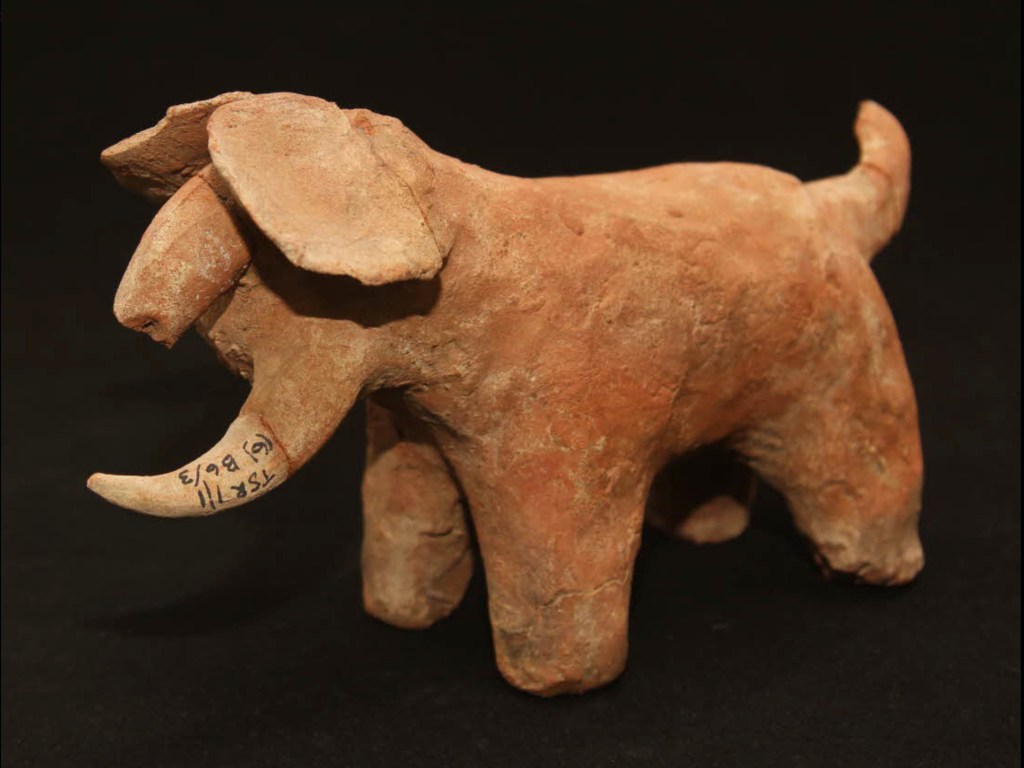
Appendix A – The Ports and Trading Centres of the Periplus
| Place Name in Periplus | Probable Modern Name | Commodities Traded |
| Myos Hormos | Quseir el-Qadim, Egpyt | |
| Berenice | Bender el-Kebir, Egypt | |
| Ptolemais of the Hunts | Hala’ib, Sudan | Tortoiseshell, ivory, |
| Adulis | Adulis, Eritrea | Ivory, rhino horn, tortoiseshell |
| Opsian Bay | Hawakii Bay, Eritrea | Obsidian stone |
| Coloe | Qohaito, Eritrea | Ivory |
| Aksum | Aksum, Ethiopia | Ivory |
| Avalites | Saylac, Somalia | Obsidian stone, verjuice, cloth, wheat, wine, tin, spices, ivory, tortoiseshell, myrrh |
| Malao | Berbera, Somalia | Fabrics, clothes, drinking cups, copper sheet, iron, gold, silver coin, myrrh, frankincense, cinnamon, duaca, copal, macir, slaves |
| Mundus | Ceerigaabo, Somalia | As Malao above plus an incense called mocrotu |
| Mosyllum | Laasqoray, Somalia | Cinnamon, fragrant gums, spices, tortoiseshell, mocrotu, frankincense, ivory, myrrh |
| Acannae | Near Masjidka Dhurbo, Somalia | Frankincense, fragrant gums from India |
| Cape of Spices | Caluula, Somalia | Cinnamon (and its different varieties, gizir, asypha, areho, iriagia, and moto) and frankincense. |
| Opone | Iskushuban, Somalia (The easternmost point of continetal Africa) | Cinnamon, slaves, tortoiseshell, |
| Sarapion | Mogadishu, Somalia | |
| Nicon | Baqdaadi, | |
| Pyralax Islands | Lamu, Kenya | |
| Menuthias | Kati, Tanzania | Tortoiseshell, turtle shell |
| Rhapta | Much debated but possibly Pemba, the island north of Zanzibar or dar es Salaam, Tanzania | Ivory, tortoiseshell, metalwork such as spears, knives and awls |
Appendix B – Europeans, Great Zimbabwe and the Myth of the Queen of Sheba
In 1871 a German geologist, Carl Mauch, and two hunters Adam Renders and George Philips might have been the first Europeans 112 to vist the ruins of Great Zimbawe. The German brought Great Zimbabwe to the outside world’s attention but despite finding obviously African artifacts at the site he wrote:
“……of the presence of quite large ruins which could never have been built by blacks.”
He decided the ruins were the site of Ophir, an unidentified region associated with the biblical King Solomon and described in the Old Testiment as a source of gold, sandlewood, ivory, monkeys and peacocks. He also proposed that Ophir was connected to the Queen of Sheba who appears in the Bible, the Qur’an and the Kebra Nagast which is the Ethiopian foundation story.
The irony being that Mauch argued that the Great Zimbawe was not African but attributed its origin to a Ethiopian queen, an African.
Over the next thirty years the Great Zimbabwe, once the royal or religious centre of the Shona nation, was looted for gold by the Rhodesia Ancient Ruins company and became the centre of furious arguments as to its origins. the archaeologist Randall-Maclver excavated the site in 1905/6 and concluded that the gold mines and buildings were built “not earlier than some time in the eleventh century A.D” and were “characteristically African” and had been build by Africans. 113
This was refuted by many self-proclaimed experts including Richard Nicklin-Hall who remarkably managed to write a whole book explaining why the gold mines and Great Zimbabwe were the work of Sabaeo Arabians (Yemeni), Phoenicians or Arabs. Just about anyone other than the Bantu who were still living there.
Other Sources and Additional Reading
- John McCracken (2012) A History of Malawi 1859-1966. Woodbridge, Suffolk: John Currey
- Thomas Pakenham (1991) The Scramble for Africa. London: Abacus
- Christopher Ehret (2023) Ancient Africa: A global History to 300 CE.Princetown: Princetown University Press.
- Frank Johnston & Sandy Ferrar (2006) Malawi, the Warm Heart of Africa. Cape Town: Struick Publishers
- Simon Beecroft & Laurie Sandsford (Editors) (2024) Africa: the Definitive Visual History of a Continent. London: DK Pengiun Random House
- Richard Gray & David Birmingham (editors) (1970) Pre-Colonial African Trade: Essays on Trade in Central and Eastern Africa before 1900. London: Oxford University Press. Gray-1970
- Shadreck Chirkure (2017) Documenting Precolonial Trade in Africa Shadreck-Chirkure-2017
- Henry W. Langworthy (1970) Understanding Malawi’s Pre-Colonial History. Henry-Langworthy-1970
- Kings M. Phiri (1982) Traditions of Power and Politics in Early Malawi: A Case Study of Kasungu District from about 1750 to 1933. Kings-Phiri-1982
- Brian Morris (2006) the Ivory Trade and Chiefdoms in Pre-Colonial Malawi Brian-Morris-2006
- Shadreck Chirikure (2014) Land and Sea Links: 1500 Years of Connectivity Between Southern Africa and the Indian Ocean Rim Regions, AD 700 to 1700 Shadreck-Chirikure-2014
- Attati Mpakati (1973) Malawi: The Birth of a Neo-Colonial State Attati- Mpakati- 1973
- B.A. Ogot (editor) (1992) General History of Africa V: Africa from the Sixteenth to the Eighteenth Century. Ogot-1992
- Edward Thomas James (2025) A World Enslaved: The Untold Story of Slavery 1200 – 1700. United Kingdom: Amazon.
- Oliver Ransford (1966) Livingstone’s Lake. London: John Murray
- Landeg White (1987) Magomera: Portrait of an African Village. Cambridge: Cambridge University Press.
- Donald Simpson (1975) Dark Companions: The African Contribution to the Eurpean Exploration of Africa. London: Paul Elek
- W.D.Gale (1958) Zambezi Sunrise. Cape Town: Howard B Timmins.
- L. Monteith Fotheringham (1891) Adventures in Nyasaland: A Two Years’ Struggle with Arab Slave Dealers in Centrasl Africa. London: Sampson Low. Republished as a British Library Historical Print Edition.
- Fred L.M. Moir (1923) After Livingstone: An African Trade Romance. London: Hodder and Stoughton Fred-Moir=1923
- Sir Harry H. Johnston (1898) British Central Africa: An Attempt to Give Some Account of a Portion of The Territories Under British Influence North of the Zambezi. London” Methuen & Co. Harry-Johnston-1898
- Sir Harry H. Johnston (1905) A History of the Colonisation of Africa by Alien Races. Cambridge: University Press. Harry-Johnston-1905
- Alfred J. Swann (1910) Fighting the Slave Hunters in Central Africa. Philadelphia: J.B.Lippincott Company Alfred-Swann-1910
- Bridglal Pachia (1973) Malawi: The History of the Nation Pachia-1973
- Alexander J. Hanna (1956) The beginnings of Nyasaland and North-eastern Rhodesia, 1859-95. Oxford: The Clarendon Press. Alexander-Hanna-1956
- Frederick D. Lugard (1893) The Rise of our East African Empire: Early Efforts in Nyasaland and Uganda. Frederick-Lugard-1893
- James William Jack (1900) Daybreak in Livingstonia: The Story of the Livingstonia Mission, British Central Africa. James-Jack-1900
- J. Frederic Elton (1879) Travels and Researches Among the Lakes and Mountains of Eastern & Central Africa. London: John Murray. Frederic-Elton-1879
- Stephen Samuel (1922) A Handbook of Nyasaland. Zomba: The Government of Nyasaland. Samuel-1922
- W. Henry Rankine (1896) A Hero of the Dark Continent: Memoir of Rev. W.M. Affleck Scott, Church of Scotland Missionary at Blantyre, British Central Africa. Henry-Rankine-1896
- A. St. H. Gibbons (1898) Exploration and Hunting in Central Africa 1895-96. London: Methuen. Gibbons-1898
- Kings M Phiri (1984) Yao Intrusion into Southern Malawi, Nyanja resistance and Colonial Conquest 1830 -1900. Kings-Phiri-1984
- Erin Rushning (2013) David Livingstone and the Other Slave Trade, Part II: The Arab Slave Trade Erin-Rushning-2013
- David Livingstone (1865) A Popular Account of Dr. Livingstone’s Expedition to the Zambesi and its Tributies: and the Discovery of Lakes Shirva and Nyassa 1858 – 1864. Accessed at Project Guttenberg’s 2001 edition. David-Livingstone-1865
- Henry Rowley (1866) The Story of the Universities Mission to Central Africa, from its commencement, under Bishop Mackenzie, to its withdrawal from the Zambezi. London: Saunders, Otley, and Co. Henry-Rowley-1866
- James Tengatenga (2013) The Legacy of Dr. David Livingstone. James-Tengatenga-2013
- I.C.Lamba (1978) British Commerce as an Anti-Slavery Device in Malawi in the 1870s amd 1880s: A Study in Miscalculated Strategy. Lamba-1978
- Owen J.M. Kalinga (1980) The Karonga War: Commercial Rivalry and Politics of Survival Owen-Kalinga-1980
- John G. Pike (1965) A Pre-Colonial History of Malawi John-Pike-1965
- R.B.Boeder (1979) Sir Alfred Sharpe and the Imposition of Colonial Rule on the Northern Ngoni Boeder-1979
- Timothy John Lovering (2002) Authority and Identity: Malawian Soldiers in Briain’s Colonial Army 1891-1964. Lovering-2002
- James Johnston (1893) Reality versus Romance in South Central Africa. New York: Fleming H. Revell Company. James-Johnston-1893
- Captain H. A. Fraser, Bishop Tozer & James Christie (1871) The East African Slave Trade and the Measures Proposed for its Extinction. London: Harrison. Fraser-1871

 Travelogues and Other Memories
I would appreciate hearing your thoughts on this subject.