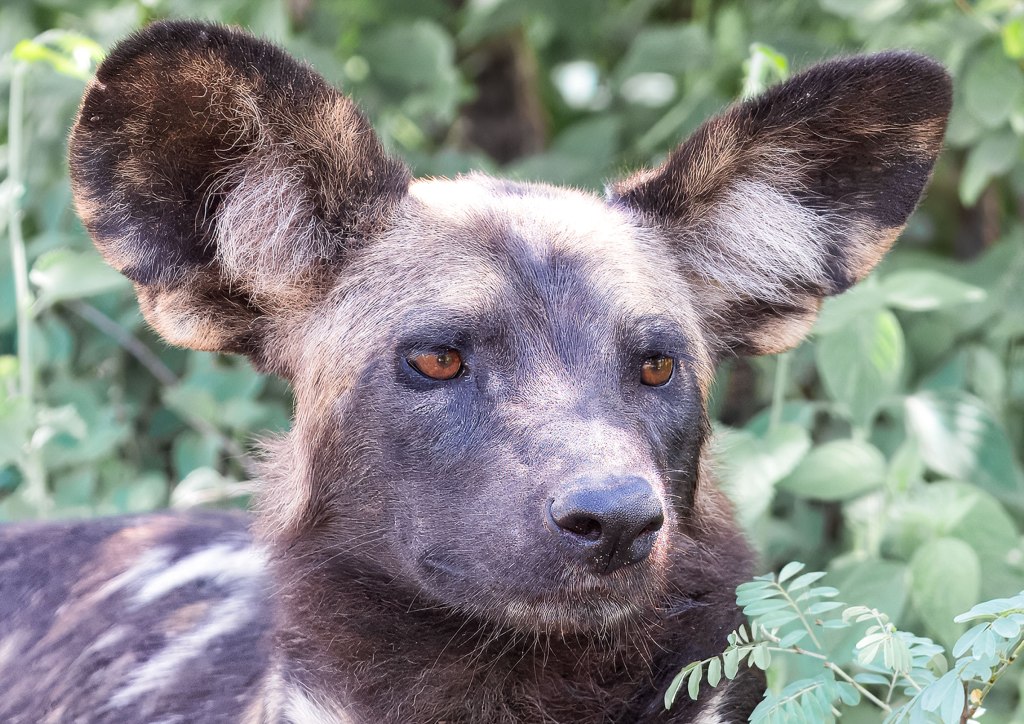
The predator with many names; Mbwa mwilu, painted dog, painted wolf, Budzatje, African hunting dog, Cape hunting dog, Hlolwa, ornate wolf, hyena dog, Nkentshane, painted hunting dog, Lycaon pictus and African wild dog. The horrible truth is that despite being the most named of creatures there are now as few as 1,500 adults left in Africa but there is some reason for optimism.

Let’s get the statistics out the way; fewer than 7,000 animals spread across 39 disconnected sub-populations in just 7% of their historic range with the no sub-population comprising more than 250 individuals.
The only surprise is that IUCN have it listed as “Endangered”. This is a species circling the drain of extinction.

© Steve Middlehurst
The threats come at wild dogs from every direction. Apart from the habitat loss that threatens wildlife worldwide they also have unique problems connected to their ancestry.
As a canine they are susceptible to deadly diseases carried by domesticated dogs including canine distemper virus (CDV), parvovirus and rabies. CDV or rabies will wipe out a pack in no time and given the tiny number of dogs left in each of the sub-populations they can become locally extinct in a matter of a few weeks. In 2017 in Laikipia County in Kenya, 21 out of 22 wild dog packs were wiped out by CDV in less than four weeks; the entire population in the Serengeti was killed by rabies in 1992 and in 2016 the Lower Sabie pack in Kruger National Park was destroyed by CDEV across a single weekend.
In the early years of the national game reserves the intent was to protect the animals the colonial settlers hunted so the early game protection officers were protecting elephants, rhinos, buffalo and antelopes by killing the natural predators including wild dogs. And, if life inside the reserves was tough then, outside it was even worse given the threat wild dogs posed to livestock farmers.

In Rhodesia in the early 1900s the government was paying a 5 shilling bounty for the skin of a wild dog and, in that country, they remained classified as vermin until 1977.
Today, across the 14 countries in Africa with populations, they remain under threat from people even inside parks and reserves; they are especially vulnerable to wire snares placed on game trails and as seen in Liwonde National Park in Malawi in 2022 an 18 dog pack, the park’s whole population was poisoned, probably by mistake by a poacher hunting birds at a water hole; In the Waterburg in South Africa a third of one of the last free-roaming packs was killed by poisoning as recently as last year.
However, these two disturbing examples are connected to the story of how conservationists are beginning to make real progress in protecting and reintroducing wild dogs.

© Matthew Moon
In July 2021 The African Parks Network working with Malawi’s Department of National Parks and Wildlife and the Endangered Wildlife Trust re-introduced wild dogs to Malawi after an absence of 60 years. The dogs were translocated from Mozambique and South Africa to form seed populations in Majete Wildlife Reserve and Liwonde National Park; both fledgling packs were initially successful, breeding and raising pups. The Liwonde pack had grown from 8 to 18 before they were tragically killed but the Majete pack continues to thrive and the original 6 dogs were in a pack of 15 by 2022.
In neighbouring Mozambique in 2018 the South African Wild Dog Advisory Group translocated a founding pack of 15 wild dogs from KwaZulu Natal to the Gorongosa National Park where they had been locally extinct for 25 years.
Zambia is one of only six remaining countries considered as strongholds for wild dogs so it is significant that African Parks in partnership with The Department of National Parks and Wildlife (DNPW) translocated wild dogs from Kafue National Park to Liuwa Plain National Park in 2021; initially moving 3 females and then slowly adding males to form a new pack.

© Matthew Moon
Translocation projects like these are one of the most effective ways to protect and conserve the wild dog. Viable habitats where they once occurred but where effective security and local community programmes have now been implemented are the ideal locations to develop new sub-populations.

Elsewhere in Zambia South Luangwa National Park is fast becoming one of the top three or four places in Africa to see wild dogs which only reappeared in the park in 2015. The Zambian Carnivore Programme’s (ZCP) annual report of 2016 tells us that there were 150 wild dogs left in the whole of east Zambia; that same publication in 2022 reports that they are actively monitoring 442 individual dogs plus another 137 being studied by citizen scientists. Other sources confirm that there are now at least 350 wild dogs in South Luangwa N.P. In between those dates the ZCP in association with the DNPW have pursued a programme of scientific conservation research and direct action built on a foundation of locally-led community involvement.

© Steve Middlehurst
In South Africa another exciting project has been underway since 2020; the Waterberg Wild Dog Initiative is a community focussed project working with live-stock farmers, game farms, public and private game reserves and other land owners to monitor and protect the free-roaming wild dog population living in the Waterburg. These dogs are not fenced in, they move across a huge, natural range including crossing national borders into Botswana and Zimbabwe. There are 30 dogs in 2 packs roaming across 170,000 hectares and about 75 individually owned private properties.
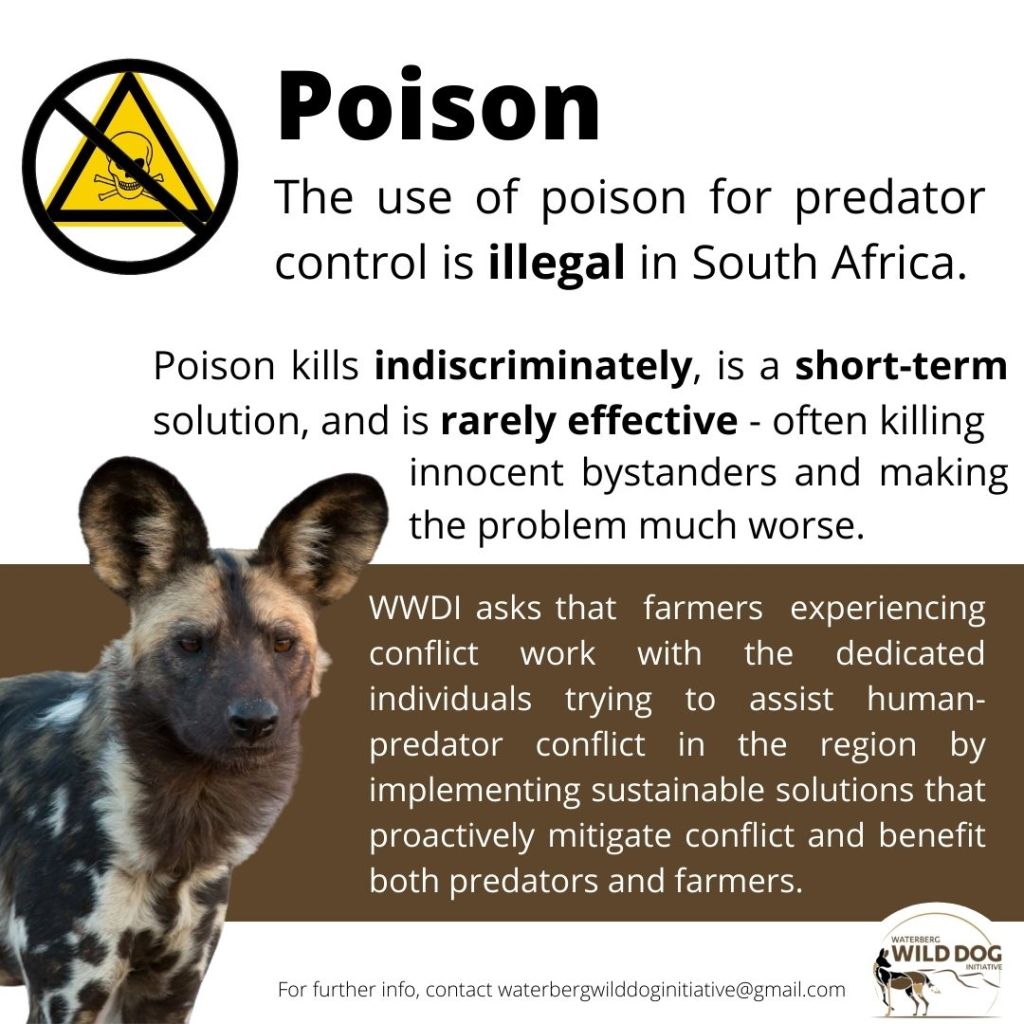
This is complex project with many facets but as evidenced in many other successful projects across Africa its success is built on a foundation of education, community buy-in and the creation and sharing of tourism driven benefits.
This project begins to provide proof that, with the right collaborative approach, we can live together with wild dogs even in a livestock-based farming district.
The fragmented nature of the surviving wild dog packs challenges their long term future. In the natural scheme of things young males leave the pack to search for female packs to spread their genes. The lack of movement between sub-populations will over the long term be detrimental to the wild gene pool and they are difficult to breed in captivity due to the complexity of their social structures. The Institute for Breeding Rare and Endangered African Mammals has been supporting researchers since 2009 to carryout a series of projects which have laid the groundwork for the development of sperm freezing techniques that can be combined with artificial insemination to introduce genetic diversity to isolated packs.
Research is also underway to develop a CDV vaccine that is safe and effective for wild dogs and, in Kenya, Tanzania and Mozambique programmes are underway to vaccinate domestic dogs and cats against rabies which not only helps to protect wild dogs but saves people’s lives. An outbreak of rabies in the Madikwe Game Reserve in South Africa in 2000 killed 10 out of 12 wild dog pups but the five adults in the same pack who had been vaccinated at least twice survived showing the potential effectiveness of a vaccination programme.
After years of rapidly declining populations it is encouraging to note that at least in South Africa the trend may have been slowed. In 2021 the population of wild dogs in Kruger was reported to have reached between 300 and 350 dogs having been as low as 120 individuals in 2009. Populations are also believed to be increasing in Aire de Conservation de Chinko (Central African Republic), Gorongosa National Park and surrounds (Mozambique), The Serengeti Ecosystem (Tanzania) and Luangwa Valley Ecosystem (Zambia).
There are projects running across most, if not all, of the countries that still host a population of African wild dogs.
These projects are often awareness and education programmes such as the brilliant Painted Dogs information resource that is part of the PACE Living with Wildlife Module.

Field projects often involve collaring and monitoring to continue research of wild dogs or to provide early warning systems that track pack movements and protect farm animals.

Image by Musekese Conservation
So let’s end on a high. In 2019 there was a rabies outbreak in the Musekese-Lumbeya region of Kafue in Zambia. It left just 14 wild dogs alive and threatened worse. But by 2022, just 3 years later, the population had doubled and as well as new pups wild dogs from elsewhere in the Kafue system were colonising Musekese-Lumbeya. There are now 5 packs in the area.
We know nature can and will recover, sometimes the help it needs is for us to stop getting in the way, sometimes it takes much more effort.
There is a comment box at the bottom of this post after Footnotes and Other Sources. Please let me know if you have any thoughts on this subject and whether you found this post useful.
Footnotes and References
- IUCN Red List. African Wild Dog. Accessed https://www.iucnredlist.org/species/12436/166502262
- The Conversation 2024 African wild dogs will soon have their own sperm bank – how artificial breeding will help them survive. https://theconversation.com/african-wild-dogs-will-soon-have-their-own-sperm-bank-how-artificial-breeding-will-help-them-survive-226542#:~:text=Those%20diseases%20can%20spread%20rapidly,in%20less%20than%20four%20weeks.
- L. Tensen and Others Spatial genetic patterns in African wild dogs reveal signs of effective dispersal across southern Africa. https://www.frontiersin.org/articles/10.3389/fevo.2022.992389/full
- Project Ark 2020 African Wild Dog. http://www.projectarkfoundation.com/animal/african_wild_dog
- African Parks 2023 The Wild Dogs of Malawi: A Historic Reintroduction. https://www.africanparks.org/wild-dogs-malawi-historic-reintroduction
- Waterberg Wild Dog Initiative 2022 Annual Report https://www.waterbergwilddogs.org.za/_files/ugd/629876_e3a0d9e0c48346d588eb155ed62daf89.pdf
- Don Pinnock 2023 Daily Maverick – ‘Devastating loss to conservation’ as six endangered African wild dogs poisoned in the Waterberg. https://www.dailymaverick.co.za/article/2023-12-13-devastating-loss-to-conservation-as-six-endangered-african-wild-dogs-poisoned-in-the-waterberg/#:~:text=The%20poison%20used%20was%20found,threat%20to%20large%20carnivores%20worldwide.
- Jocelin Kagan 2021 Daily Maverick ‘Africa’s Wild Dogs’: Nomads of the Bushveld https://www.dailymaverick.co.za/article/2021-01-05-africas-wild-dogs-nomads-of-the-bushveld/
- Institute for Breeding Rare and Endangered African Mammals – The African Wild Dog https://ibream.org/the-african-wild-dog/
- Wildlife Vets International 2021 Proteting African Painted Dogs from Disease https://www.wildlifevetsinternational.org/news/protecting-african-painted-dogs-from-disease
- Markus Hofmeyr & Others 2006 A second outbreak of rabies in African wild dogs (Lycaon pictus) in Madikwe Game Reserve, South Africa, demonstrating the efficacy of vaccination against natural rabies challenge https://www.researchgate.net/publication/229960248_A_second_outbreak_of_rabies_in_African_wild_dogs_Lycaon_pictus_in_Madikwe_Game_Reserve_South_Africa_demonstrating_the_efficacy_of_vaccination_against_natural_rabies_challenge
- Africa Geographic 2022 Hope for African wild dogs? New report https://africageographic.com/stories/hope-for-african-wild-dogs-new-report/
- African Parks 2021 Three Wild Dogs Translocated to Liuwa Plain National Park, Zambia https://www.africanparks.org/three-wild-dogs-translocated-liuwa-plain-national-park-zambia
- PACE Living with Wildlife – a new PACE resource on Painted Dogs https://www.paceproject.net/pace-news/living-with-wildlife-a-new-pace-resource-on-painted-dogs/
- Zambian Carnivore Programme 2022 Annual Report https://travelogues.uk/wp-content/uploads/2024/04/3c3e4-zcp2022annualreport-2023-08-28asmall.pdf
- Zambian Carnivore Programme 2016 Annual Report https://travelogues.uk/wp-content/uploads/2024/04/38876-zcp-2016-annual-report.pdf

 Travelogues and Other Memories
Leave a reply to The Day of the Painted Wolves – Travelogues and Other Memories Cancel reply