- Introduction
- A Region in Turmoil
- Mthethwa and Zulu
- Slave Raiding from the Cape
- The Kololo People
- Conclusion
- Appendix 1 – Dingiswayo
- Footnotes
- Other Sources and Additional Reading
Introduction
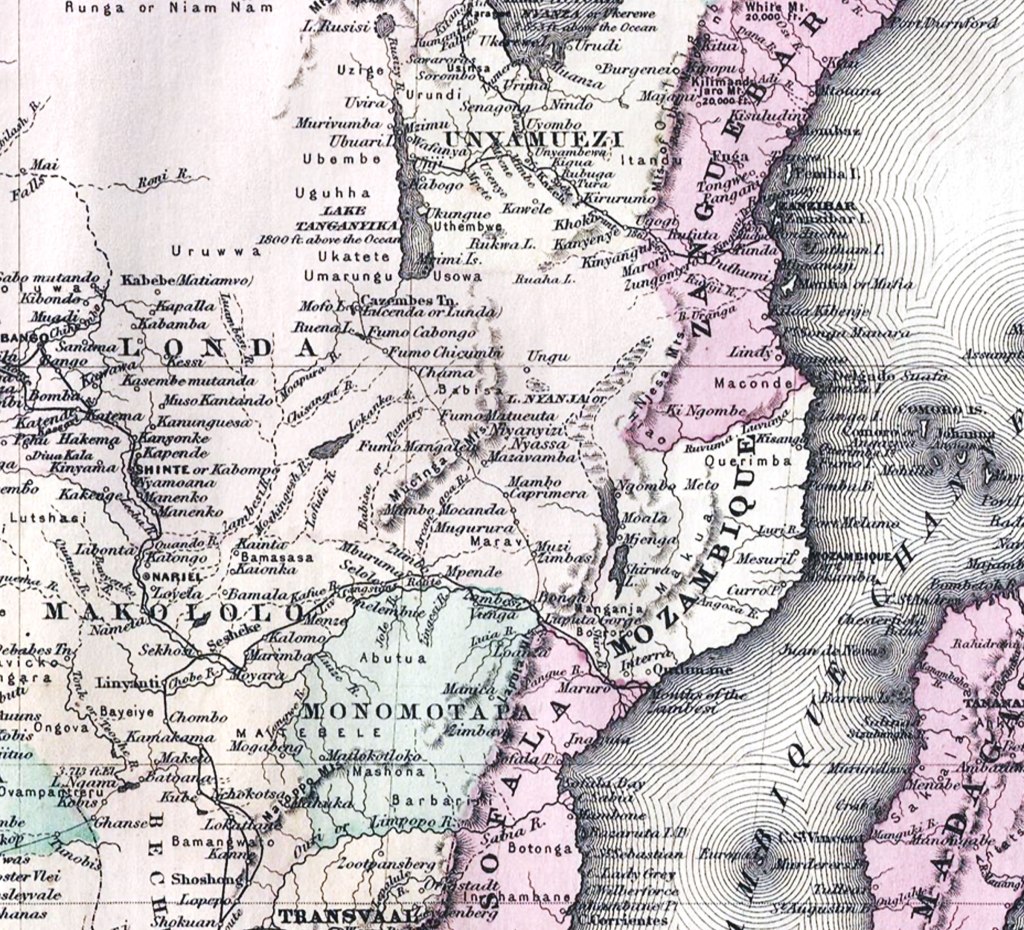
Livingstone’s arrival in the Shire Valley in 1859 put in motion a chain of events that in 1891 led to Britain formally taking possession of a land and its people that was initially named the British Central Africa Protectorate, subsequently renamed Nyasaland in 1907 and which is now Malawi.
Informal colonisation by Europeans started as early as 1861 when Bishop Mackenzie accompanied Livingstone’s expedition to Lake Malawi and established the short lived Universities Mission to Central Africa (UMCA) mission station at Magomero near present day Zomba in Southern Malawi.
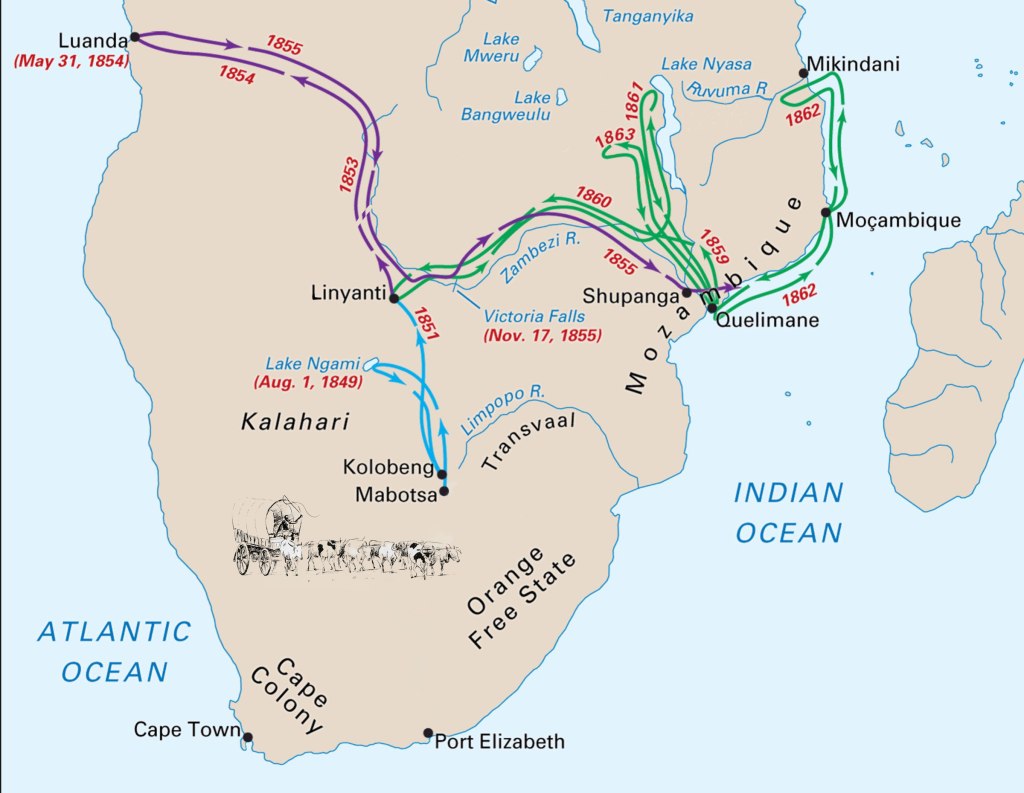
Livingstone had been accompanied on this journey by 152 Makololo men whom he had first met at Linyanti on the Chobe river in what is now the Caprivi Strip, the salient that connects Namibia to Zambia and Zimbabwe. Makololo is a convenient collective term for these people as the majority were from the subjected people who made up Makololo-Lozi Kingdom. These porters, along with many others, had accompanied the Scottish doctor on the 1855/6 expedition that made him a household name travelling from Barotseland on the Chobe river to Luanda in the west and then back to Quelimane and the Indian Ocean in the east.
When he returned to England in 1856 Livingstone left 123 Makololo porters at Tete, the Portuguese trading post on the Zambezi River, promising that he would return and lead them back to Sekeletu the Makololo King at Linyanti.
“They promised to wait till I came back, and, on my part, I assured them that nothing but death would prevent my return.” 3
It was two and half years before he returned to the Zambezi river and by then thirty of the Makololo had died of smallpox and six had been murdered.4 Many of the remainder had made new lives for themselves in Tete and only a few wanted to return to Linyanti which was now at the centre of a kingdom in terminal decline. Just the 15 mentioned above wanted to rejoin Livingstone and they were still with him when he journeyed up the Shire Valley with the UMCA..
After the departure of Livingstone and the missionaries the Makololo settled in Malawi and became a bulwark against slaving in the Shire Valley and the foundation of an important group of people in Malawi.
This is their story but it began not in Malawi nor at Tete nor even in Barotseland but far to the south in the area southwest of Delagoa Bay that was once known as Maputoland. It was here that a series of events eventually led to a small group of Makololo settling in Malawi.
A Region in Turmoil
The Mfecane
The Mfecane is a disputed term that has historically been used to describe a chain of events allegedly triggered by conflict amongst people living in the area to the southwest of Delagoa Bay in the 1790s.
It is argued that conflicts between groups of Bantu “Ngoni” people resulted in the rise of the Zulus and precipitated their militaristic expansion.
These conflicts are alleged to have triggered the dispersal of large groups of people from the area; people who subsequently colonised, often with violent conquest, many parts of the huge region that we now know of as South Africa, Lesotho, Botswana, Zimbabwe, eSwatini, Zambia, Malawi and Mozambique.
Right: A Zulu Warrior 5
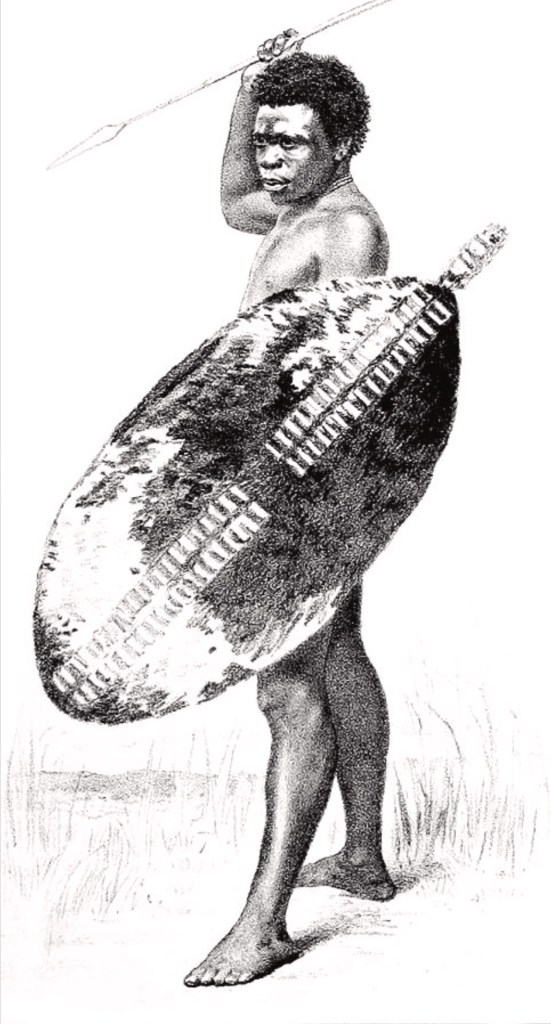
The term mfecane, or the “crushing” is disputed by many contemporary historians who argue that white commentators and historians in the 19th and 20th centuries created the idea of mfecane to enable them to blame the surge of violent activity that swept across the whole region solely upon Shaka Zulu and his Impis. Shaka is presented as a despotic monster who, at the head of his newly reorganised regiments (impis) armed with a revolutionary short stabbing spear of his own design, attacked neighbouring chiefdoms forcing them to flee and thereby start a domino effect that swept across the continent.
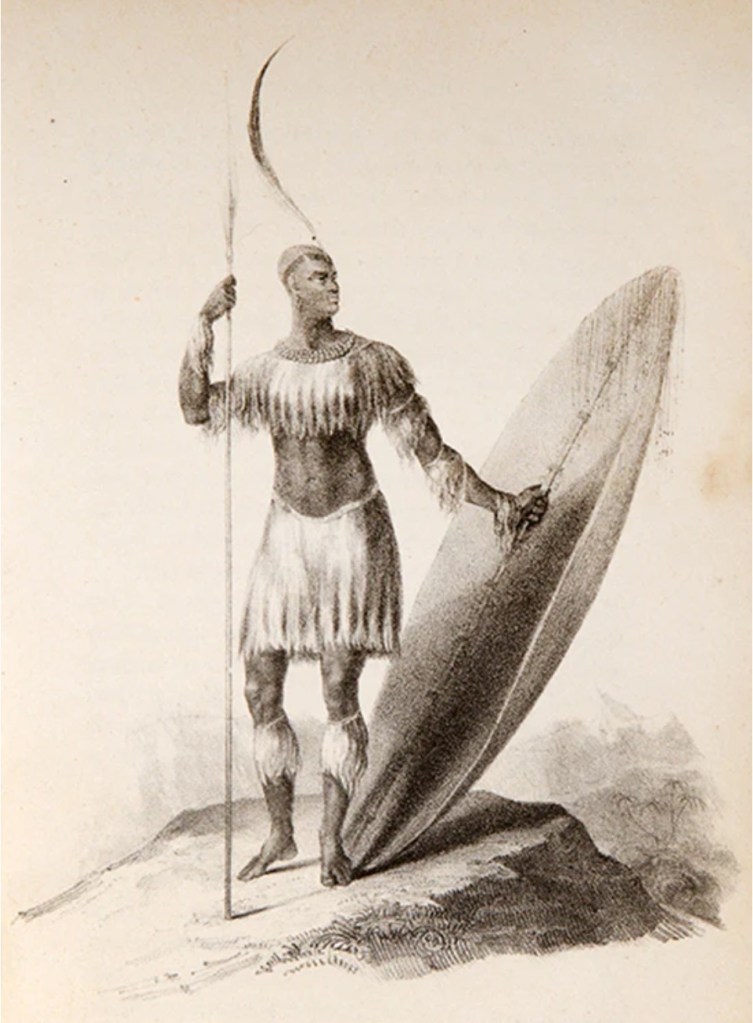
Julian Cobbing, a leading proponent of the idea that the Zulus were demonised and blamed for the mfecane to cover up the fact that the white settlers were the real cause of unrest, argues that there is no reliable record of the so-called Ngoni “internal” conflicts which allegedly facilitated the rise of King Shaka and his Zulus as the dominant military power in the 1820s. He also argues that the often referenced stories that Shaka reorganised the Zulu’s military system as well as inventing the short stabbing-spear and the horns of the buffalo battle tactic are unsubstantiated myths.
According to Cobbing the structure of the Zulu regiments and the short handled stabbing spear date from long before Shaka.8 This is but one example of how Shaka is surrounded by a fog of much repeated myths that obscure our understanding of this crucial moment in southern African history. 9
Other writers including Donald Morris, the author of The Washing of the Spears 10 and Magma Fuze, the only Zulu to write a history of his tribe in their own language, The Black People and Whence They Came 11, are certain that Shaka did invent the short stabbing spear and the battle tactics of the Zulu warriors. Others, including Elizabeth Eldredge 12 argue that Shaka was trained in those tactics by the Mthethwa chief, Dingiswayo, who had conquered over fifty major clans and many minor ones often by the threat of violence and assimilation rather than extermination and in whose army Shaka had served.
This level of disagreement suggests that our understanding of this period is not only incomplete but that myth and reality are highly intermingled. But, as pointed out by Norman Etherington:
“Throughout the (mfecane) debate one key assumption went unquestioned by all parties: that a wave of exceptional violence accompanied by huge loss of life did sweep across all the uncolonised regions of southeast and central Africa in the early nineteenth century, disrupting a previous equilibrium.” 13
The dispute amongst historians is whether mfecane was caused by white colonists or:
“….. a special epoch of purely African-initiated violence which spread by chain reaction following the rise of the Zulu monarchy.” 14
There are several known unknowns: it is hard to access how peaceful the region had been in the 17th and 18th centuries before the so-called mfecane but in the early to mid 1800s it is clear that large numbers of people were on the move causing a domino effect as groups bumped up against each other with varying degrees of violent interaction. 15
It is impossible to estimate the loss of life resulting from black on black conflict in this period but it was probably significant leaving some areas depopulated. We also know of chiefs who led their people over great distances; for example, the Ngoni who arrived in modern day Malawi via Mozambique and Tanzania or the Makololo settling in Zambia having both originated in southeast Africa.
The Disruptors
Whether it is treated as a single but widespread regional event labeled as the mfecane or treated as connected and unconnected conflicts and migrations it is clear that in the early decades of the 19th century people were on the move.
There have been attempts to attribute this movement and the subsequent violence on a single primary cause but, it seems more likely that a number of both unrelated and interrelated factors occurred to trigger the turmoil that caused the dominoes to start falling across early 19th century southern and southeastern Africa.
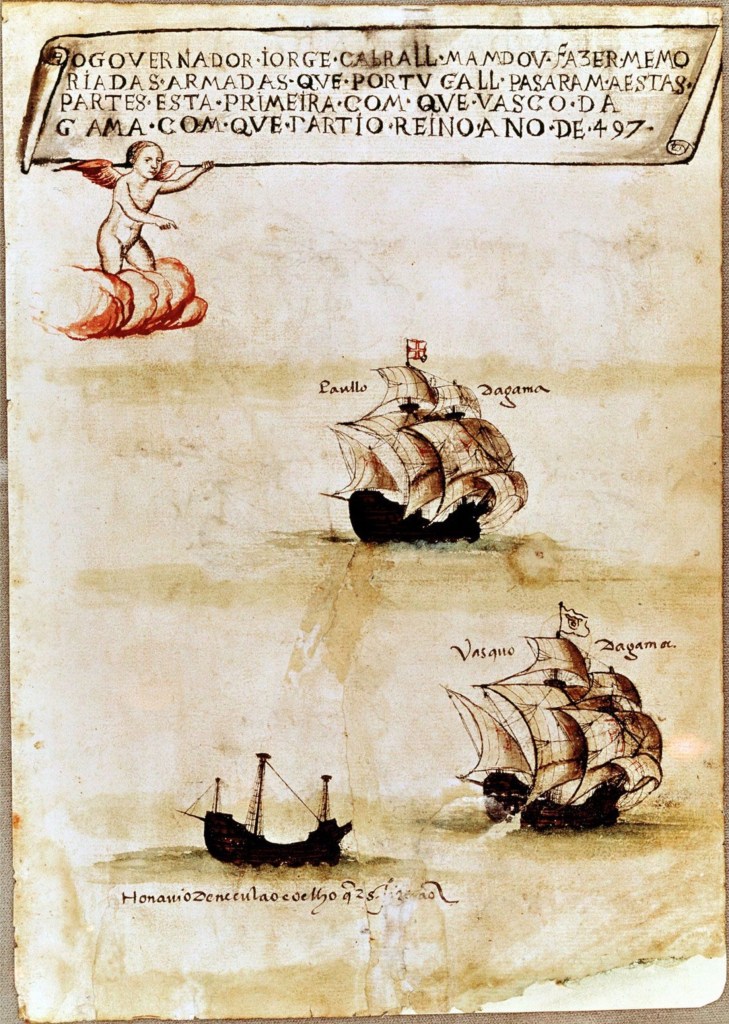
However, two significant events occurred long before the mfecane that, potentially, are the source from which much else flows: in 1502, António do Campo, a member of Vasco da Gama’s expedition to the Indies, discovered Delagoa Bay, a natural harbour 460 kms north of present day Durban and 60 kms east of the eSwatini Mozambique border. It is now the location of Maputo, the capital of Mozambique, a thriving city of around three million people.
The second event occurred a hundred and fifty years later and 2,000 kilometres to the southwest when, in 1652, Jan van Riebeeck, a Dutch civil servant, landed on the beach at Table Bay and proceeded to build a small fort.
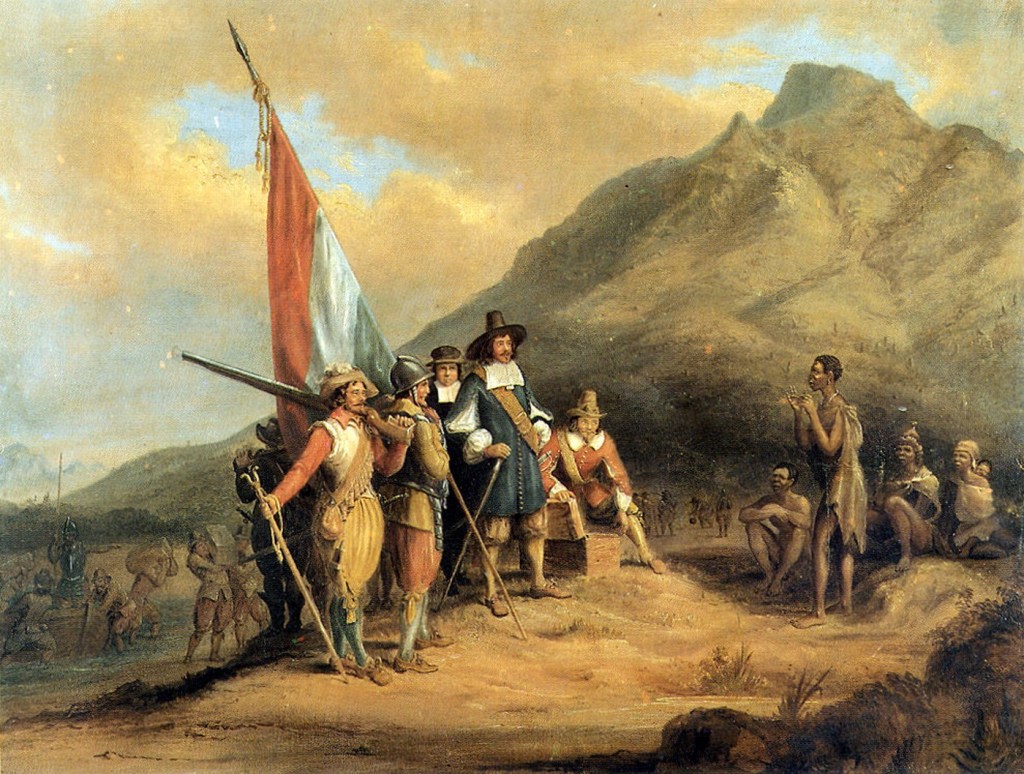
Painted by Charles Davidson Bell 16
The impact of the Europeans arriving to the southwest and north of what is now KwaZulu Natal and Lesotho was impactful and radically changed south and southeast Africa.
Mthethwa and Zulu
But Africa was not an empty land, a sleepy backwater where nothing had ever changed. For a thousand years Bantu speaking people had been slowly migrating in an clockwise direction from west Africa to the east, then, down through the Great Lake region and, by 1550, 17 they were firmly established in the southeast.
They were organised into tribes, clans and chiefdoms that jostled for primacy in any given area; coexisting or engaging in varying degrees of conflict which often led to further migration.
Kloppers makes an important point that should be borne in mind whenever discussing tribal groups in pre-colonial Africa:
“…..the classification of the peoples of southeast Africa into neat groups (clans, tribes) based on a model of Europe in the pre-historic era is a distortion of reality. Before the era of state formation in southeast Africa people lived in fluid ever changing social groupings (chiefdoms).” 18
The fluidity of tribal groupings is fundamental to understanding pre-colonial Africa. People gravitated to social groups for various reasons but often the overarching need was security with individuals having far greater allegiance to their family or clan rather than their tribe. 19
In the second half of the eighteenth century a number of chiefdoms including the Thembe, Mabhudu, Dlamini, Ndwandwe and the Mthethwa were vying for the control of territory between Delagoa Bay to the North and the Mfolozi River in the south. John Wright believes that the largest group only comprised a few thousand people and that the growth of these chiefdoms and the clashes between them was triggered by the:
“rapid expansion after about 1760 of an international trade in Ivory at Delagoa Bay” 20
In the late eighteenth century several chiefdoms in the coastal region between Delagoa Bay and the Thukela river began to expand dislodging other clans who progressively moved south first to below the Thukela river, then to the Mngeni, where Durban stands today, then to the Mzhomazi until finally settling south of the Mzimkhula river. These migrations and the conflicts that often accompanied them obviously predate Shaka Zulu who was not born until around 1787.
The Mthethwa Paramountcy
The Mthethwa chiefdom were in the Great Lakes region after 200 AD prior to moving south over many hundreds of years to initially settle in present day eSwatini perhaps by 1200 and then in the 1600s they moved further south to the Nkandia region of KwaZulu Natal.
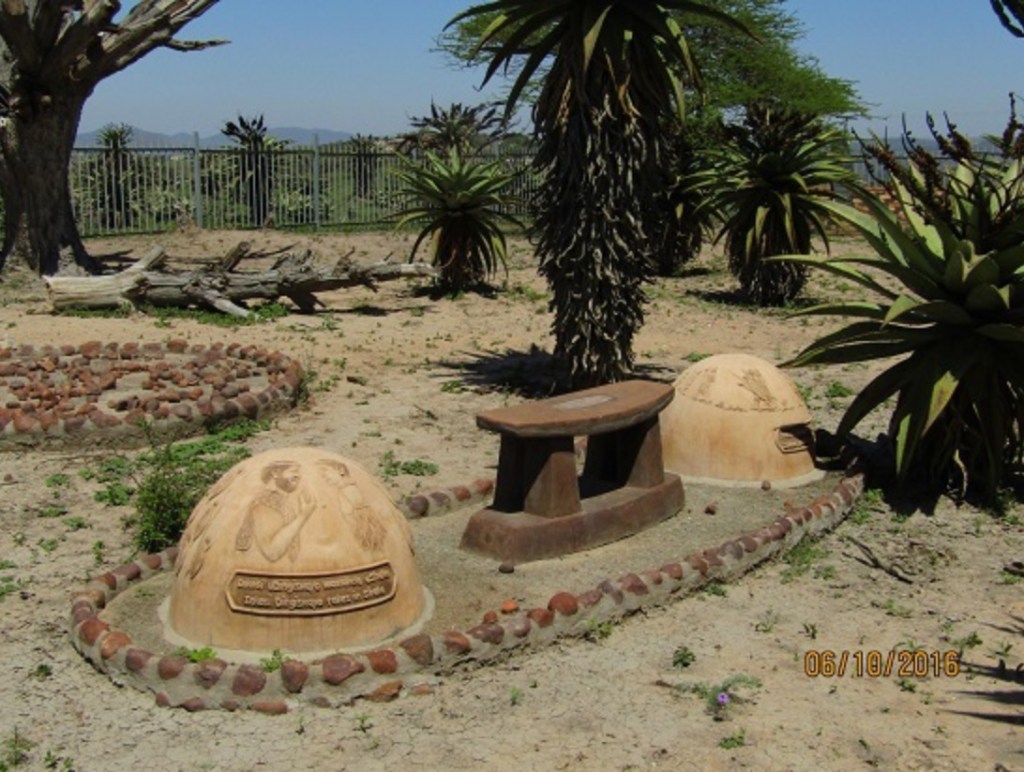
The chiefdoms were growing and clashing with each other and smaller chiefdoms until, around the turn of the 18th and 19th centuries, Chief Dingiswayo forged a state, the Mthethwa or Mtetwa Paramountcy, centred on Oyengweni, south of the Mfolozi River in modern day KwaZulu Natal. (see appendix 1 below for the story of Dingiswayo’s rise to the chiefdomship).
Dingiswayo had learnt about disciplined and structured warfare, probably from or, by observing the Portuguese, and organised his warriors into regiments that expanded his territory through a combination of raiding and heavy handed diplomacy of the “join us or else” variety. When not engaged in bullying the neighbours the regiments were despatched to hunt elephants. Hunting, raiding and the creation of a confederation of Nguni clans, the Paramountcy, provided Dingiswayo with a steady flow of ivory, slaves and cattle.
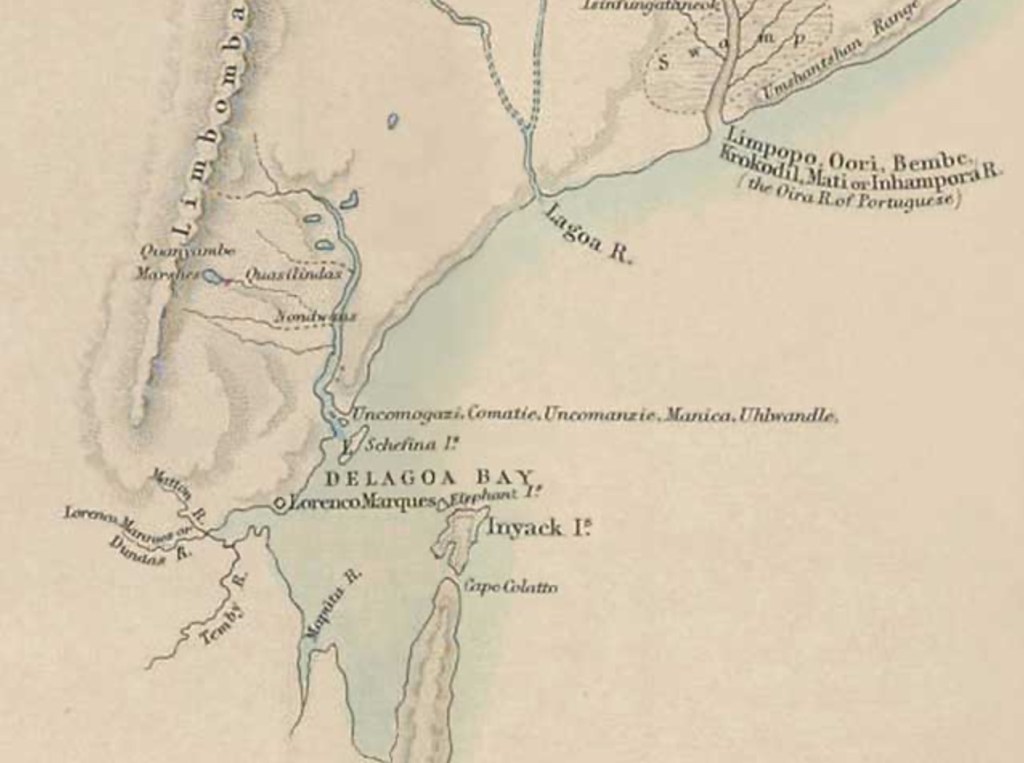
He formed alliances with the Temba and Mabudu chiefdoms to his north who had access to the Portuguese at Delagoa Bay with whom they had traded ivory, cattle and quite probably slaves since the days of the earliest whaling station. Dingiswayo funnelled ivory and slaves to the Portuguese through these alliances that were clearly mutually beneficial as evidenced by the Mabudu (or as suggested by other sources the Portuguese) sending musket-armed warriors to support the Mthethwa’s attacks on other chiefdoms. 21
Ivory had little or no value to the people of sub-Saharan Africa; it was something left lying around by the thirty million elephants that populated every corner of their continent. It was the outsiders that placed a value on elephant teeth and whilst some ivory had been traded with Arabs, Greeks, Romans and Indians for well over a thousand years it was when the supply of Asian ivory started to fall short of demand and new markets opened up in Europe that ivory become one of the most, if not the most valuable, commodities in Africa.
But ivory was not the only commodity increasing in value and motivating Dingiswayo and other chiefs to raid their neighbours.
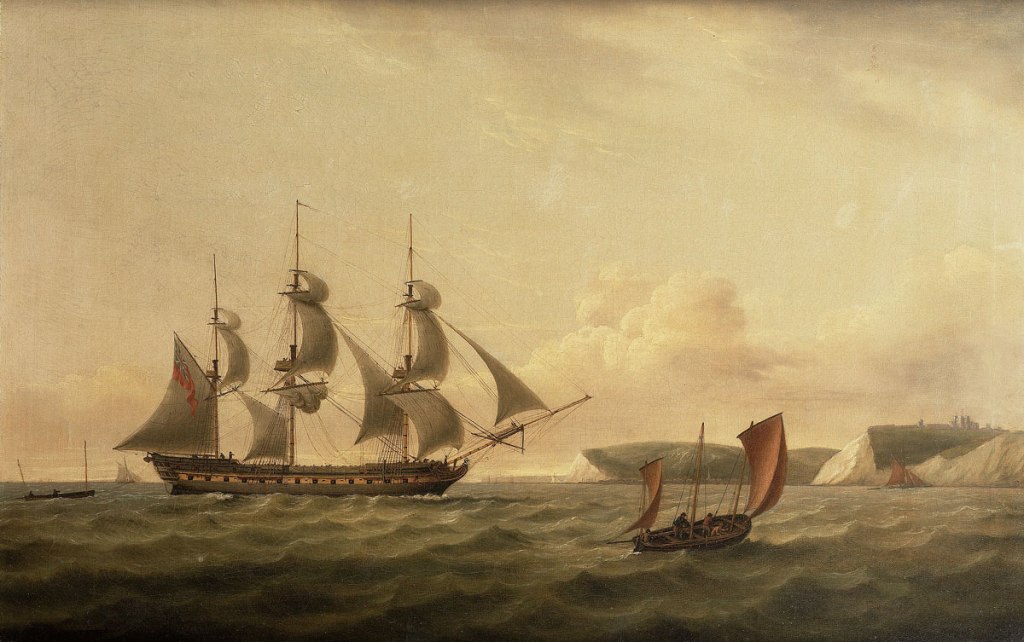
The Slave Trade Act had passed into British law in 1807 and in 1808, whilst the Napoleonic Wars still raged in Europe, the British Admiralty gave orders to two ships, HMS Solebay, a 32 gun Frigate under the command of Edward Henry Columbine and HMS Derwent, a 16 gun sloop under the command of Frederick Parker to patrol the west coast of Africa from their base at Portsmouth.
This tiny flotilla would evolve to become the West African Squadron which, under various names and commanders, continued to patrol the Atlantic until it was absorbed into the Cape of Good Hope Squadron in 1867. It intercepted 1,600 slave ships and freed around 150,000 slaves at a cost of the lives of over 1,600 British sailors, roughly 10% of sailors on patrol each year. 23
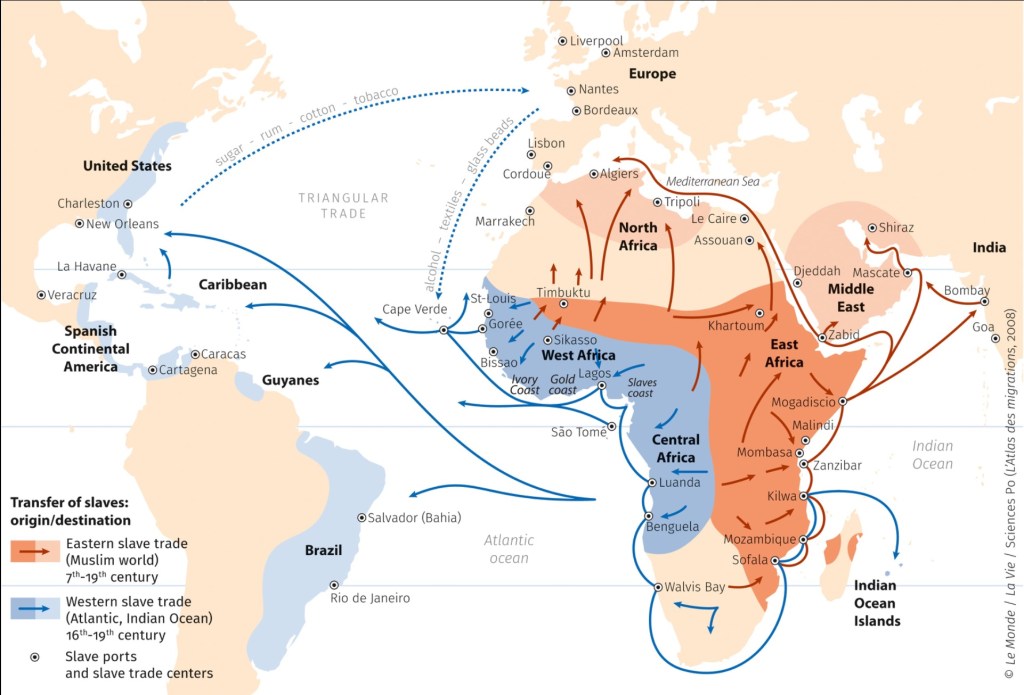
The increasing activity of British warships on the west coast of Africa after 1808 cut off the supply of enslaved Africans to the Portuguese plantations in Brazil and the Mascarene Islands and the French plantations in the Indian Ocean; this resulted in a heightened demand for east African as opposed to west African slaves.
By 1810 slaves were probably being traded in significant numbers at Delagoa Bay and by the 1820s it had become a major slave and ivory trading depot.
Dingiswayo had the foresight to recognise the benefit of controlling these commodities at source. Bringing other clans and chiefdoms into a confederacy either by force or persuasion and by using his regiments to hunt elephants and slaves when not engaged in empire building gave him access to more cattle, enslaved people and ivory than his contemporaries. This fuelled the creation and growth of the Mthethwa Paramountcy which, in effect, was a pre-cursor to the Zulu Kingdom.
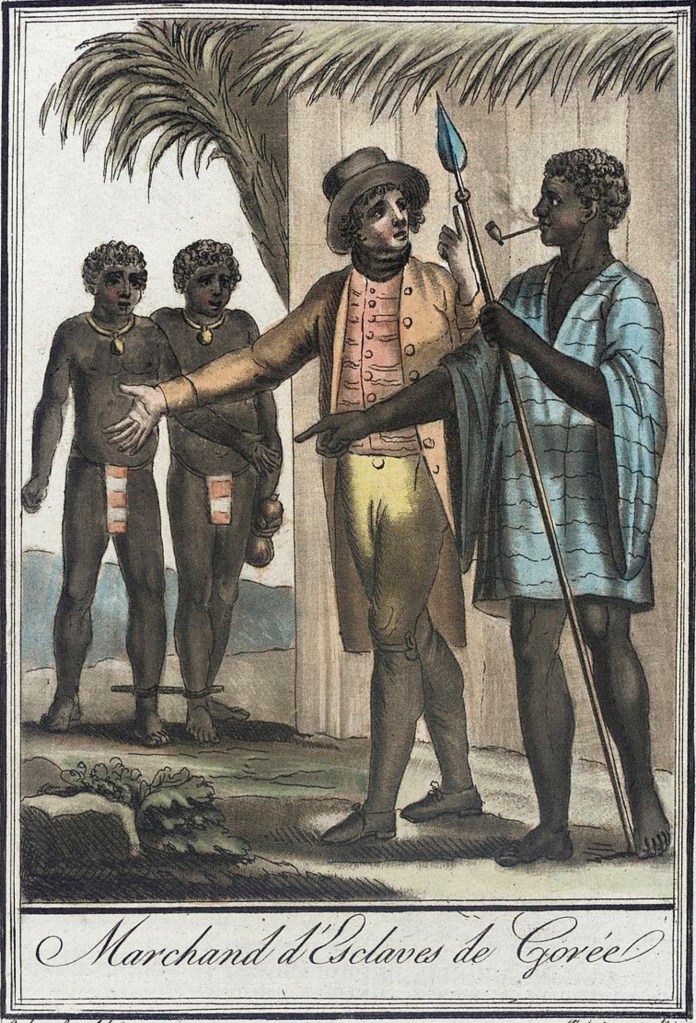
The ivory trade and later the slave trade facilitated the rise of the Mthethwa Paramountcy and triggered significant armed conflicts between Dingiswayo and other chiefs in the region such as Sobhuza and Zwide who also fought with each other.
The Zulu Kingdom
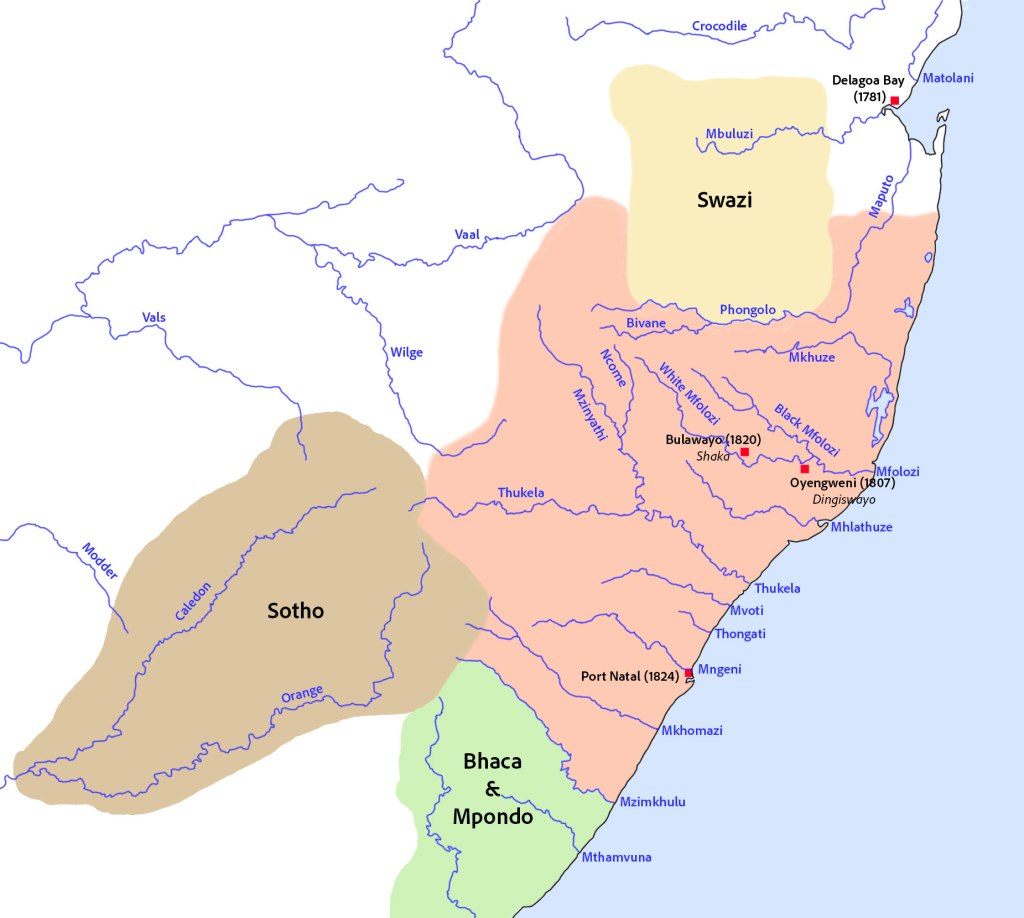
The period between 1750 and 1815 had already seen plenty of conflict and enforced migration but at this time a young warrior by the name of Shaka kaSenzangakhona was serving with great distinction as a general in the regiments of the Mthethwa Paramountcy. Dingiswayo had trained and facilitated Shaka to become the great warrior king who created the Zulu Nation taking conflict, conquest and enforced migration to a whole new level.
Shaka was still serving in Dingiswayo’s army when his father, Senzangakona, died in 1816. He returned to his homeland to take control of the Zulu clan which, at that time, probably numbered less than 1,500 people and as such was one of the smallest of the 800-odd Eastern Nguni-Bantu clans in the region. 26 He reorganised and trained the Zulu warriors to undertake his conquest of many of the clans and chiefdoms of southeast Africa including, of course, Dingiswayo’s Mthethwa.
Unlike Dingiswayo who mostly, but not always 27, grew his empire by amalgamation Shaka grew his by force. His highly disciplined regiments, armed with their long-bladed, short-hafted assegais soon overwhelmed over a hundred different clans and chiefdoms. Villages that resisted were destroyed, their cattle taken and the population enslaved, killed or driven away.
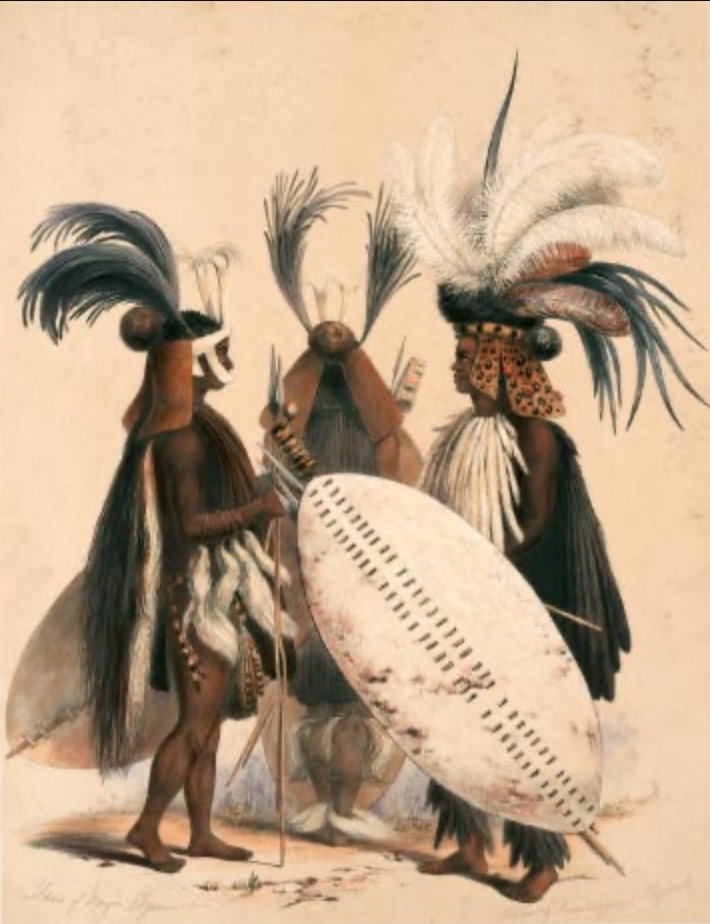
When a chief submitted Shaka generally left the existing hierarchy in place or appointed someone from the traditional ruling family to rule. Some clans simply ran for the hills before Shaka’s impis arrived.
Two other powerful chiefdoms had existed in the region along with the Mthethwa and they soon fell foul of the Zulus; Sobhuza’s Ngwane were settled along the Phongolo River south of what is now now eSwatini and to their south Zwide’s Ndwandwe held a large swathe of land between the Phongolo and Black Umfolozi Rivers.
Sometime around 1818 the Ndwandwe displaced the Ngwane and Sobhuza led his people north into, what is now,central eSwatini, where in time, they became known as the Swazi people. Sobhuza forged a kingdom that by his death in the late 1830s stretched from the Phongolo River in the south to modern day Barberton in the North. Modern day eSwatini is only slightly smaller making this state one of the most enduring in southern Africa.
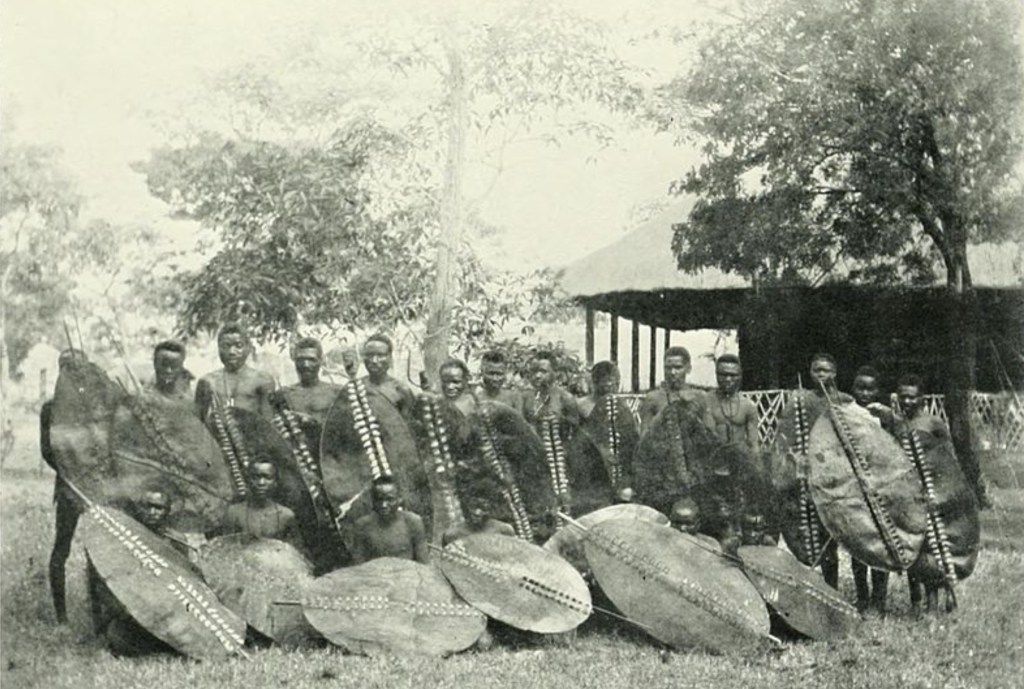
Zwide’s Ndwandwe were subsequently defeated by Shaka’s Zulu between 1818 and 1820 and at least three of the Ngoni clans who had supported and fought for Zwide migrated north as a result. Zwangendaba and his Jere-Ngoni were one of these clans and after fleeing from their land near modern day Pongola they were at Delagoa Bay by around 1822. The Portuguese and English traders referred to this group as Vatua, Vatwah or Vatwas, names they also often also used for the Zulus which adds to the confusion when trying to understand this period.
Thirty years later Zwangendaba and his people were as far north as Lake Tanganikya and after his death the clan split and one group moved south to violently occupy an area to the west of Lake Malawi.
A third example are the Makololo whose arrival in Zambia came about as a direct result of clan leaders putting as much distance as possible between themselves and the Zulus. These are but a few of the many enforced migrations that in practice often became violent conquests of new territory. Examples of the domino effect, the rolling violence that swept across southern and central Africa.
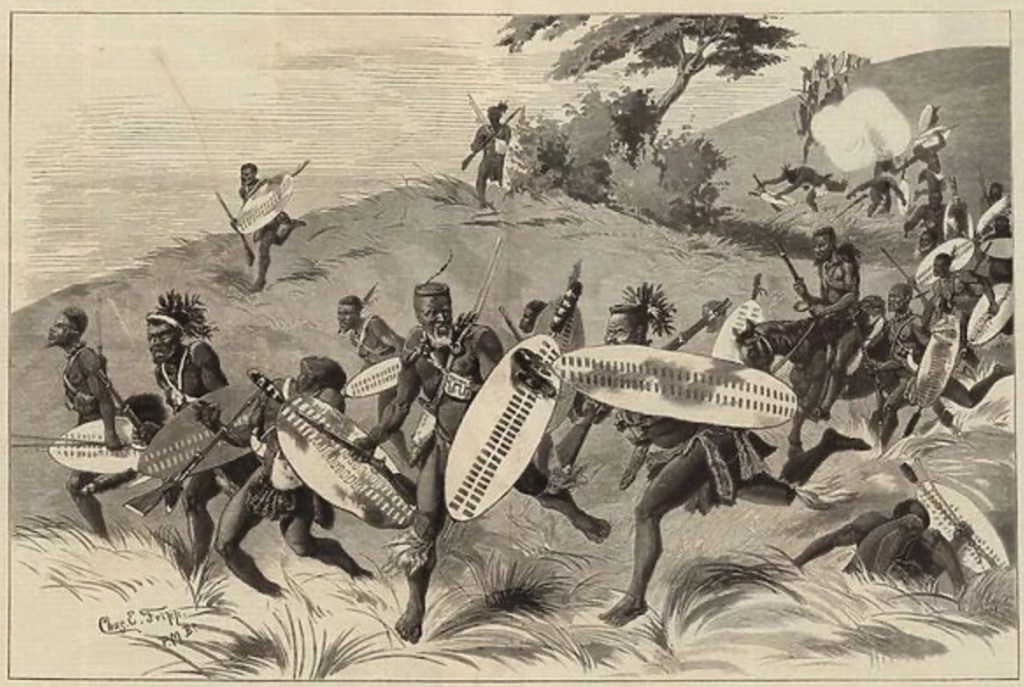
Migrations such as these have been used by historians to support the argument that the so-called mfcane was caused by Shaka’s Zulus. It is clear that Zulu aggression was the immediate cause of Sobhuza’s occupation of modern day eSwatini, the Ngoni settling in Tanganyika, Malawi and Zambia and the Makololo forging a kingdom in what is now northern Botswana and southwest Zambia where they met Livingstone in 1851.
Morris describes the impact of Shaka’s impis:
“Within two years Shaka bested the only clans large enough to threaten him, the Ndwandwe and the Qwabe, and in a series of annual campaigns he then struck at and smashed the complex network of clans living to the south of the Zulu territories. By 1823 the region was a depopulated ruin of smoking kraals, and the terrified survivors had broken up tribal patterns as far away as the Cape Colony.” 29
Or, Was it the Europeans?
However, to attribute the so-called mfcane, solely to the Zulus is to ignore everything that was happening in a region directly and indirectly influenced by the existence of European traders at Delagoa Bay long before Dingiswayo or Shaka.
The area influenced by a handful of Europeans sweating it out in a tiny fort on the coast was enormous because the ever increasing demand for ivory and slaves was a malevolent force spreading like a virus across the whole of east and central Africa, sucking enslaved people from deep in the interior to the Portuguese controlled coast, corrupting far distant communities to become slave hunters and traders.
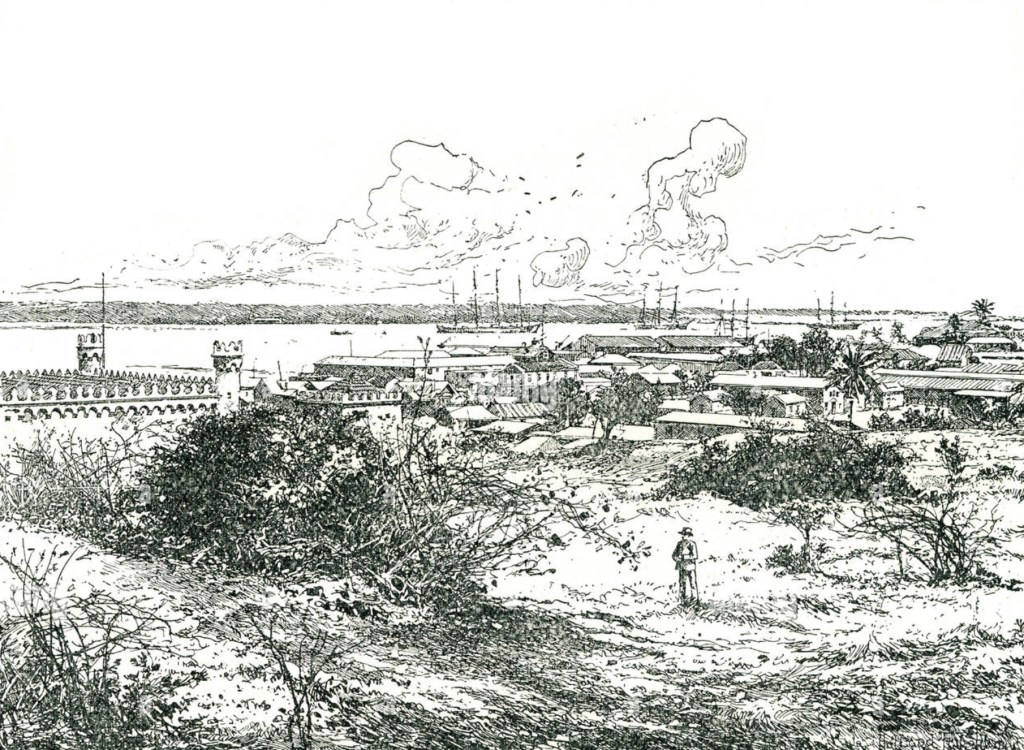
Before the Europeans arrived southeast Africa featured a social landscape of a very large number (Morris says over 800), comparatively small, Nguni-Bantu chiefdoms generally rubbing along together with similar cultures and roughly equal wealth as measured by the amount of territory they controlled and the number of cattle they owned. The ivory and slave trades fundamentally changed this dynamic; access to the Europeans gave those chiefdoms nearest to Delagoa Bay new status and any clan who could control the flow of ivory and slaves to the traders could become disproportionally wealthy and powerful enabling them to absorb or conquer smaller less wealthy, less powerful communities.
The mfecane was a consequence of the two great east African trades: ivory and slaves, which disrupted, corrupted and perverted everywhere they reached and everything they touched. Whole ethnic groups such as the Swahili people of the east coast and the Yao, initially from Mozambique but later in Malawi, become professional slavers as regional economies changed to become focussed on slave and ivory hunting.
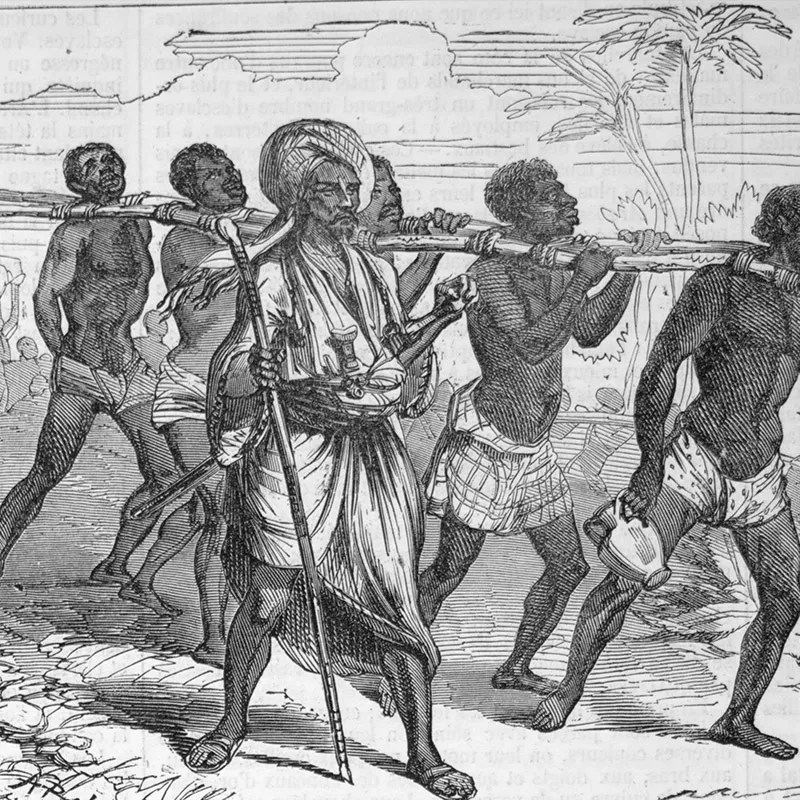
Arabs, Indians, Americans and Europeans financed and managed a massive malevolent organisation that sucked 17,000,000 30 people out of east Africa to the coast and away to Arabia, the Indian Ocean and Latin America before the end of the 19th century. Simultaneously it instigated and facilitated the slaughter of enough elephants to export 34,000,000 elephant tusks to make ornaments, trinkets, piano keys and billiard balls.
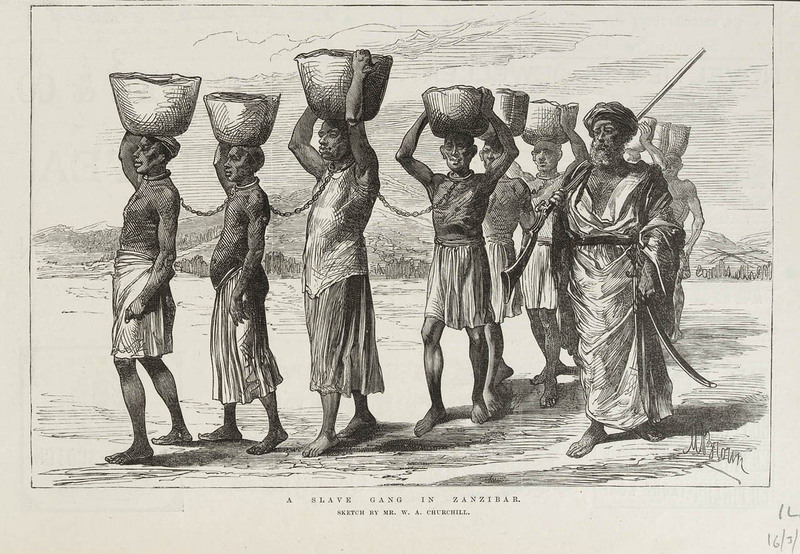
It is impossible to estimate how many elephants have to die to harvest 34 million tusks and beyond any mathematician’s skills to calculate how many men, women and children died in slave raids, were abandoned to die by the roadside after collapsing on the march to the coast carrying heavy loads, who suffered in misery and died of disease in slave compounds and slave ships, or were slaughtered under the slavers’ knives at castration camps where only a handful of young men were strong enough to survive the barbaric practice of being gelded like cattle.
The enormity of the savage rape of Africa in the 17th and 18th centuries is impossible to comprehend and its short and long term consequences impossible to quantify.
Slave Raiding from the Cape
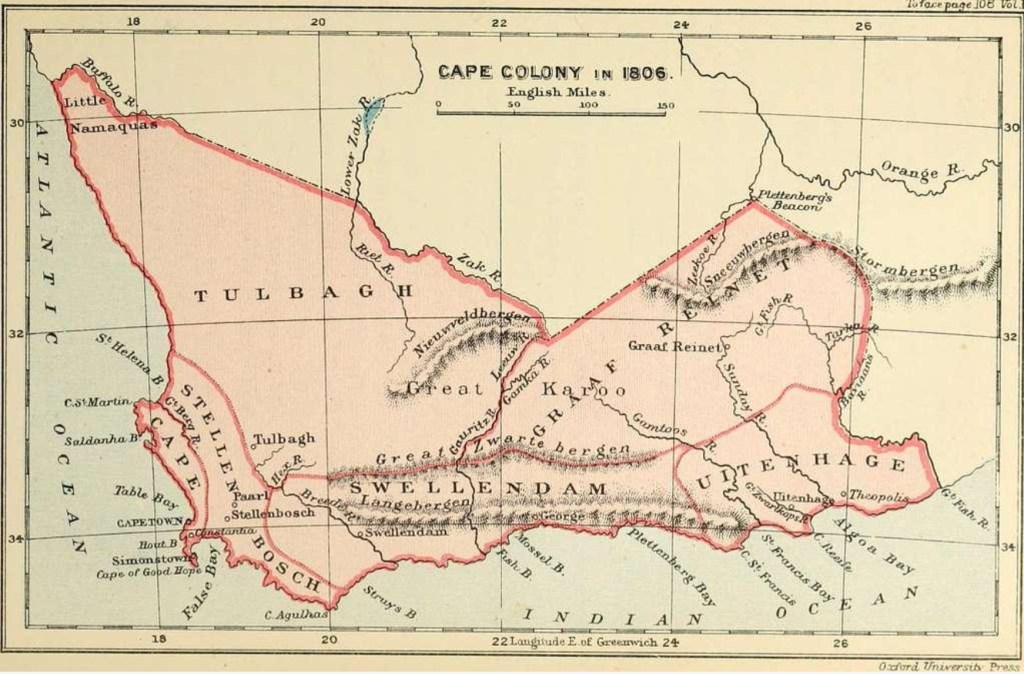
Far from Delagoa Bay and the east coast of Africa the Cape Colony was the second great disrupter, a settlement whose influence extended far beyond its own borders. In 1800, at the tip of a vast continent, the Colony had a population of less than 25,000 white people of whom 16,000 lived in a single city. Initially nothing more than a revitalling station for Dutch ships heading to the East Indies it had slowly grown as the early farmers transitioned from arable to mixed farming and then, as they moved away from the Cape and into drier areas, to become pastoralists.
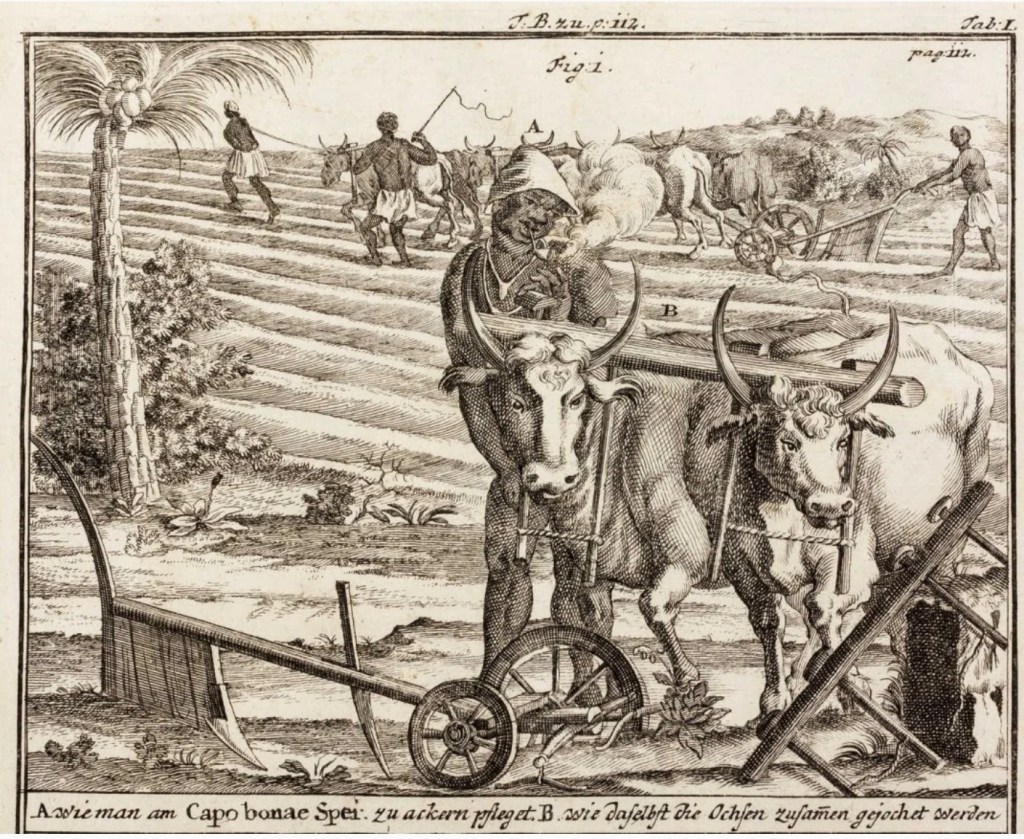
Initially the Cape Colony imported slaves from various places in the Indian Ocean but as the colony expanded the farmers began to supplement their labour force by enslaving Khoikhoi and other indigenous people living near or outside the colony’s borders. It is unclear how many of these men and women are included in any estimates of slavery in the colony but in total there were around 25,000 enslaved people by 1800. This is a non-trivial number in humanitarian terms but as well as slaves taken in the region and enslaved Khoikhoi these people included imports from the Indian Ocean and their descendants, as well as enslaved people purchased from east coast Portuguese traders stopping at the Cape on their way to Brazil. Therefore, until around 1790 or 1800, the impact of the Cape Colony was predominantly localised.
But, in the 1790s oppression and slavery inside the colony began to trigger a wave of people crossing the northern border and the Orange River. They were a mixture of free blacks, Khoikhoi, escaped slaves, convicted criminals, escaped white convicts and people of mixed race who referred to themselves as Bastaards. Many of these migrants were armed and mounted and in no time they were rustling cattle and settling on land owned by clans of the BaTswana Kingdom.
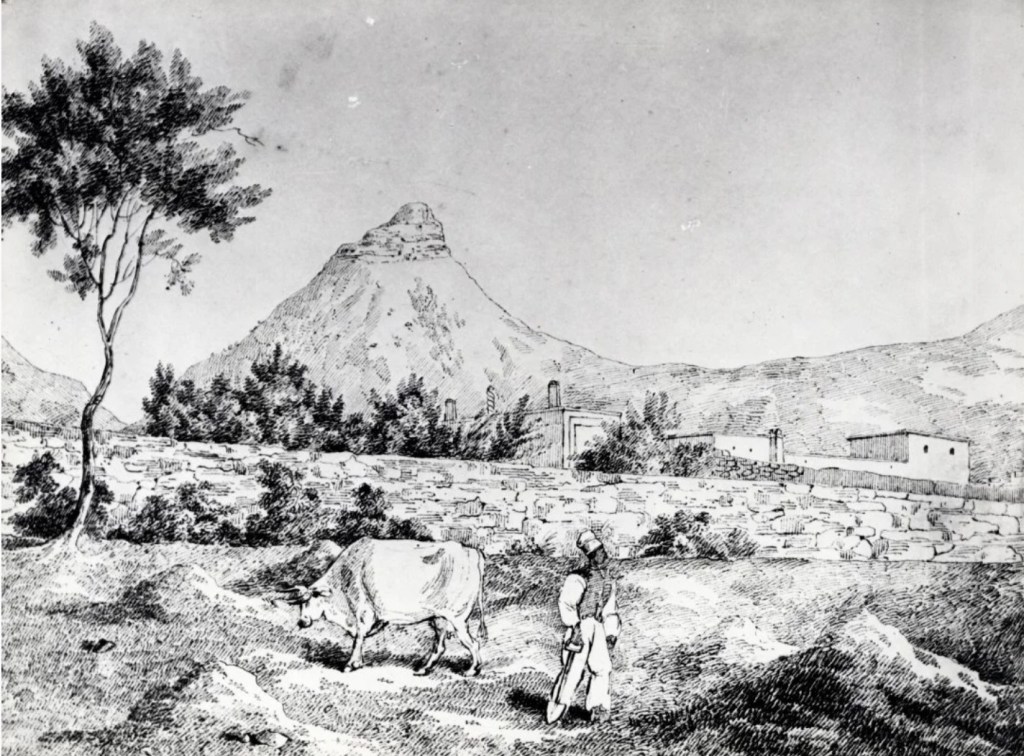
Amongst the raiders there were white criminals such as Jan Bloem, a German who had murdered his wife and a Dutchman, Pieter Pienaar who targeted the Khoisan living in the area to capture children whom he sold to Boer farmers.
This raiding became so intensive with, at times, four or five hundred raiders in a single attack that the Transorangia region was plunged into chaos, poverty and famine, Elizabeth Eldredge quotes Hans Luykens, an eye witness:
“Women and children were tied to trees and, after being ill-treated, killed and whole communities had been robed of their cattle, so that these inoffensive tribes, not able to defend themselves, with their inferior weapon, the spear, were now wandering about in a state of wanton privation, many perishing from hunger.” 33
In the early 1800s Boer families living in outlying districts were often managing huge herds of cattle with as many as ten or twelve thousand head, and they needed large numbers of herders who were often young boys and historically they had simply been taken by force from indigenous communities or purchased from raiders.
Even before 1808 slaves had been expensive but once the British banned slave trading it became far more difficult to find and buy slaves and their value increased significantly. The Dutch government had allowed farmers to indenture the children of Khoikhoi slaves and servants and keep them bound to their farms until they reached the age of twenty-five. The “apprentice” system survived the arrival of the British and was clearly slavery under a different name. It was also widely abused as birth dates were rarely recorded.
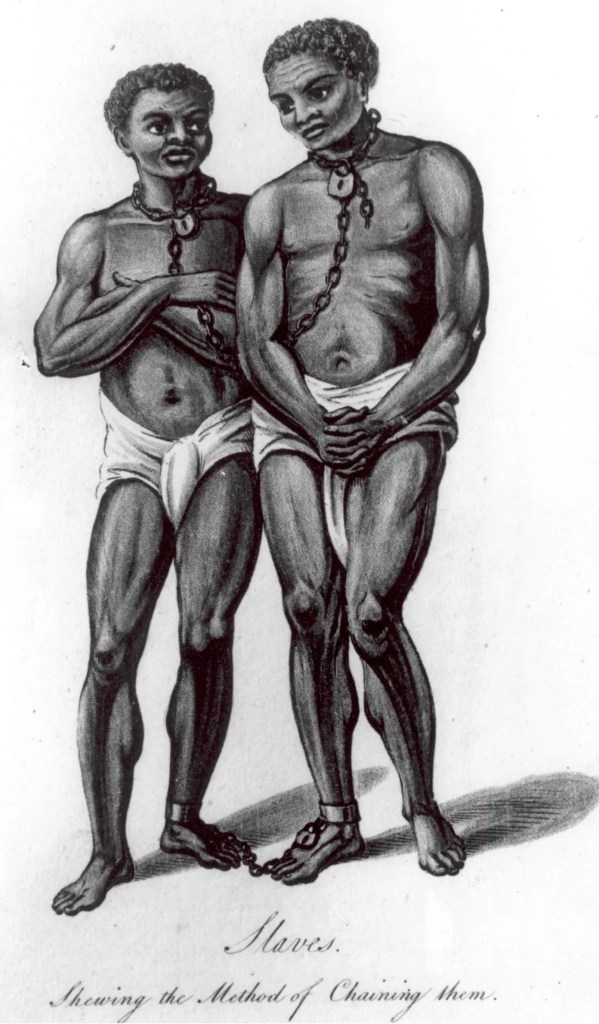
As late as in the 1840s David Livingstone was shocked to discover that forced labour was prevalent among the Boer farmers in the Transvaal. These farmers had huge farms for themselves and expanded on a regular basis arguing that they need at least 12,000 acres for each of their (many) sons. Of course this land was seized from indigenous Africans.
Africans who resisted were driven off and their cattle and sheep taken. Livingstone became increasingly involved with displaced Africans who settled near his mission stations and survived on a combination of handouts and by growing food on marginal land.
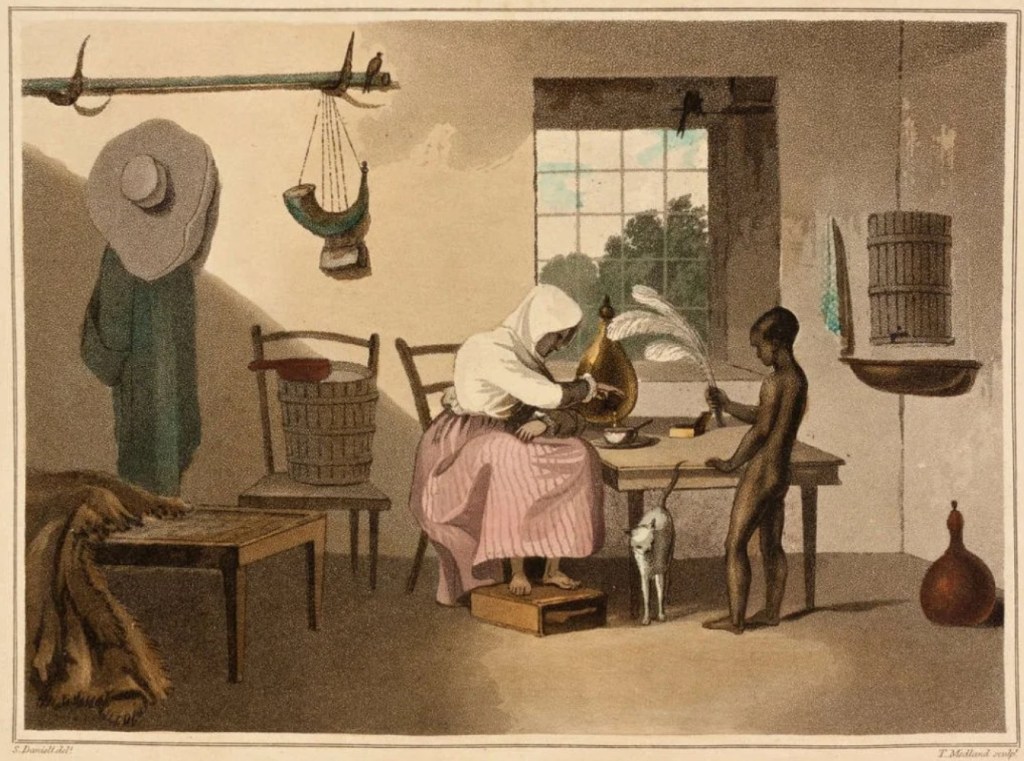
Chiefs on land adjacent to Boer farms were forced to provide unpaid labour to plant and harvest at the expense of tending their own subsistence farms. Livingstone argued long and hard with these farmers during the years that he ran the missions at first Mabotsa and then Kolobeng but they were stubbornly certain of their status as God’s chosen people and that the black African had been placed on earth to work for them.
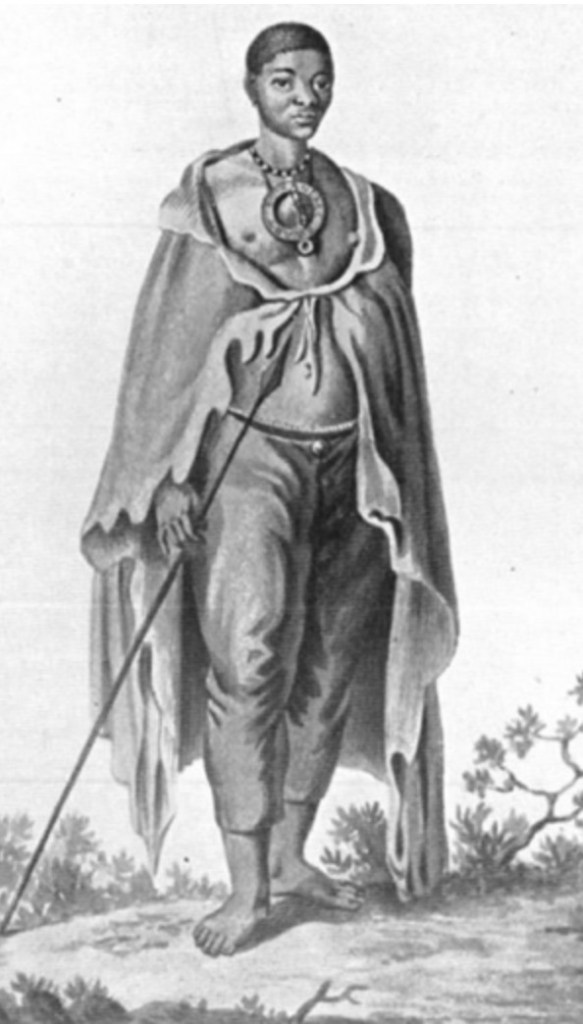
In the 1820s the Griqua, people of mixed Dutch and Khoikhoi, who had settled north of the Orange River split into two groups. The traditional chiefs continued to cooperate with the Colony but a group that became known as the Bergenaars broke away and became, what the British Government agent called, a “lawless horde” 35
The Bergenaars were mounted and well armed raiding peaceful African settlements, killing the men, taking the women and young to sell as slaves and rustling the sheep and cattle.
The same Government Agent, John Melvill, was convinced that they were funded by the colonial farmers who were subsequently buying the slaves and cattle.
The Bergenaar and other Griqua who were not associated with the missions at Griquatown were raiding in outlaw bands far and wide. There were reports of raiding from missionaries and government agents from across the regions that are today the Northern Cape, the North West province of South Africa and modern Namibia and Botswana
Throughout this period migrants who had been displaced by the Zulus were arriving from the east and attempting to settle in an area already ravaged by famine and slave hunting. The indigenous population was unable to cope with absorbing newcomers and were dealing with Griqua raiding.
The end result of course being more migration and more black on black conflict.
The Makololo People
First Meetings on the Chobe River
In 1846 David Livingstone and his family settled amongst the Bakwena people whose chief Sechele was to be Livingstone’s only convert to Christianity. The Kolobeng Mission 25 kilometres west of Gaborone in modern day Botswana was the Scottish doctor’s only real home in all of his time in Africa but he believed he was under an obligation to explore further north and reach the rich land of rivers and lakes that he had heard lay beyond the Kalahari desert.
In 1850, after two previous attempts, he and a companion, William Cotton Oswell, reached the Chobe river and made contact with the Makololo people whose chief Sebetwane he was keen to meet.
Sebetwane appears to have been equally pleased to meet the explorers and had bribed minor chiefs to give them assistance as they passed through their lands. 36
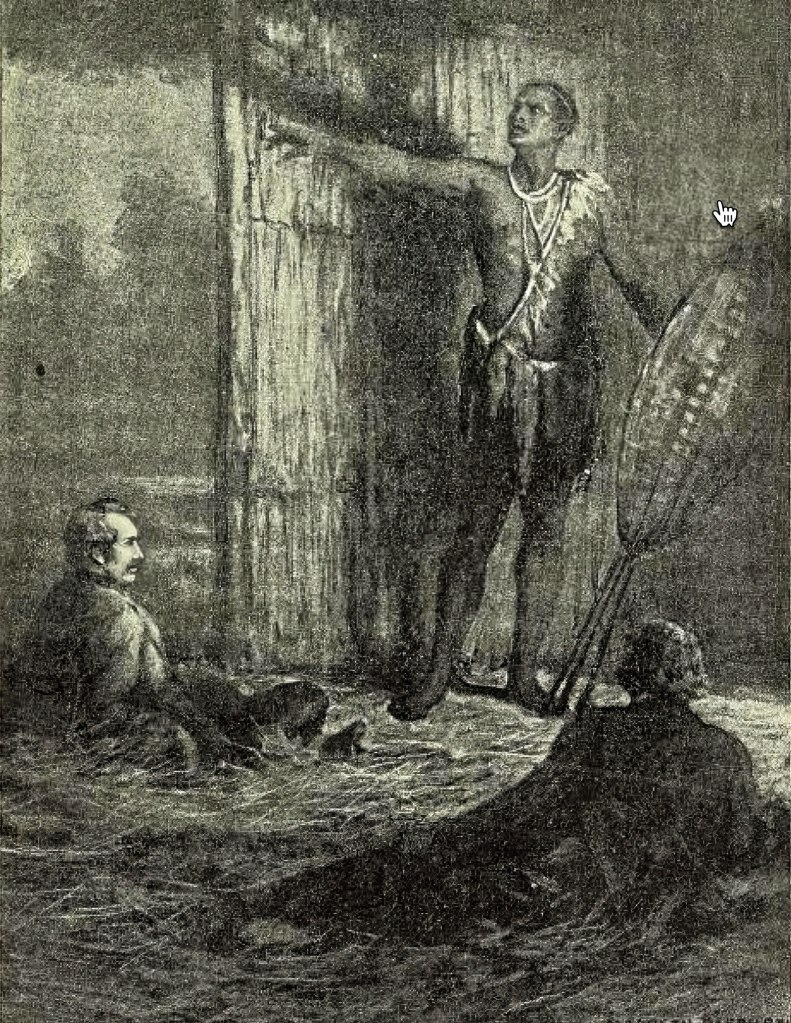
At their first meeting Oswell was impressed by the “finest (native) I ever saw” he was:
“Beloved of the Makololo, he was the fastest runner and the best fighter among them ; just, though stern, with a wonderful power of attaching men to himself, he was a gentleman in thought and manner.”
During their first night the chief visited them in their hut and told them the story of his life (see illustration above 37).
King Sebetwane
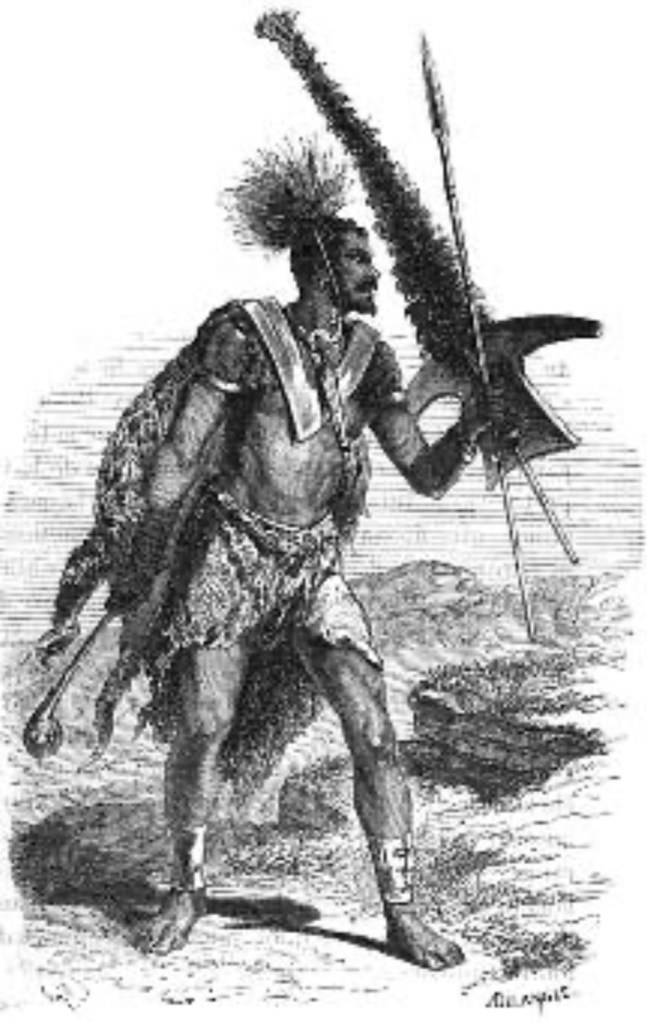
In the early 1820s Sebetwane, who had been born between 1790 & 1800, was the chief of the Bafokeng-ba-ha-Patsa clan (Patsa), a Sotho people, living in Transorangia between the Orange and Vaal rivers.
At this time the Orange river was beyond the official extent of the Cape Colony but was an informal border separating the colonists and the indigenous people who were attempting to maintain their culture and way of life..
After 1808 the British ban on importing slaves triggered armed Griqua and Korannas raiders to begin capturing women and children from the region to sell to Boer farmers.
In 1829 a missionary wrote:
“Amongst the Griquas and Bergenaars, who are in considerable connection with the Cape, slaves obtained by barter or by capture from Bootchuanas (Batswana) and Bushmen (Khoisan), are a common article of saleable property.”
And a newspaper article in 1834 stated:
“Among the Basotho, cattle have now become scarce, and commandos do not now as usual go out in search of them so much as of children, whom they carry off in great number and dispose of them to farmers, who readily give a horse or inferior gun for each.” 38
Some clans reacted by acquiring guns from the colonists or the Portuguese at Delagoa Bay. There were very few commodities that would tempt a colonist or an European trader to part with a gun so it is quite possible that clans who armed themselves against slavers had to become slavers to do so.
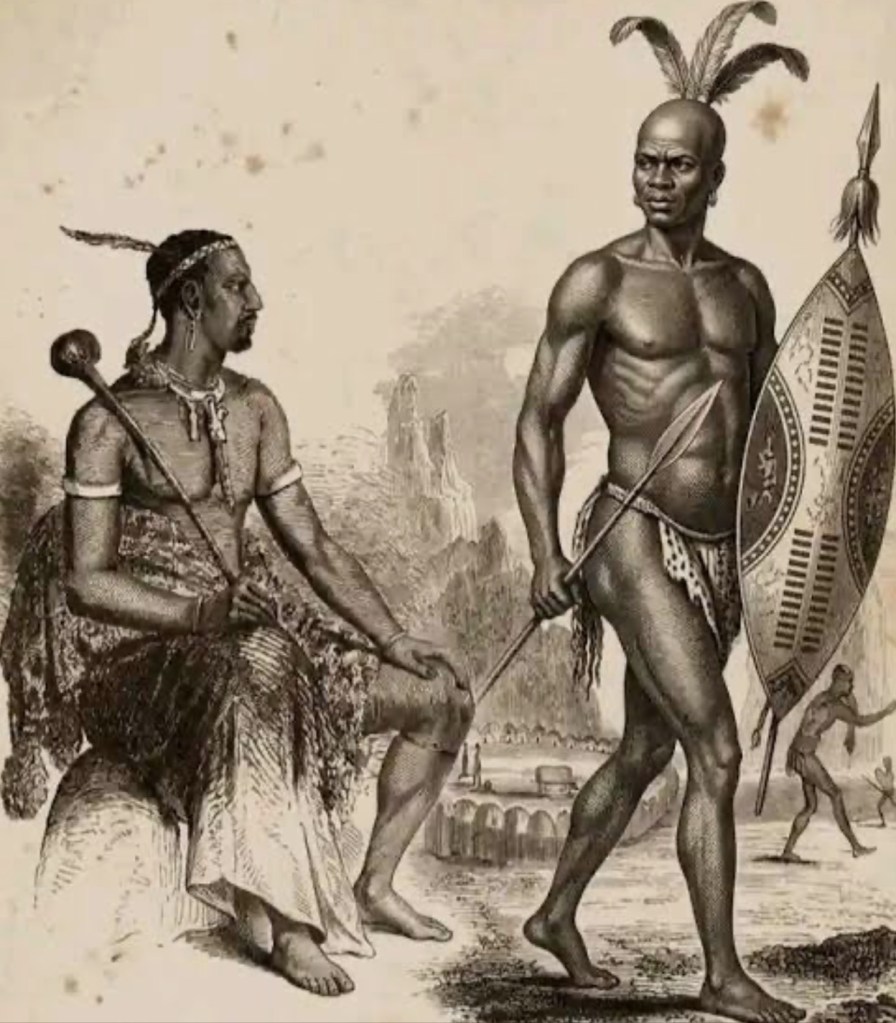
Pressure from the clans forming military states in what is now Kwa Zulu Natal as discussed above and raids from Griqua and Korannas from the Cape Colony caused Chief, later King, Moshoeshoe (see left) to lead his Mokoteli clan into the highlands of what is now Lesotho where he welcomed other displaced people and, in time, created the Sotho nation. 39
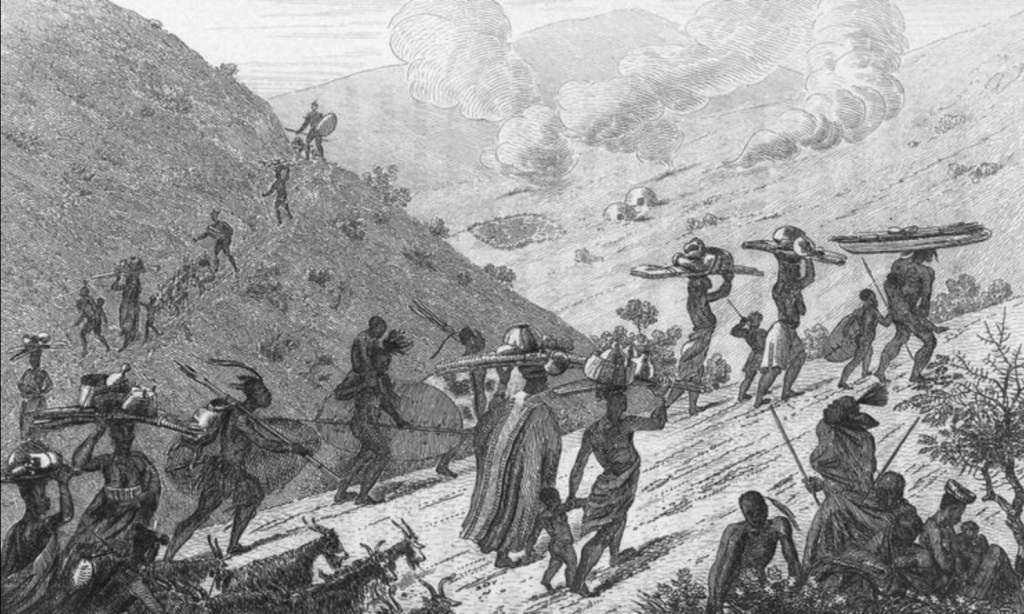
The Makololo under Sebetwane’s leadership were one of many clans who, under the same pressures, made the decision to leave the region. After the loss of most of their cattle to Griqua raiders armed with modern firearms he is alleged to have said to the clan:
“My masters, you see that the world is collapsing. We shall be eaten up one by one. Our fathers taught us peace means prosperity, but today there is no peace, no prosperity! Let us march!” 40
Botswana 1825 to 1840
The Makololo were semi-nomadic, pastoralists, militaristic by nature and led by a warrior chief. In 1823 they joined up with the Bataung and began to raid for cattle, women and children into what is now the Transvaal and Botswana where only the Bangwaketse were strong enough to resist them.
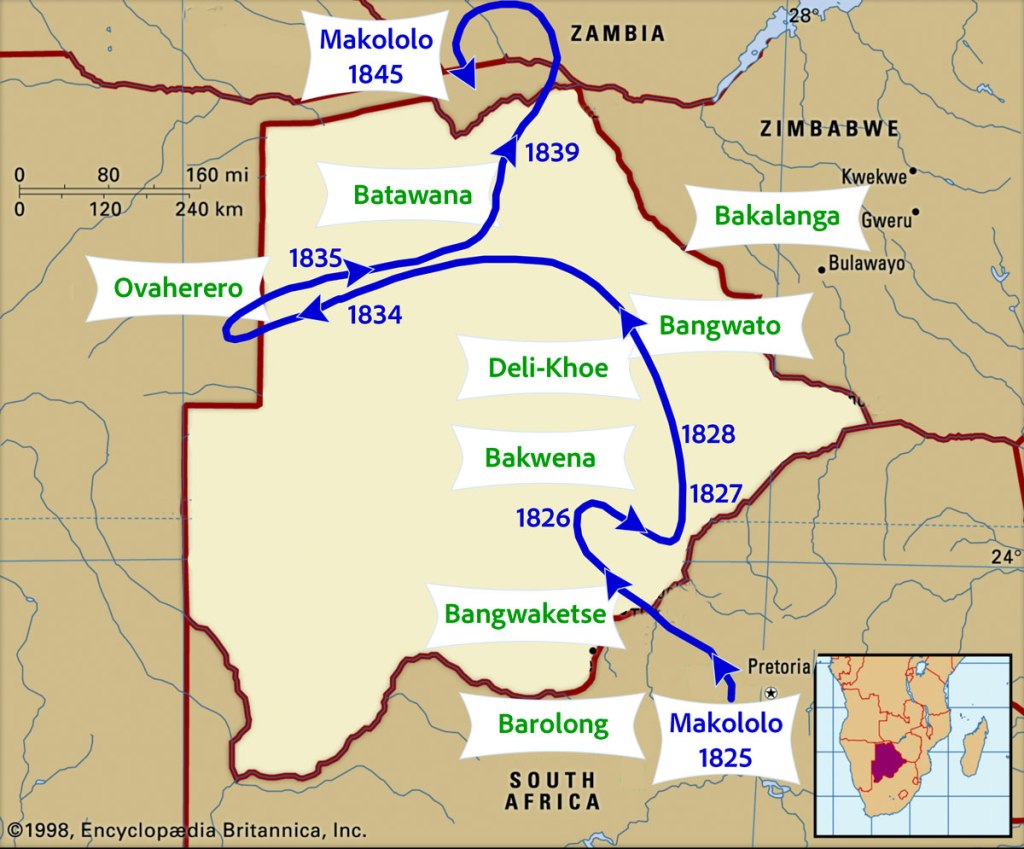
In 1824 the Makololo raided into the Transvaal forcing more displacement but in 1825 they had to leave following the arrival of the more powerful Amandebele (Ndebele) people who had fled the Zulu kingdom. Mzilikazi, their leader, had been one of Shaka’s generals but had fallen out of favour when he refused to give Shaka cattle he had taken in raids against the Sotho clans. When Shaka sent a regiment to explain the error of his ways Mzilikazi quickly left the Zulu Kingdom.
In 1825 the Makololo moved back into Botswana where Sebitwane gained his reputation as “the greatest cattle thief in Botswana history”, 41 In 1826, they engaged in a battle against the combined forces of several Botswana clans where they prevailed but Sebetwane took a severe chest wound from which he never fully recovered. In August of that year they were attacked by the Bangwaketse at Dithubaruba and forced to flee east.
In 1827 after recovering from their defeat the Makololo moved into central Botswana raiding each community they encountered for cattle and captives. By now their activities in the region had set the indigenous clans against each other as chiefdoms who had lost their cattle to Sebetwane looked to restore their wealth by becoming raiders in their own right. The Batswana people were rapidly learning the power of muskets and were now engaging with white traders to acquire their own firearms.
Once again we can see the domino effect of migration with menaces; clans were forced to acquire guns to defend themselves against armed warriors and to achieve this they raided weaker communities to take captives as currency.
In 1830 Sebetwane was forced by the continued resistance of the Batswana people to move further north and raid the Deli Khoe people who were famous for their long-horned cattle. Four years later the Makololo moved into Ngamiland forcing the Batawana people to flee into the Okavango Delta where they joined forces with other displaced clans and were able to resist the invaders.
Sebetwane was desperately in need of more guns; this was still the case when he met Livingstone in 1850 and whilst it is rather played down by the Scottish doctor it is clear that the Makololo, who had been capturing women and children during their time as raiders, had become perennial slavers as this was the trading commodity the Europeans were interested in. In 1834 Sebetwane thought his best hope for increasing his arsenal lay with making contact with the Europeans on the African west coast but when he headed into what is now Namibia he was turned back by the Ovaherero and Naro-Khoe.
He now returned to Botswana’s Ngamiland where he defeated and enslaved the Batawana. In 1840 he finally crossed the Zambezi and turned his attention to conquering western Zambia.
Much of what is now Botswana had been ravaged by Makololo raiding. The status quo had been overturned and the clans weakened in the nearly twenty years that it took Sebetwane to pass through the region. This left them vulnerable to the next wave of invaders, the Amandebele, who had pushed the Makololo into Botswana back in 1825. In 1837 the Amandebele entered southeast Botswana and rampaged through the region for the next two years before settling in pre-colonial Zimbabwe.
Conclusion
Sometime around the end of the 1830s Sebetwane finally left Botswana, crossed the Chobe river and began to carve out a state in, what is now, Zambia’s Southern Province.
Sebetwane had led his people from the Orange river to what is now Zambia. They were refugees from slavers, raiders and empire builders but had evolved into a warrior band who fought their way northeast looking for land to settle. As they went they raided for cattle, women and children to grow the clan and to replace their losses. Other refugees joined them and by the time they reached Zambia they were a multi-lingual group who Sebetwane had somehow forged into a clan, the Makololo.
There story didn’t end there and I will endeavour to continue it in one or two more posts.
Appendix 1 – Dingiswayo
Tradition tells us that Dingiswayo was born in around 1770 and originally named Godongwana or Ngodongwa. His father was a Nguni chief whom Godongwana, as he was then known, attempted to overthrow sometime in the first decade of the 19th century. He failed but escaped to become a fugitive wandering the bush in what is now Kwazulu Natal.
The story goes that he met an armed and mounted European** making his way to Delagoa Bay with whom he travelled for some time. Near the mouth of the Thukela River Godongwana heard news of his father’s death and that his brother, Mawewe, had assumed the Chiefdomship He decided to return to his home leaving the European to proceed on his own. Allegedly, and presumably soon after they separated, the European was murdered by local tribesmen and somewhat coincidentally and miraculously Godongwana acquired his horse and gun.
Mounted and equipped with the foreigner’s weapon Godongwana returned to his clan, ousted his brother and became Chief. He subsequently renamed himself Dingiswayo, one in distress, to ensure his people remembered the hard times he had endured before becoming their leader.
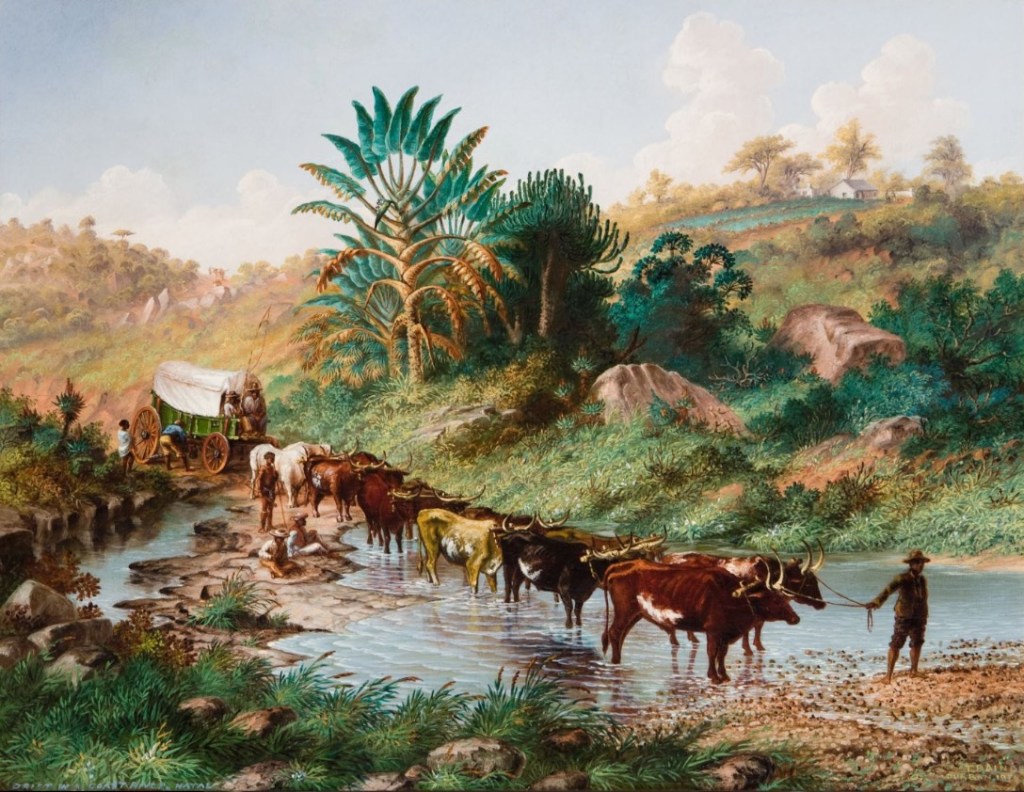
** The much repeated story is that the European was Dr Andrew Cowan of the British 83rd Regiment who left Cape Town in 1808 (not 1806 as usually stated) leading a well equipped expedition with the aim of reaching Delagoa Bay. The expedition force included three other Brits including Captain Donovan of the Cape Regiment and two more junior soldiers. They were supported by local guides, Khoikhoi soldiers, and servants and travelled with four wagons. They reached the mission station at Klaarwater where they rested before heading for the Kuruman River and the kraal of Chief Malibongwe, of the baTlhaping people. They sent a last letter from near the Molopo river near present day Mafikeng/Mahikeng but then disappeared. 44
William Burchell undertook a remarkable 7,000 kilometre expedition across southern Africa between 1811 and 1815 (for the full and amazing story of his trek see Three Zebras and Two Rhinos: William J Burchell). He was asked by the authorities in Cape Town to find any evidence he could regarding the disappearance of the Cowans and Donovan expedition and consequently when in 1813 he reached Graaf-Reinet he wrote to Henry Alexander, the Colonial Secretary in Cape Town, to update him on the outcome of his enquiries.
He reported that Cowan’s party had been murdered north of Kuruman in southern Botswana by the Nuakketsi clan. He had learnt of this from the Bachapin and tried to convince the Chief of that clan to provide him with an escort to visit the site of the murder but his request was refused. 45
Much later David Livingstone also mentions the ill-fated Cowans and Donovan expedition. His one and only convert to Christianity, Chief Sechele, told him a story about his Great Grandfather, Mochoasele, meeting two white men dying of fever in the country near the Limpopo river. The clan’s rainmakers, revered spiritual leaders, were concerned that the dead white men’s wagons might prevent the rains and ordered that they were thrown into the river. Livingstone, certain that these men were indeed Cowans and Donovan, writes that he met the chief of that village who remembered, as a boy, eating the white men’s horses which he recalled tasted like Zebra. 46
Whichever story is true it seems very unlikely that it was Dr Cowans that Godongwana / Dingiswaayo met south of the Thukela river on the coast of the Indian Ocean.
Footnotes
- A.J.Johnson’s 1866 Map of Africa Johnson-1866 ↩︎
- John McCracken (2012) A History of Malawi 1859-1966. Woodbridge, Suffolk: John Currey ↩︎
- David Livingstone (1857) Missionary Travels and Researches in South Africa. London: John Murray ↩︎
- George Martelli (1972) Livingstone’s River. Newton Abbot: Victorian and Modern History Book Club ↩︎
- South Africa, Zulu Warrior 1882 from British Library Zulu-Warrior ↩︎
- Nathaniel Isaacs (1836) Travels and adventures in eastern Africa, descriptive of the Zoolus, their manners, customs, etc. etc. with a sketch of Natal. London: Edward Churton ↩︎
- Nathaniel Isaacs met King Shaka (or Chaka) in 1825. He described him:
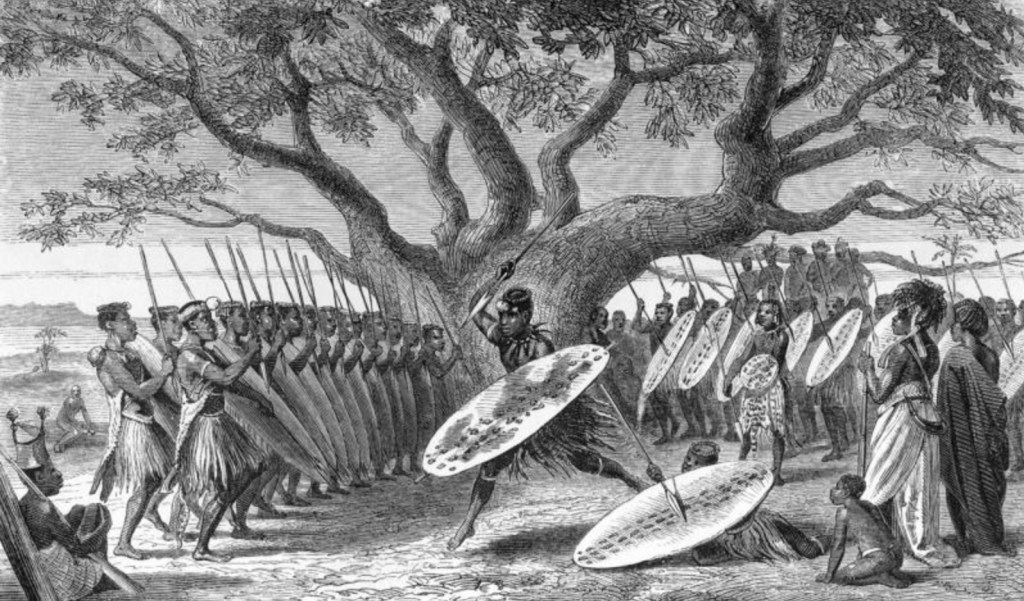
“We now expressed a wish to see him in his war dress; he immediately retired, and in a short time returned attired : his dress consists of monkeys’ skins, in three folds from his waist to the knee, from which two white cows’ tails are suspended, as well as from each arm ; round his head is a neat band of fur stuffed, in front of which is placed a tall feather, and on each side a variegated plume. He advanced with his shield, an oval about four feet in length, and an umconto, or spear, when his warriors commenced a war song, and he began his manoeuvres. Chaka is about thirty-eight years of age, upwards of six feet in height, and well proportioned 8 ↩︎ - Julian Cobbing (1988) The Mfecane as Alibi: Thoughts on Dithakong and Mbolompo Cobbing-1988 ↩︎
- Daphna Golan offers an extensive essay on the myths and clichés that are contained in the stories we are told of Shaka and his impis. Carolyn Anne Hamilton (1992) The Character and Objects of Chaka’: A Reconsideration of the Making of Shaka as ‘Mfecane’ Motor Hamilton-1992 ↩︎
- Donald R. Morris (1965) The Washing of the Spears: The Rise and Fall of the Zulu Nation. London: Jonathan Cape. ↩︎
- Magma M. Fuze (1922) Abantu Abamnyama or The Black People and Whence They Came. Translated by H.C.Lugg and edited by A.T.Cope. Pietermaritzburg: University of Natal Press ↩︎
- Elizabeth A Eldredge (2004) The creation of the Zulu kingdom, 1815-1828: War, Shaka, and the consolidation of power. Cambridge: Cambridge University Press ↩︎
- Norman Etherington (2004) A Tempest in a Teapot? Nineteenth-Century Contests for Land in South Africa’s Caledon Valley and the Invention of the Mfecane Etherington-2004 ↩︎
- Etherington (2004) ↩︎
- Etherington (2004) ↩︎
- Jan van Riebeeck arrives in Table Bay in April 1652, painted by Charles Davidson Bell – National Library of South Africa ↩︎
- According to the Portuguese a chiefdom they called the Tembe was established at Delagoa Bay in 1550. See: Elizabeth A Eldredge and Fred Morton (Editors) (2019) Slavery in South Africa: Captive Labour on the Dutch Frontier. London & New York: Routledge. ↩︎
- Kloppers (2003) ↩︎
- In Magomero, Landeg White’s beautiful description of the evolution of a Malawian village over a period of 126 years, there are several examples of women seeking protection for themselves and their children by willingly joining people that one might call their captors. In practice many men and women joined the early mission for food, shelter and a sense that the missionaries would protect them. Later, describing the time long after the mission had left, White talks of people being accepted into the village society and the dominant tribe based on their clan names. Landeg White (1987) Magomero: Portrait of an African Village. Cambridge: Cambridge University Press. ↩︎
- John Wright (2001) Political Transformations in the Thukela-Mzimkhulu Region in the Late Eighteenth and Early Nineteenth Centuries. Published in The Mfecane Aftermath: Reconstructive Debates in Southern African History (2001) Edited by Carolyn Hamilton. Johannesburg: Witwatersrand University Press & Pietermaritzburg: University of Natal Press. ↩︎
- The story goes that when Dingiswayo was a fugitive hiding from his father he met a European on his way to Delagoa Bay and somehow, after the European’s demise, acquired his horse and gun. This introduction to European technology not only helped him overthrow his father and become King of the Mtetwa but inspired him to forge a relationship with the Portuguese at Delagoa Bay and encourage his people to trade with the Europeans. ↩︎
- HMS-Amazon ↩︎
- Stephen Middlehurst (2025) The Royal Navy and the East African Slave Trade 1808 to 1853 Middlehurst-West-African-Squadron ↩︎
- Western and Eastern slave trades, 7th to 19th centuries. Slave-trades-map ↩︎
- King Dingiswayo’s Memorial Dingiswayo-Grave ↩︎
- Donald R. Morris (2026) Shaka, Zulu Chief. Morris-2026 ↩︎
- Morris (1965) describes battles where Shaka fought whilst serving in Dingiswayo’s army. The strategy was to brutally suppress the first local clans that were added to the confederacy so that more distant clans recognised that resistance was futile. ↩︎
- Issac Samuel (2023) Guns and Spears: a military history of the Zulu kingdom. Samuel-Zulus-2023 ↩︎
- Donald R. Morris (1965) The Washing of the Spears: The Rise and Fall of the Zulu Nation. London: Jonathan Cape. ↩︎
- There is endless debate about how many people were exported from east Africa as slaves. Some estimates put the number around 9 million and some, including Tidiane N’Diaye, a Senegalese anthropologist, believe it was at least 17 million. How many more died during slave raids, the long marches to the coast, in primitive castration centres or in the holds of slaving ships is perhaps beyond estimate and certainly beyond comprehension. ↩︎
- Cape Town Museum – Enslaved Lives Cape-Town-Museum- Enslaved-Lives ↩︎
- Cape Town Museum – Enslaved Lives Cape-Town-Museum- Enslaved-Lives ↩︎
- Elizabeth A Eldredge (2019) Slave Raiding Across the Cape Frontier. London & New York: Routledge. ↩︎
- Cape Town Museum – Enslaved Lives Cape-Town-Museum- Enslaved-Lives ↩︎
- Eldredge (2019) ↩︎
- W. Edward Oswell (1900) William Cotton Oswell: Hunter and Explorer, The Story of his Life Volume 1 Edward-Oswell-1900 ↩︎
- Oswell (1900) ↩︎
- J. Ramsey, B. Morton & T. Mgadia (1996) Building a Nation: A History of Botswana from 1800 to 1910. Gaborone: Longman Botswana. Ramsey_and_co_Botswana ↩︎
- The story of King Moshoeshoe (1796 – 1870) is remarkable and worth researching. He forged a state in the mountains of Lesotho that resisted, not just slave raiders, but the Boers and the British. ↩︎
- Ramsey & co. ↩︎
- Walima Kalusa (2023) The Kololo Kingdom in the Upper Zambezi. Kalusa-Kololo-Kingdom ↩︎
- South African Military History Mfecane Mfecane-Kololo ↩︎
- Graham Leslie McCallum (2016) Iconic Themes – The Cape Wagon – A Pictorial Trek. McCallum-Cape-Wagons ↩︎
- Hazel Crampton (2012) The Explorer Who Got Lost: Dr Andrew Cowan’s Journal Found Crampton-2012 ↩︎
- Roger Stewart & Marion Whitehead (2022) Burchell’s African Odyssey. Cape Town: Struik Nature. ↩︎
- Livingstone (1857) ↩︎
Other Sources and Additional Reading
- David Livingstone (1857) Missionary Travels and Researches in South Africa. London: John Murray
- Donald R. Morris (1965) The Washing of the Spears: The Rise and Fall of the Zulu Nation. London: Jonathan Cape.
- Magma M. Fuze (1922) Abantu Abamnyama or The Black People and Whence They Came. Translated by H.C.Lugg and edited by A.T.Cope. Pietermaritzburg: University of Natal Press.
- Carolyn Hamilton [Editor] (2001) The Mfecane Aftermath: Reconstructive Debates in Southern African History. Johannesburg: Witwatersrand University Press & Pietermaritzburg: University of Natal Press.
- Elizabeth A Eldredge (2004) The creation of the Zulu kingdom, 1815-1828: War, Shaka, and the consolidation of power. Cambridge: Cambridge University Press
- Elizabeth A Eldredge (1991) Sources of Conflict in Southern Africa ca 1800-1830 – The Mfecane Reconsidered. University of Witwatersrand. Eldredge-1991
- E.K.Mashingaidze (1989) The Impact of the Mfecane on the Cape Colony. Mashingaidze-1989
- Elizabeth A Eldredge and Fred Morton (Editors) (2019) Slavery in South Africa: Captive Labour on the Dutch Frontier. London & New York: Routledge.
- Linell Chewins and Peter Delius (2020) The Northeastern Factor in South African History: Reevaluating the Volume of the Slave Trade out of Delagoa Bay and its Impact on its Hinterland in the Early Nineteenth Century. Chewins-Delius-Delegoa-Bay-Slave-Trade
- J. Ramsey, B. Morton & T. Mgadia (1996) Building a Nation: A History of Botswana from 1800 to 1910. Gaborone: Longman Botswana. Ramsey_and_co_Botswana
- Walima Kalusa (2023) The Kololo Kingdom in the Upper Zambezi. Kalusa-Kololo-Kingdom
- Janet Wagner Parsons (1997) the Livingstone’s at Kolobeng 1847 -1852. Gaborone: The Botswana Society and Pula Press
- George Martelli (1972) Livingstone’s River. Newton Abbot: Victorian and Modern History Book Club
- John McCracken (2012) A History of Malawi 1859-1966. Woodbridge, Suffolk: John Currey
- Thomas Pakenham (1991) The Scramble for Africa. London: Abacus
- Christopher Ehret (2023) Ancient Africa: A global History to 300 CE.Princetown: Princetown University Press.
- Frank Johnston & Sandy Ferrar (2006) Malawi, the Warm Heart of Africa. Cape Town: Struick Publishers
- Simon Beecroft & Laurie Sandsford (Editors) (2024) Africa: the Definitive Visual History of a Continent. London: DK Pengiun Random House
- Richard Gray & David Birmingham (editors) (1970) Pre-Colonial African Trade: Essays on Trade in Central and Eastern Africa before 1900. London: Oxford University Press. Gray-1970
- Shadreck Chirkure (2017) Documenting Precolonial Trade in Africa Shadreck-Chirkure-2017
- Henry W. Langworthy (1970) Understanding Malawi’s Pre-Colonial History. Henry-Langworthy-1970
- Kings M. Phiri (1982) Traditions of Power and Politics in Early Malawi: A Case Study of Kasungu District from about 1750 to 1933. Kings-Phiri-1982
- Brian Morris (2006) the Ivory Trade and Chiefdoms in Pre-Colonial Malawi Brian-Morris-2006
- Shadreck Chirikure (2014) Land and Sea Links: 1500 Years of Connectivity Between Southern Africa and the Indian Ocean Rim Regions, AD 700 to 1700 Shadreck-Chirikure-2014
- Attati Mpakati (1973) Malawi: The Birth of a Neo-Colonial State Attati- Mpakati- 1973
- B.A. Ogot (editor) (1992) General History of Africa V: Africa from the Sixteenth to the Eighteenth Century. Ogot-1992
- Edward Thomas James (2025) A World Enslaved: The Untold Story of Slavery 1200 – 1700. United Kingdom: Amazon.
- Oliver Ransford (1966) Livingstone’s Lake. London: John Murray
- Landeg White (1987) Magomera: Portrait of an African Village. Cambridge: Cambridge University Press.
- Donald Simpson (1975) Dark Companions: The African Contribution to the Eurpean Exploration of Africa. London: Paul Elek
- W.D.Gale (1958) Zambezi Sunrise. Cape Town: Howard B Timmins.
- L. Monteith Fotheringham (1891) Adventures in Nyasaland: A Two Years’ Struggle with Arab Slave Dealers in Centrasl Africa. London: Sampson Low. Republished as a British Library Historical Print Edition.
- Fred L.M. Moir (1923) After Livingstone: An African Trade Romance. London: Hodder and Stoughton Fred-Moir=1923
- Sir Harry H. Johnston (1898) British Central Africa: An Attempt to Give Some Account of a Portion of The Territories Under British Influence North of the Zambezi. London” Methuen & Co. Harry-Johnston-1898
- Sir Harry H. Johnston (1905) A History of the Colonisation of Africa by Alien Races. Cambridge: University Press. Harry-Johnston-1905
- Alfred J. Swann (1910) Fighting the Slave Hunters in Central Africa. Philadelphia: J.B.Lippincott Company Alfred-Swann-1910
- Bridglal Pachia (1973) Malawi: The History of the Nation Pachia-1973
- Alexander J. Hanna (1956) The beginnings of Nyasaland and North-eastern Rhodesia, 1859-95. Oxford: The Clarendon Press. Alexander-Hanna-1956
- Frederick D. Lugard (1893) The Rise of our East African Empire: Early Efforts in Nyasaland and Uganda. Frederick-Lugard-1893
- James William Jack (1900) Daybreak in Livingstonia: The Story of the Livingstonia Mission, British Central Africa. James-Jack-1900
- J. Frederic Elton (1879) Travels and Researches Among the Lakes and Mountains of Eastern & Central Africa. London: John Murray. Frederic-Elton-1879
- Stephen Samuel (1922) A Handbook of Nyasaland. Zomba: The Government of Nyasaland. Samuel-1922
- W. Henry Rankine (1896) A Hero of the Dark Continent: Memoir of Rev. W.M. Affleck Scott, Church of Scotland Missionary at Blantyre, British Central Africa. Henry-Rankine-1896
- A. St. H. Gibbons (1898) Exploration and Hunting in Central Africa 1895-96. London: Methuen. Gibbons-1898
- Kings M Phiri (1984) Yao Intrusion into Southern Malawi, Nyanja resistance and Colonial Conquest 1830 -1900. Kings-Phiri-1984
- Erin Rushning (2013) David Livingstone and the Other Slave Trade, Part II: The Arab Slave Trade Erin-Rushning-2013
- David Livingstone (1865) A Popular Account of Dr. Livingstone’s Expedition to the Zambesi and its Tributies: and the Discovery of Lakes Shirva and Nyassa 1858 – 1864. Accessed at Project Guttenberg’s 2001 edition. David-Livingstone-1865
- Henry Rowley (1866) The Story of the Universities Mission to Central Africa, from its commencement, under Bishop Mackenzie, to its withdrawal from the Zambezi. London: Saunders, Otley, and Co. Henry-Rowley-1866
- James Tengatenga (2013) The Legacy of Dr. David Livingstone. James-Tengatenga-2013
- I.C.Lamba (1978) British Commerce as an Anti-Slavery Device in Malawi in the 1870s amd 1880s: A Study in Miscalculated Strategy. Lamba-1978
- Owen J.M. Kalinga (1980) The Karonga War: Commercial Rivalry and Politics of Survival Owen-Kalinga-1980
- John G. Pike (1965) A Pre-Colonial History of Malawi John-Pike-1965
- R.B.Boeder (1979) Sir Alfred Sharpe and the Imposition of Colonial Rule on the Northern Ngoni Boeder-1979
- Timothy John Lovering (2002) Authority and Identity: Malawian Soldiers in Briain’s Colonial Army 1891-1964. Lovering-2002
- James Johnston (1893) Reality versus Romance in South Central Africa. New York: Fleming H. Revell Company. James-Johnston-1893
- Captain H. A. Fraser, Bishop Tozer & James Christie (1871) The East African Slave Trade and the Measures Proposed for its Extinction. London: Harrison. Fraser-1871
- Linell Chewins (2023) The Imperialist Dream of João Albasini, a Portuguese Trader in South-East Africa, 1847–1870 Chewins-2023
- Linell Chewins (2020) The Northeastern Factor in South African History: Reevaluation the Volume of the Slave Trade out of Delagoa Bay and its Impact on its Hinterland in the Early Nineteenth Century. Chewins-2020
- Anjuli Webster (2024) Inter-Imperial Entanglement: The British Claim to Portuguese Delagoa Bay in the Nineteenth Century Webster-2024
- Nosipho Majeke (2016) Triumph of disunity: The Griqua Nation Majeke-2016
- Eric Flint (1970) Trade and Politics in Barotseland during the Kololo Period Flint-1970
- Walima Kalusa (2009) Elders, Young Men, and David Livingstone’s “Civilizing Mission”: Revisiting the Disintegration of the Kololo Kingdom, 1851-1864 Kalusa-2009


I would appreciate hearing your thoughts on this subject.