- George Fleming 1802 to 1879
- William Cotton Oswell 1818 to 1893
- George Fleming’s Travels with Livingstone
- The Lake Ngami Expedition 1849
- Oswell’s Fourth Expedition 1850
- The 1851 Expedition to King Sebetwane
- John Thomas and a Final Word on Oswell
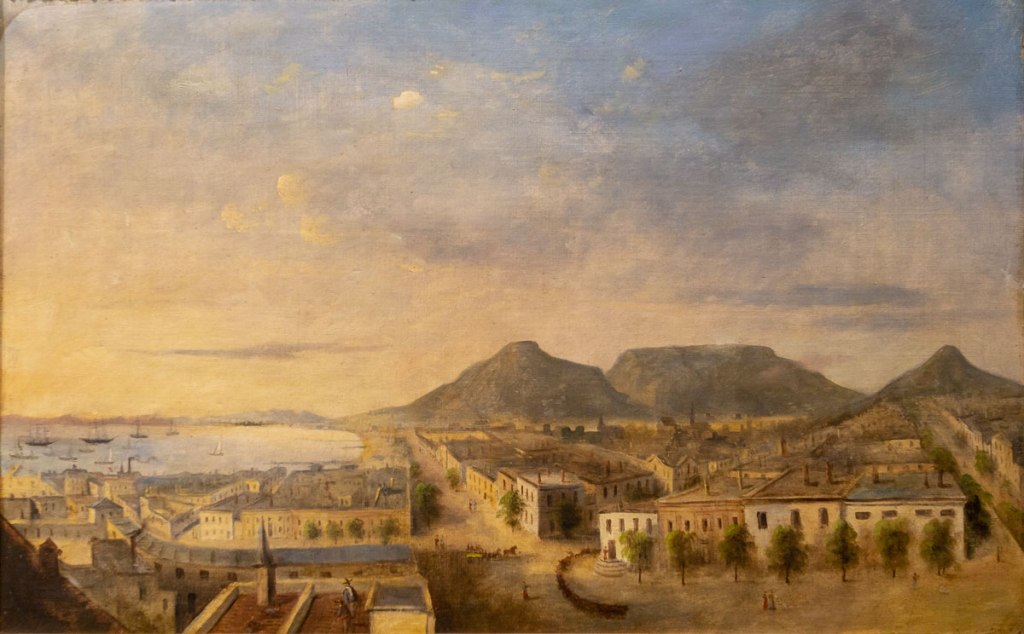
- Cape Town to Kuruman
- On Towards Linyanti
- One Last Mission in 1856
- Remembering George Fleming
- Later Life
- Appendix I – The Batswana-Boer War
- Footnotes
- Other Reading
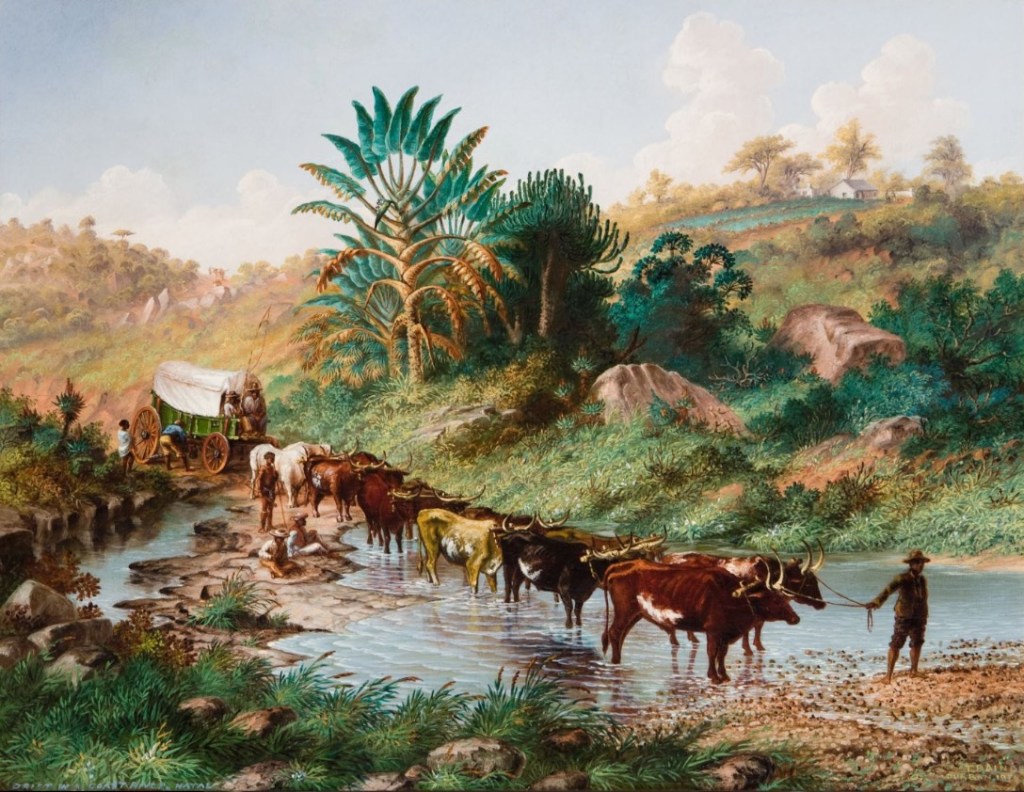
George Fleming 1802 to 1879
In the context of putting names to people that have generally been ignored by historians it is worth taking a closer look at George Fleming, an African American who Livingstone said had been a slave and who, at different times in the mid-19th century, was an expedition cook, an explorer and a long-distance trader in Southern and Central Africa.
Fleming is an intriguing character. He was one of the very earliest Americans, perhaps the very first, to take part in expeditions to explore the African interior. 1
We know very little about George Fleming the person and the little we know of his past is hearsay. In a letter to his brother Charles in 1853 Livingstone writes:
“George ……. is an American or perhaps was for he calls himself a West Indian, for there, freedom was proclaimed to the slave and I suspect he once was one.” 2
On his marriage certificate he stated that he had been born in Grenadia (Grenada) in the West Indies on the 1st January 1802 3 but Livingstone is suggesting that calling himself a West Indian is a convenient explanation for how an African American came to be a free man at a time when slavery was still common practice and legal in the United States.
We know the colour of his skin but not what he looked like, whether he was short or tall, plump or skinny, quiet or gregarious. We are told he was an “excellent cook”. 4
However, we do know with a remarkable degree of accuracy where he was and what was happening around him for over ten years of his life because some of the people he travelled with wrote down, often with obsessive detail, what they saw; which of course, is mostly what he saw.
He witnessed significant moments in history, he knew and became friends with some of the most famous men of his age, he met kings, queens and princes and was the first non-African to visit landmarks that only a handful of Europeans and quite probably no other American saw at any point in the same century in which he lived.
I believe that he was the very first American explorer of the African interior and it must have been many decades before the next black American canoed the Zambezi, drank water from Lake Ngami, crossed the Kalahari or saw Mosi-oa-Tunya. 5
It is generally thought that Fleming was born in 1801 but we know next to nothing of his life until 1848. It is possible that he was a ex-seaman living in the established community of black sailors that had grown up around Simon’s Town at the Cape. This community comprised “Siddees” or “Sidhis” who arrived from East Africa, the Seychelles and Zanzibar as freed slaves or indentured labour, and off Royal Navy ships where they served in a variety of roles..
They mixed in with Kroomen, freemen from West Africa with a long history of serving on British warships. The British Admiralty had employed Kroomen at Simon’s Town since 1838 when the first West African Kru people were landed there from HMS Melville. (For more about these people see The Bombay Africans)
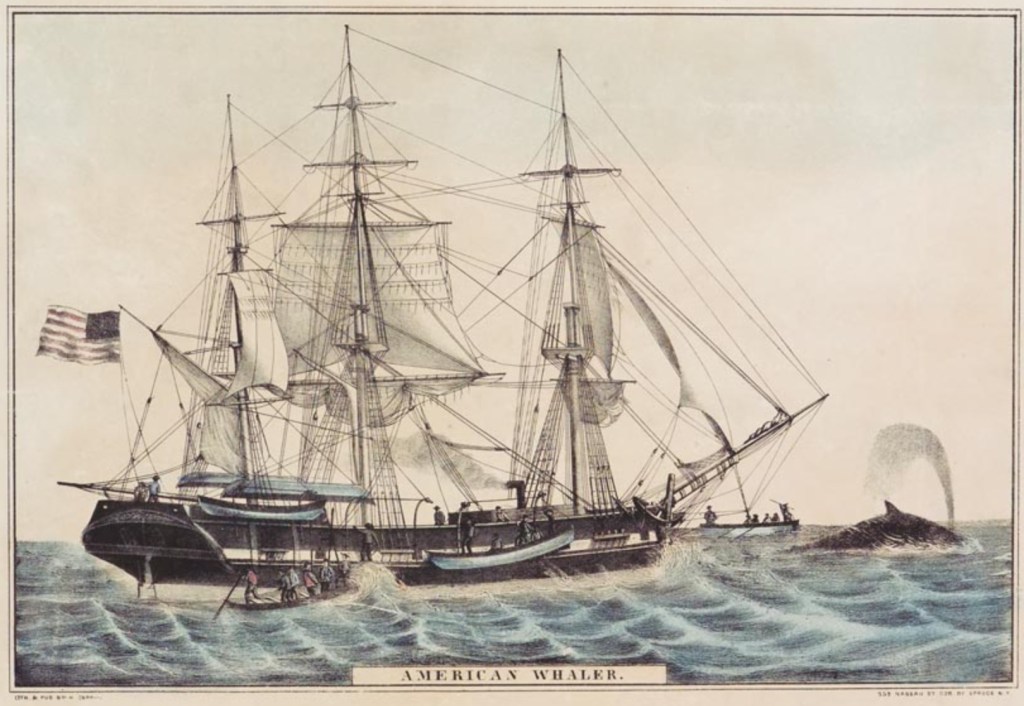
Fleming had possibly arrived in Africa on an American whaling ship given that in the 1840’s over 700 whaling ships hailed from the United States representing around 80% of all the whalers afloat anywhere in the world. 7
In the early 19th century hundreds of these ships stopped at Simon’s Town every year to resupply on their way to and from the Pacific Ocean.
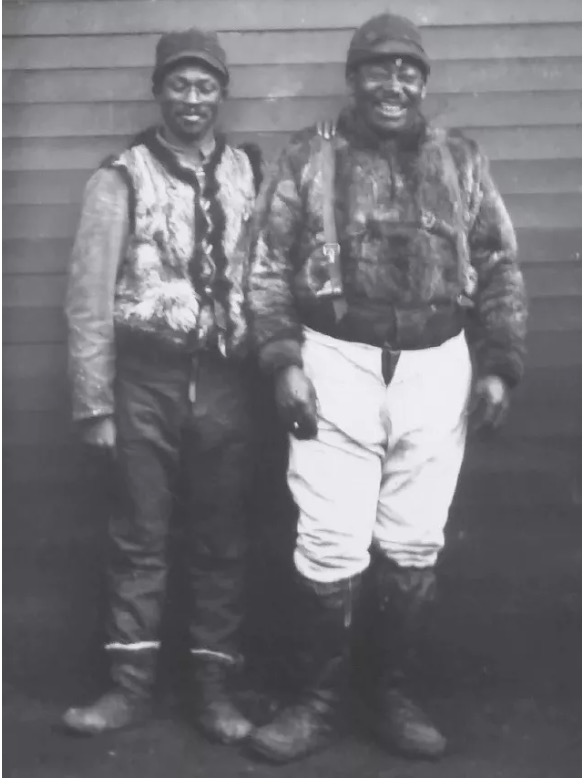
Up to 40% of the crews were black and there were, at least, 64 black captains. 8
This seems a likely way for a liberated or escaped American slave to have arrived in Africa.
Right: Black American whalers 9
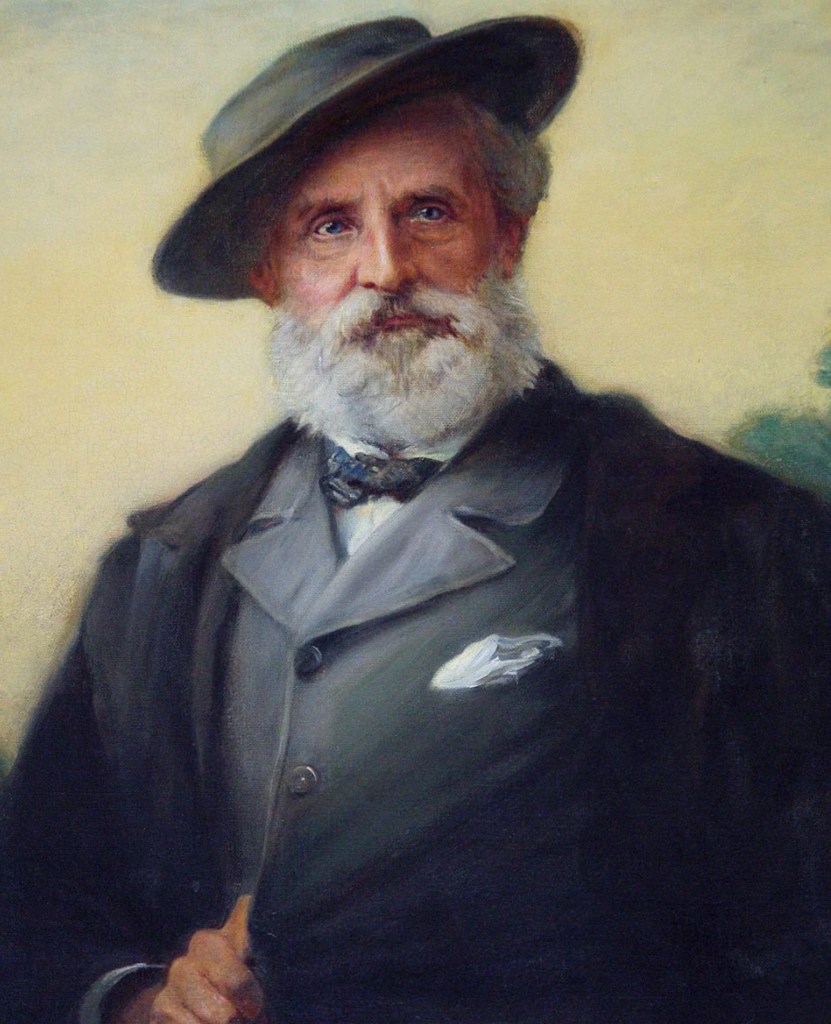
The first documented reference to Fleming is contained in the “rough notes” 10 kept by the hunter and explorer William Cotton Oswell 11 regarding his third expedition to Africa.
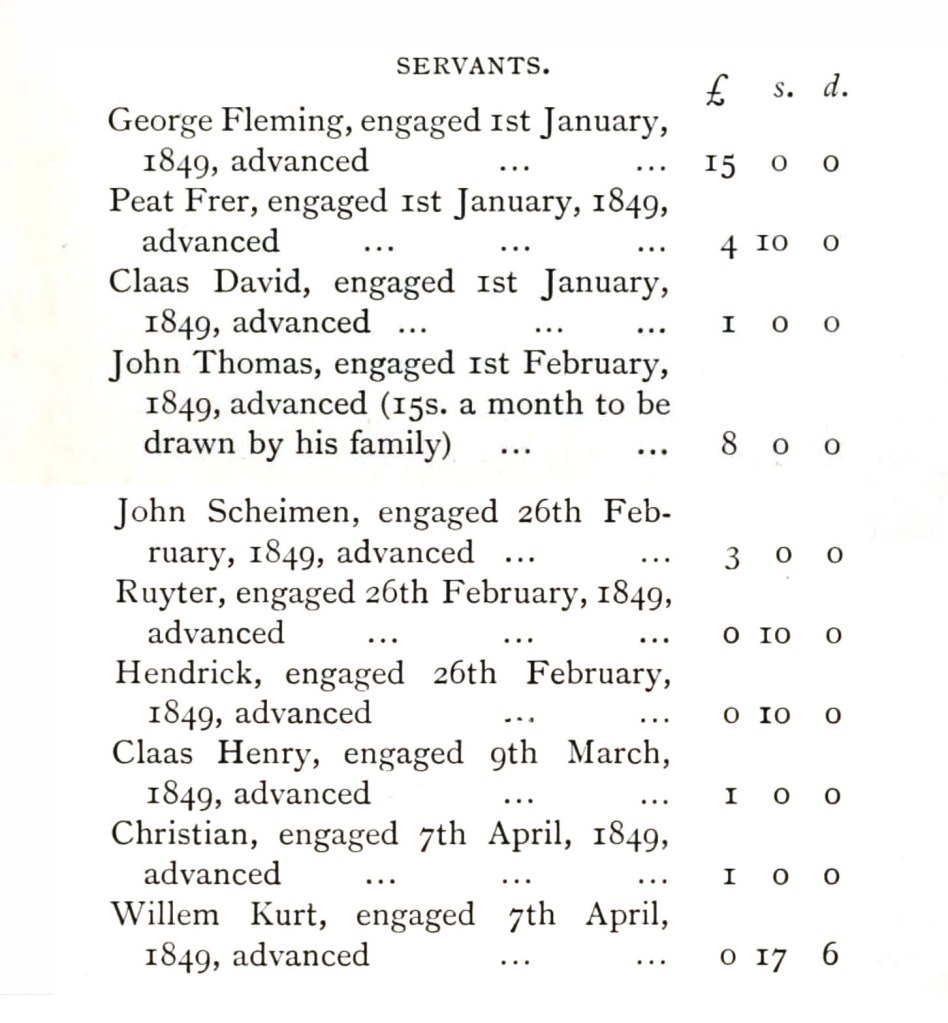
On 1st January 1849 he notes that he hired George Fleming as his expedition cook, advancing him £15. But he probably knew him as early as 1844.
Right” William Cotton Oswell 12
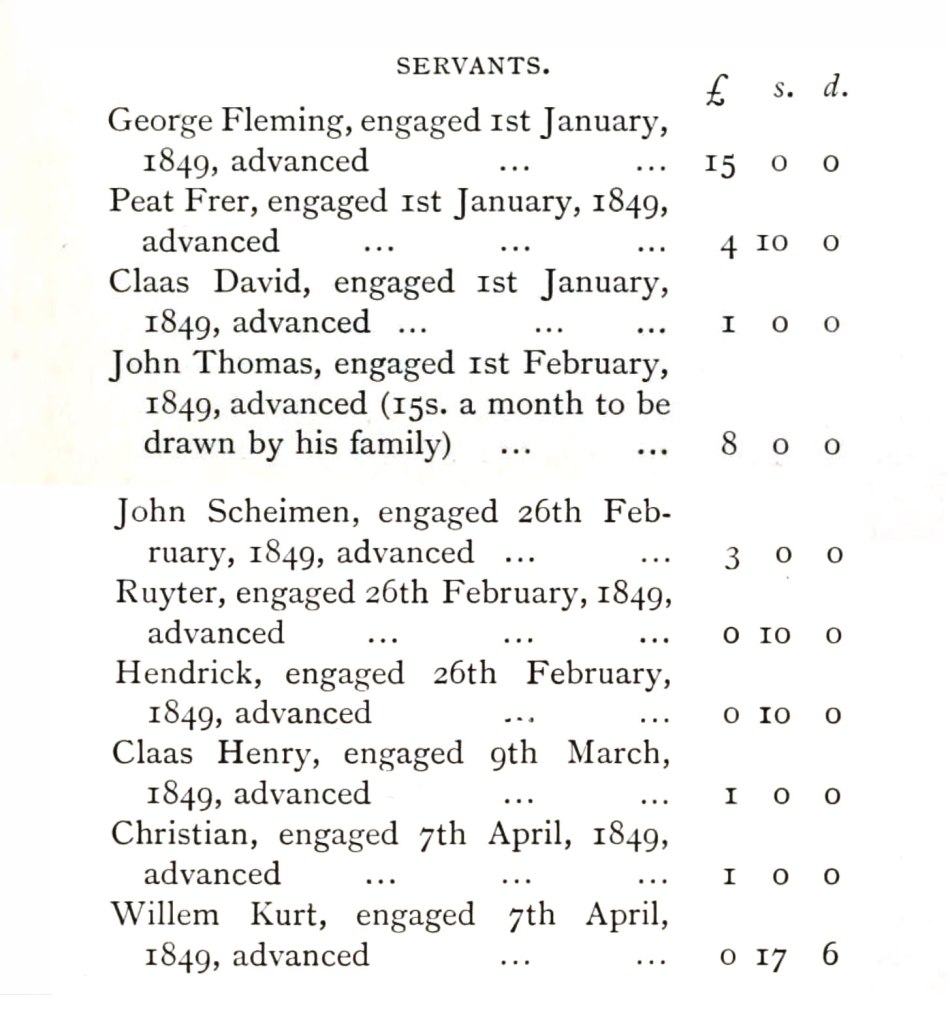
These types of lists are rare and are one of the few sources that allow us to put names to African porters and servants. Because these men were recruited in Cape Town they have deceptively European names. but we already know that George Fleming was black and John Thomas, a black African, is the best documented of Oswell’s servants and someone we will mention again later.
Oswell is a key figure in Fleming’s story.
William Cotton Oswell 1818 to 1893
Born at Leytonstone in the county of Essex on 27th April 1818 and known as Cotton to his friends William Cotton Oswell, if not for his modesty and unwillingness to sit down and write his memoirs, might have become as well known as Burton, Speke, Livingstone and the other Victorian explorers who shared a common skill in self publicity. We know of him from Livingstone’s letters, journals and books and his son published some of his correspondence in 1900. He did write an extended essay for a hunting journal when in his seventies which is helpful but mostly focusses on how he shot, so called, big game and repeatedly escaped from being eaten by lions. 15
His father died in 1822 leaving William’s mother, Emily, with four daughters and two sons. Tragically all four of William’s sisters died young and his distraught mother was saved from penury by the kindness of her father and brother who took responsibility for her and her sons. Her brother Benjamin became a surrogate father and helped Emily raise two boys who became known as well mannered and charming.
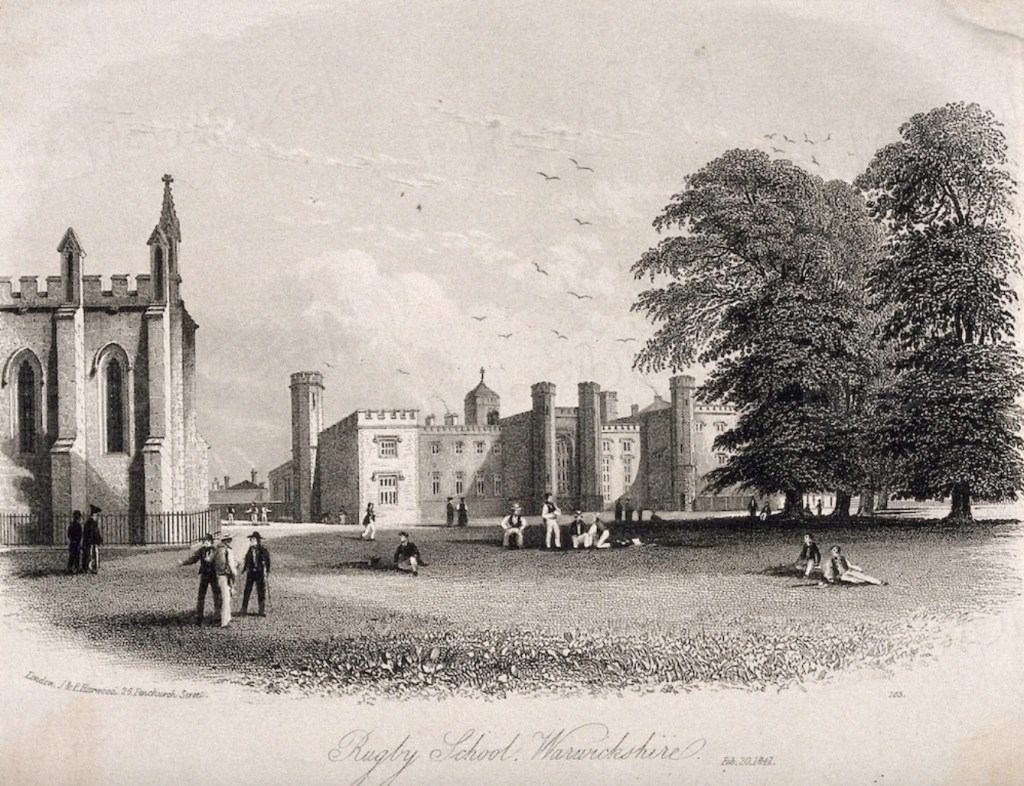
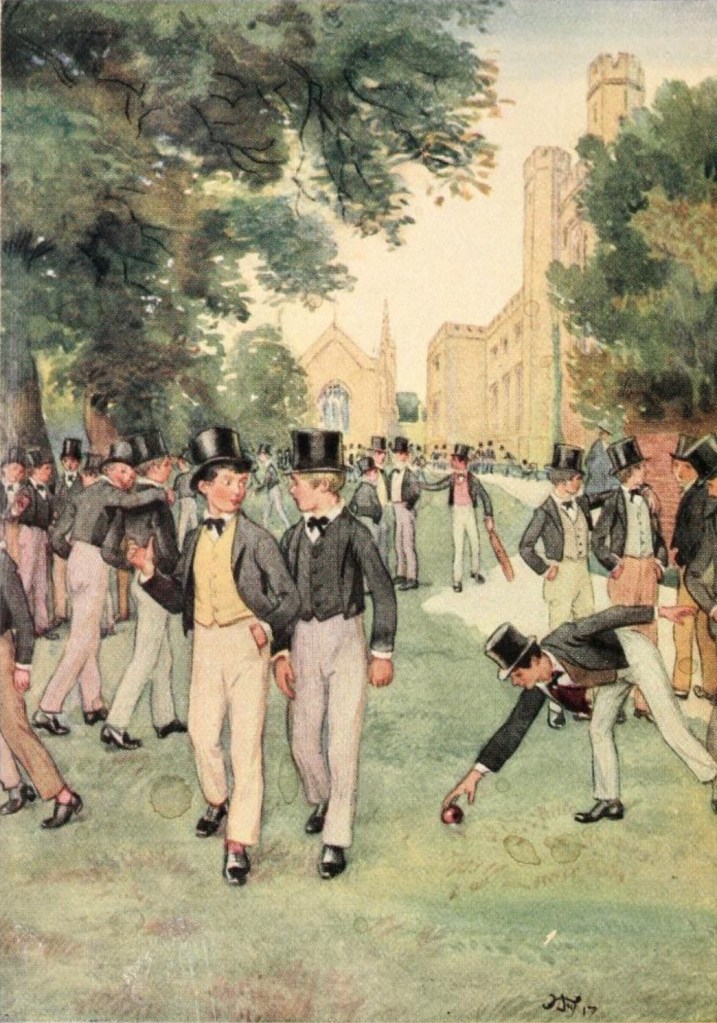
In 1833 William, already an accomplished cricketer, passed the entry exam and gained entry to Rugby School just five years ahead of Tom Hughes, the author of Tom Brown’s School Days, who was one of many junior boys who looked up to Oswell.
Right: an illustration from Tom Brown’s Schooldays 16

In later life Tom Hughes said of Oswell:
“It was the rare mixture of kindliness and gentleness with marvellous strength, activity and fearlessness which made him facile princeps (easily first or acknowledged leader) among his contemporaries. I don’t believe he ever struck a small boy or even spoke to one in anger.
No doubt his good looks added to the fascination, he stood six feet high in his stockings when he left school at eighteen, but did not look his height from the perfection of his figure – broad in shoulders, thin in flank, and so well developed he was called ‘The Muscleman’” 18
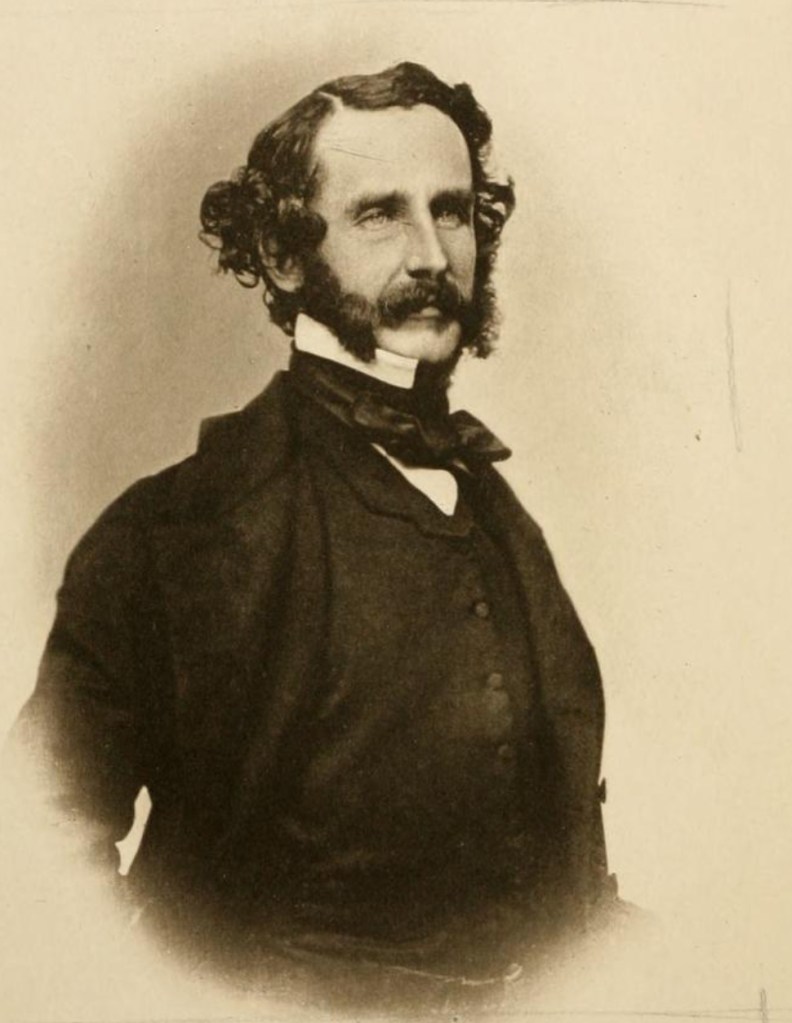
Sir Samuel Baker described him as:
“The perfection of a Nimrod. Six feet in height, sinewy and muscular, but nevertheless light in weight, he was not only powerful but enduring. A handsome face, with an eagle glance, but full of kindliness and fearlessness…… He was a first rate horseman, and his shooting was from the saddle, or by dismounting for the shot after he had run his game to bay.” 19
Left: William Cotton Oswell as a young man 20
After school another uncle, also called William , a Director at the Bank of England, secured him a post with the Honourable East India Company. He trained for eleven months at their college at Haileybury before leaving England in September 1837 to take up a post in India where he achieved the ranks of “Collector” and “Judge” and where he remained until 1844. After nearly dying from severe and multiple bouts of malaria he was given two years’ leave and sent to Cape Town to convalesce .
First African Expedition 1844-45
In Cape Town he joined Mungo Murray, a Scottish hunter from Lintrose and one time Deputy Lieutenant of Perthshire, on a hunting trip north of the Orange River. It was in the course of this expedition that he first met David and Mary Livingstone at their first mission station at Mabotse, a twelve day trek by ox-drawn wagon from Mary’s father’s mission at Kuruman.
They struck up an unlikely friendship as in Oswell’s own words:
“…..he could neither shoot nor ride (except on oxback) – this was not his business. I am afraid he despised the role of a sportsman.” 21
Despite their differences Oswell’s son wrote after his father’s death:
“…. a friendship sprang up between him and Dr. Livingstone which thenceforward until the death of the great missionary, in 1873, never for a moment wavered or faltered.”22
Livingstone provided Oswell and Murray with guides and a headman called Syami to assist them in their journey further north.
“After staying two days with the Rev Mr Livingstone, the best, most intelligent and most modest of the missionaries, and having by his advice taken a direction which led is at first rather to the westward, and eventually to the north east, for three months we revelled in the finest climate, the finest shooting, and anything but tame scenery …. We were fully repaid for our long journey, fort we penetrated further than anyone had done before us.”
An interesting aspect of his first hunting expedition is that he hunts to feed the indigenous people they meet along the way. He is far from the “white hunter, black heart” image of the Victorian hunters and explorers that we are often presented with.
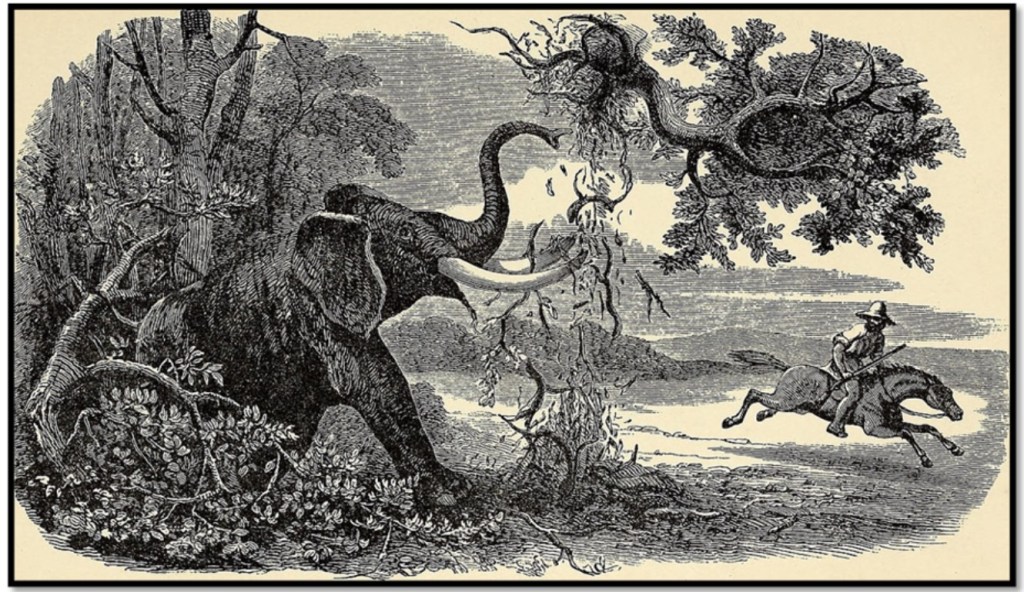
When he reached the Bakaa people, near Kolobeng, he met their chief who greeted them warmly asking why they were in his country. When he heard they were there to hunt he beseeched them take his people with them as they were starting. Oswell and Murray were joined by 600 starving men, women and children who followed them to the hunting grounds where they spent seven weeks slaughtering elephants and rhinoceros. Each Bakaa ate between “12lbs to 15lbs” of elephant meat every day and were soon fattened up with healthly looking skins and a happy disposition.
Oswell and Murray hunted along the Limpopo River before returning to the Cape which they reached in December 1845.
We do not know whether George Fleming was with them on this first expedition but we do know that John Thomas was there as Oswell mentions him in his journal. He describes him as an “Africander” which was a term sometimes used to describe someone of mixed race but probably here means that he was born in Cape Town. He believed him to be the son of slaves and described him as:
“…… a grand specimen of manhood, good nature, faithfulness, and cheerful endurance, I never met his equal, white or black….. Let it be enough to say that he was a perfect servant to a very imperfect master.” 24
He is never given a particular title but accompanied Oswell for five years often acting as a mediator between the black expedition members, who called him “Bono Johnny”, and the white hunters.
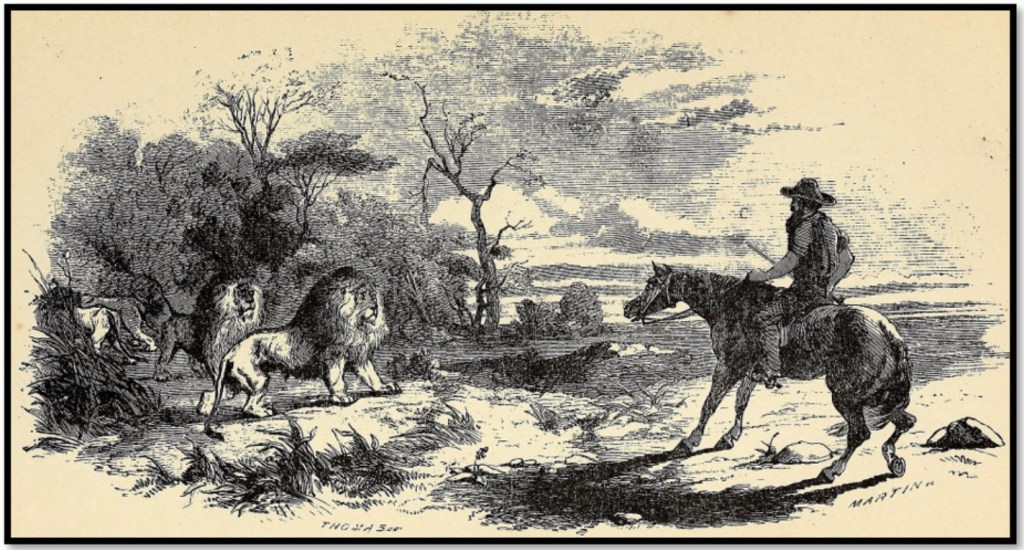
I believe that John Thomas was, amongst other things, Oswell’s gun bearer so, when they were together in Africa, he accompanied him whilst hunting. This would explain the close relationship the two men formed and why Thomas is mentioned in letters and journals.
If Fleming was a wagon driver and the expedition cook he would have spent far less, perhaps very little time with Oswell but the evidence is that Oswell was a man built strong relationships with people and then remained loyal to them. We know that he hired John Thomas in 45, 46 and 48 and we know Fleming was on the 46 and 48 expeditions so it seems highly likely that he was also there in 1845.
Second African Expedition 1846
In March 1846 Oswell set out to explore the course of the Limpopo and engage in more hunting. He reached the Marique River in April with John Thomas in attendance and hunted in that area for five or six weeks.
He then received a message from Captain Frank Vardon, an officer in the 25th Madras Infantry who was hunting near by, suggesting they join forces.
Vardon turns out to be a good companion and a fine shot and they clearly become close friends.
Right: Frank Vardon 26
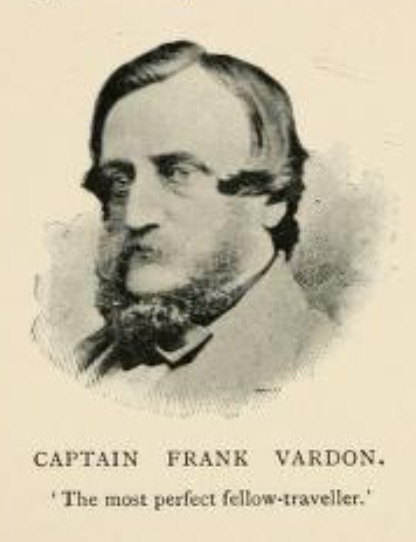
It is Vardon who provides us with evidence that George Fleming was with them on the Limpopo. In a letter to Oswell in 1851, he writes:
“I often think of you and wonder whether you have any of your old servants with you. Where is George ? I should much like to know. Have you Piet or Claas or John ?”
Surely the same George Fleming, Peat Frer, Claas David and John Thomas listed in his notes when preparing for the 1848/9 expedition to Lake Ngami with Livingstone.
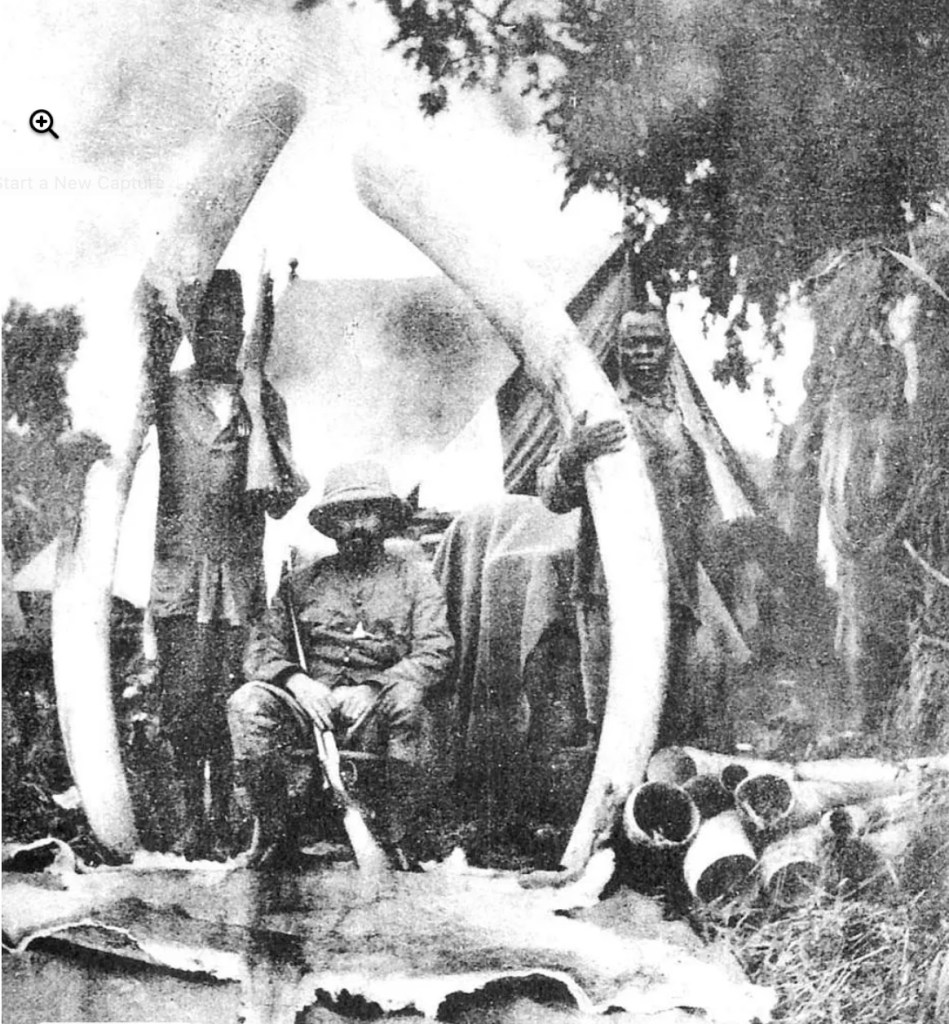
Sadly Oswell was intent on slaughtering elephant for their ivory, sometimes collecting 500 pounds of ivory in a day, whist his companion Vardon preferred rhino. Whilst not mentioning him by name Oswell complimented Fleming’s culinary skills:
“We had a capital cook at the wagons and had eaten elephant’s trunk many and many times.” 28
Oswell was back in Cape Town in late 1846 when he returned to India where, apart from a visit to England to see his mother for the last time, he stayed until late 1848.
George Fleming’s Travels with Livingstone
The Lake Ngami Expedition 1849
Livingstone
As early as 1841 when making his first journey in Africa from the coast at Port Elizabeth to Kuruman Livingstone had heard rumours of a great freshwater lake to the North that would take two months to reach by ox-wagon. He wrote, in a letter to Rev D. G. Watts (a missionary friend in India), that there was rivalry between the French and British missionaries to be the first to reach this lake but:
“If they give your humble servant a month or two to acquire the colloquial language they may spare themselves the pains of being first in at the death. I can acquire the language while travelling, without this ponderous vehicle, as well as by remaining at Kuruman—perhaps better, for I shall live as they do and mix constantly with them and I can obtain information respecting the population at the same time.” 30
This seems significant when put into the context of how he revelled in the simple pleasures of African travel.
“I like travelling very much indeed, there is so much freedom connected with our African manners. We pitch our tent, make our fire, etc., where ever we choose, walk, ride, or shoot as our inclination leads us.”
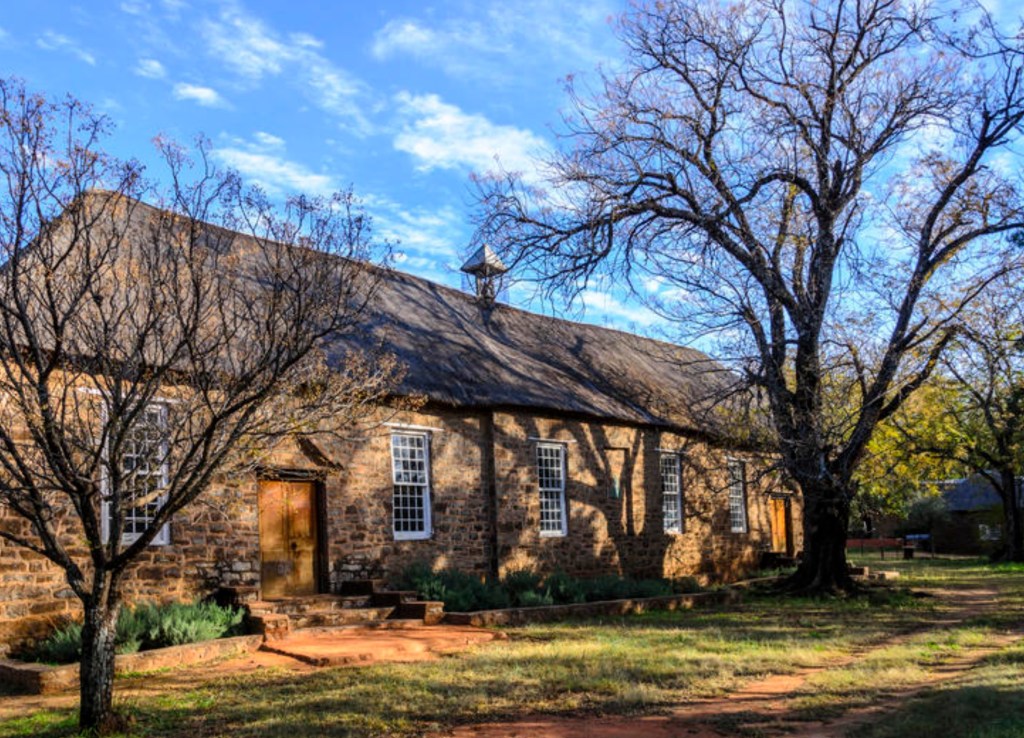
Soon after becoming established at Moffat’s mission at Kuruman he became bored with the sedentary mission life and started to travel far and wide into what is now Botswana. On his second long trek in 1842 he reached the northern edge of the Kalahari and heard more about the great lake that no white man had seen that lay further north; he wrote that he had come within ten days march of that lake.
When Oswell met Livingstone in 1844 they discussed feasible routes to the rumoured lake which by then, according to Janet Wagner-Parsons, had become “a topic of interest and conjecture among Europeans”.
Livingstone wrote that when he wanted to travel east from Kolobeng to visit the Boers who were harassing the Batswana people near the mission Sechele refused to accompany him saying that it would put his life at risk.
‘‘Suppose we went north,” I said, “would you come?’ ‘This was the first time I had thought of crossing the Desert to Lake Ngami.” 32
Livingstone is often the least reliable source regarding Livingstone so it is unclear when he first thought of looking for a route to the lake.
Livingstone knew that the lake district “abounded in ivory” and that the people in the area and on route were protective of this source so, through Sechele, he sent messages and gifts to obtain permission to travel the path he had in mind.
In 1848 he wrote to Sir Thomas Steele, with whom he had traveled in 1842, asking him to join the expedition.
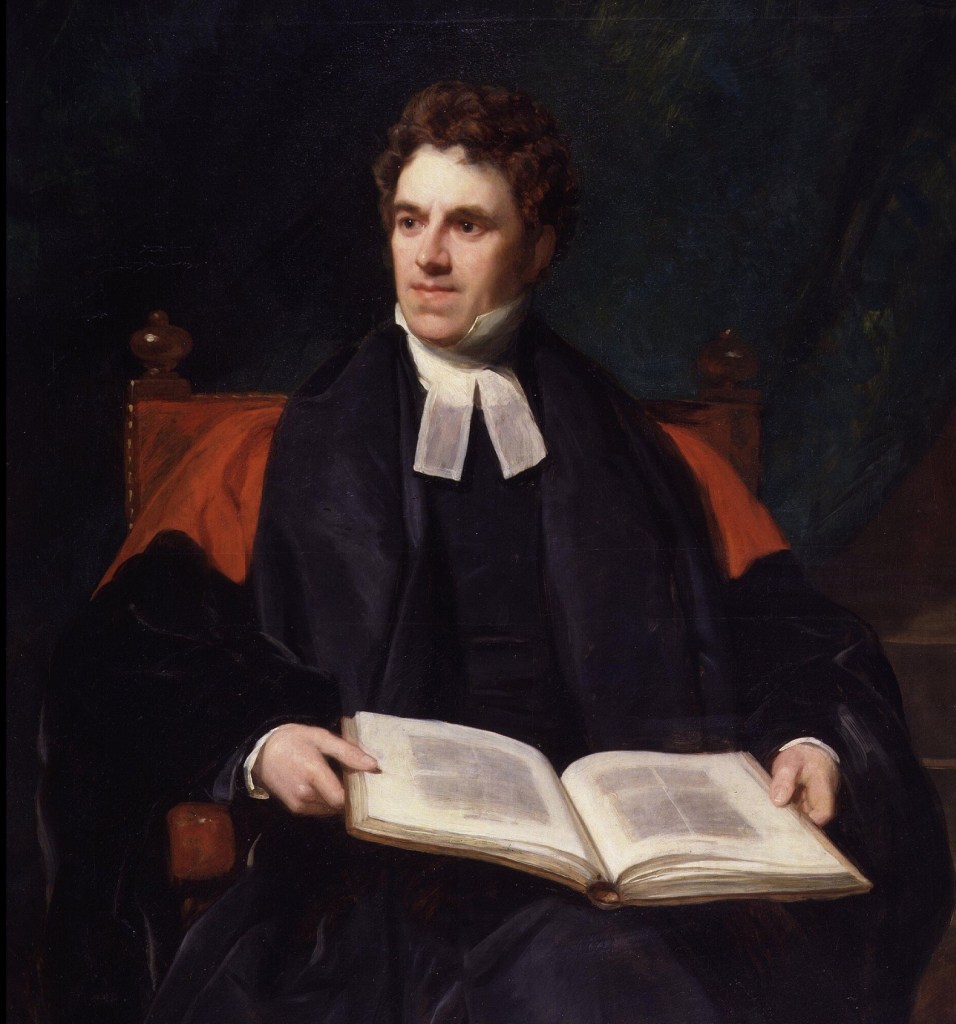
Right: Sir Thomas Montague Steele by Carlo Pellegrini 33
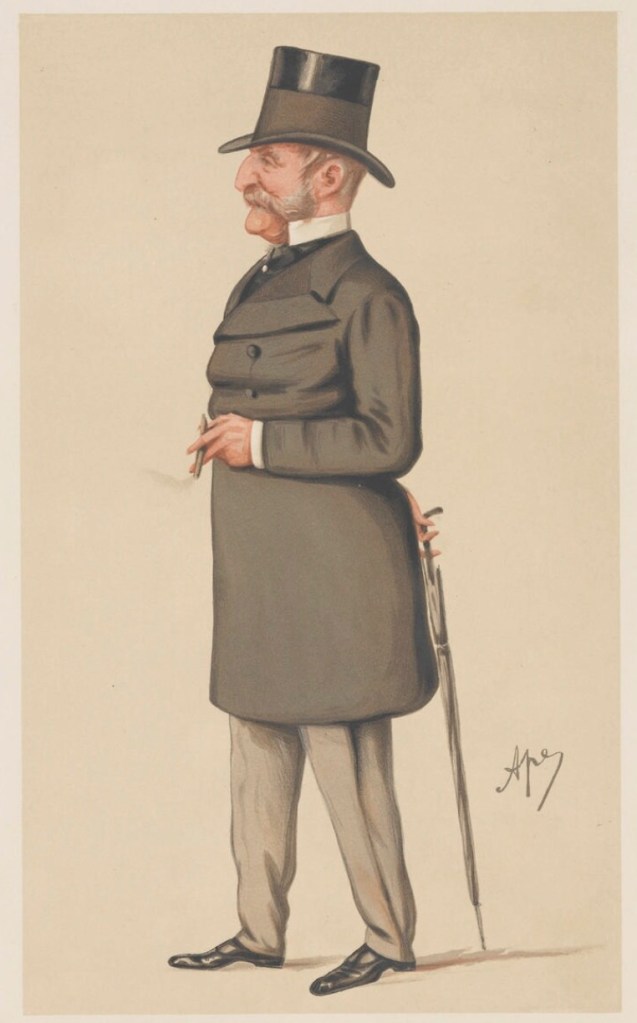
Steele declined but passed the letter to William Cotton Oswell who was not only enthusiastic for a new adventure with his friend Livingstone but was willing to finance the whole expedition.
Whose Expedition Was It Anyway?
Sources disagree on one seemingly important point: Did Oswell join Livingstone’s expedition? or, was it the other way round?
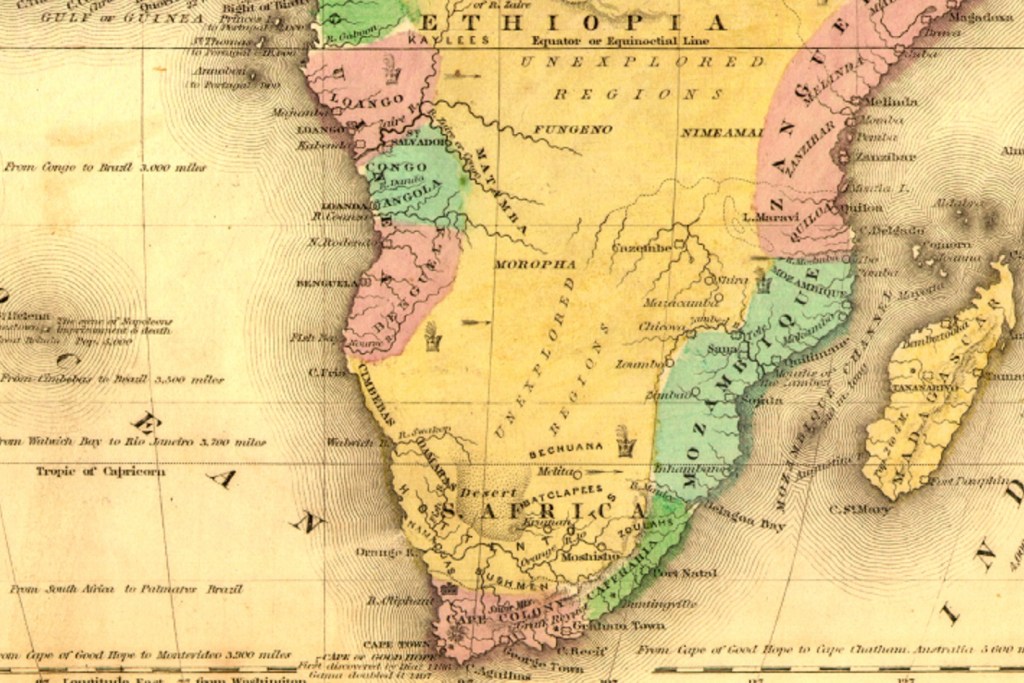
Livingstone was the man on the ground at Kolobeng, 965 kilometres from Lake Ngami which lies southwest of the Okavango Delta in northwest Botswana.
His qualifications as expedition leader included having influence with Kgosi (King) Sechele (see right34) who had contact with other clan leaders and Kgosi to the north enabling him to smooth the passage to the lake.
Right: Kgosi Sechel
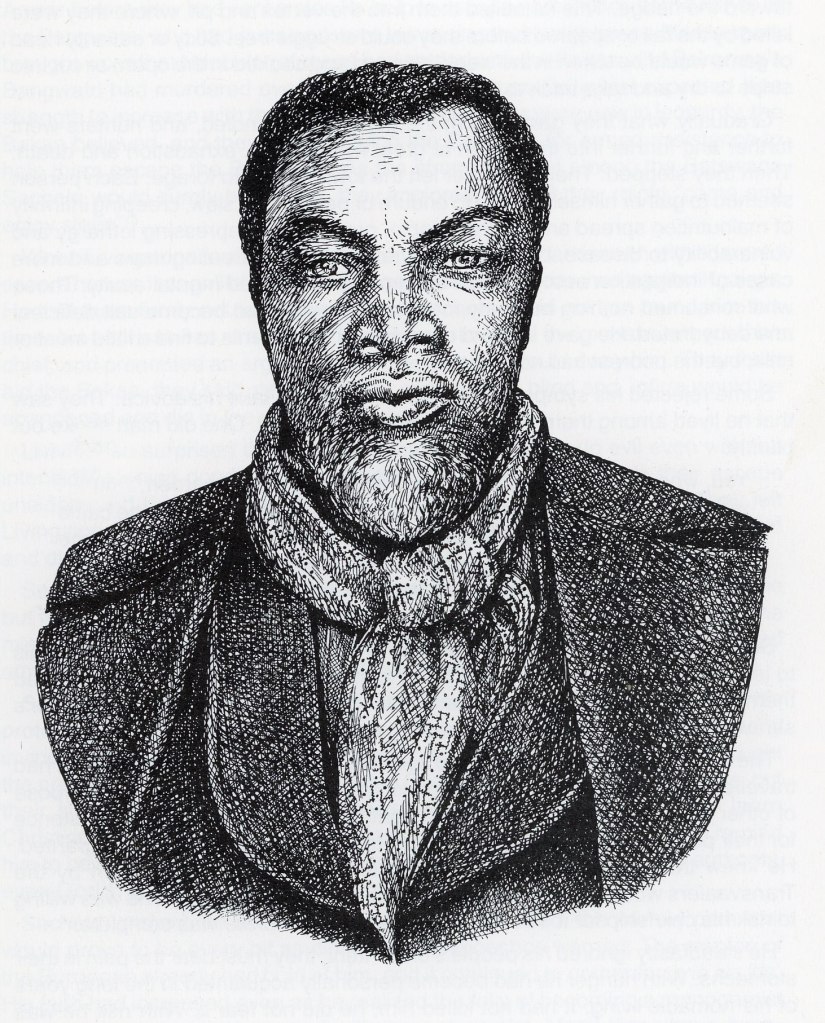
He was a linguist and could communicate with many of the people living around the edge of Kalahari in modern day Botswana, he had lived among these people, understood their culture and valued them as colleagues and friends. Apart from trekking up to Kuruman from Cape Town he had made at least three long journeys into the marginal lands that skirt the Kalahari Thirstlands where he had formed relationships with a number of clans and an enduring friendship with Kgosi Sechele.
Oswell’s qualifications were firstly his wealth which enabled him to finance the whole expedition but also his skills as a hunter. As previously discussed he could survive for long periods in the wilderness feeding himself and his team through his skill as a marksman. He was a keen observer of the land and its wildlife and could navigate and map 35 the bush. Last, but not least, he was a proven leader of both Europeans and Africans.
In those early days of his travels Livingstone was not the geographer that he would become. His motivations in the 1840’s were about making his mark as a missionary and having traveled into the area north of Kuruman he recognised that there were many people living around the Kalahari and beyond that had not heard the word of his god. In a letter to D. A. Tidman, the Foreign Secretary of the London Missionary Society he wrote:
“No other missionaries having ever visited the numerous tribes in that direction……. It is therefore imperatively necessary to endeavour to extend the gospel to all the surrounding tribes.” 37
He wrote to his brother just before leaving for the lake to say he was waiting for Oswell:
“The honour of discovery will probably be given to him, but I shall have the privilege of first preaching Jesus and the resurrection on its shores.”
As it turned out Oswell did not attempt to claim anything on his return and if not for letters to his uncle and an old friend we would know little of his part in the journey. Oswell and Murray were firm friends with a common interest in adventure and hunting and may have recognised the financial benefit from gaining access to the Elephant-rich lands of the Okavango Delta.
Despite having little in common Oswell was close to Livingstone:
“We were the firmest of friends, both a trifle obstinate, but we generally agreed to differ, and in all matters concerning the natives I of course waived my crude opinions to his matured judgment… .”
Because of his subsequent journeys across Africa history will lean towards thinking it was Livingstone’s expedition but it was probably more of an informal gathering of friends and their servants with an unlikely mix of motivations.
There were four British men on the expedition. Livingstone was escaping the challenges of missionary life at Kolobeng where things were not going well. James Hubert Wilson, who would later marry one of Sechele’s daughters, was seeking to trade with the people living near the lake. Oswell was dealing with the early death of his mother and desperate to get back into the African wilderness and Mungo Murray, the Scottish aristocrat, probably just sought adventure.
Oswell
We know that Oswell and Livingstone had talked of the lake and Oswell had heard more of it from people he had met on his expedition to the Limpopo in 1846. Judith Listowel believes he would have searched for it in 1847 or 48 if he had not returned to England from India to be with his dying mother. 39
As well as his letter to Steele Livingstone may also have written to Oswell about the lake expedition as in September 1848 the latter provided Livingstone with his travel plans saying:
“I received your long letter yesterday. Many thanks for it; it has cheered my heart wonderfully. D.V. I propose being at the Cape by the middle of December next. . . . My chief anxiety is to give you to understand for certain, that with God’s blessing I will be with you towards the close of May, 1849, and earlier if the horse-sickness will allow me. … I sail on the 25th prox. Steele will not accompany me ; Murray perhaps may. … If not altogether incompatible with your views I hope to find you at Kolobeng on my arrival.” 40
Once Oswell reached the Cape he set about preparing for the expedition. This entailed hiring his old team as listed above and buying enough stores to last up to a year in the wilderness.
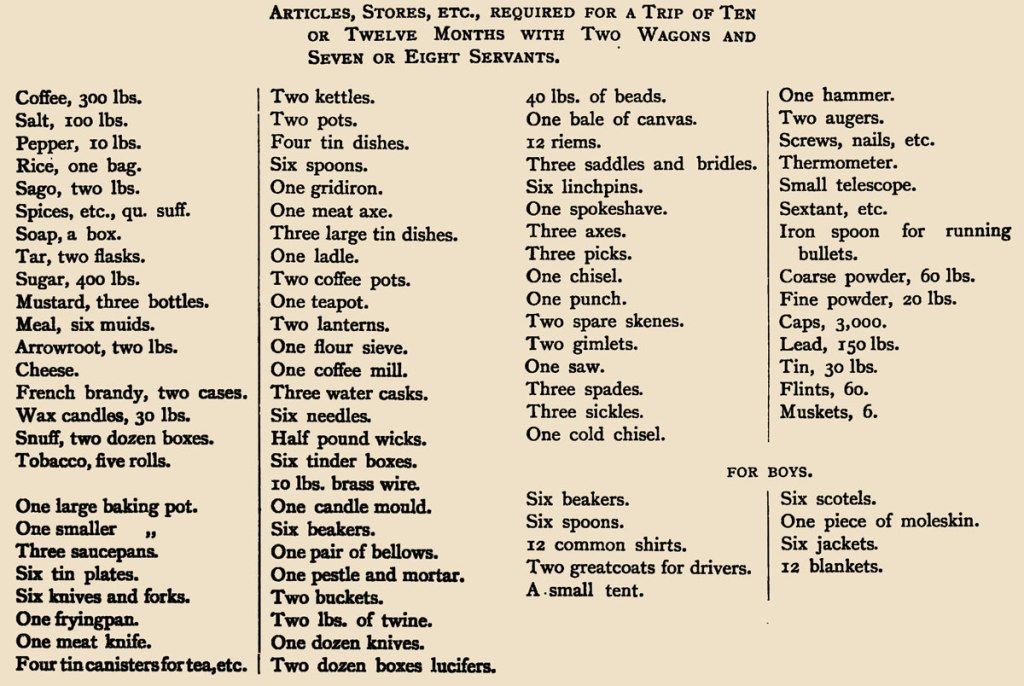
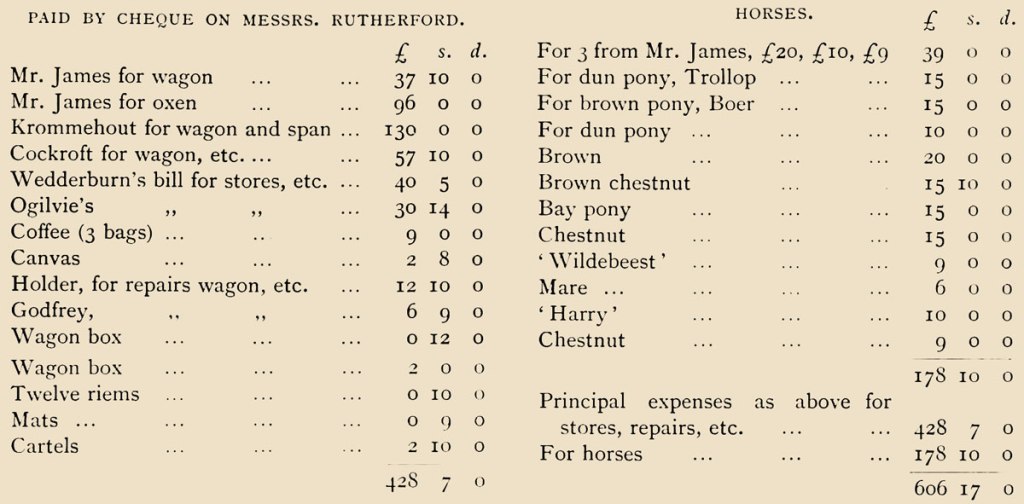
Oswell wrote cheques for nearly £607 for stores, wagons, oxen and horses and a further £32 in advances for the servants. Based on inflation since 1848 this is now the equivalent of around £100,000. To better put this in context, in 1848 Livingstone’s annual allowance was £100 from which he had to build and/or maintain mission buildings as well as clothing and feeding his family. In the space of a few days Oswell invested the equivalent of ten years of Livingstone’s salary in the expedition.
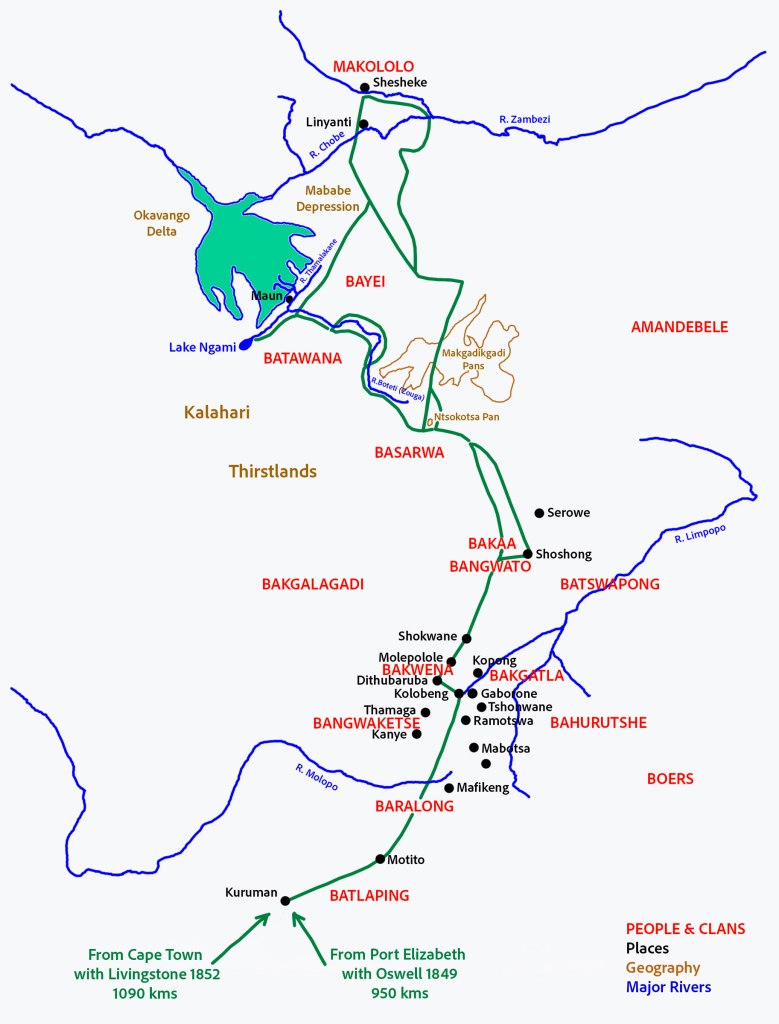
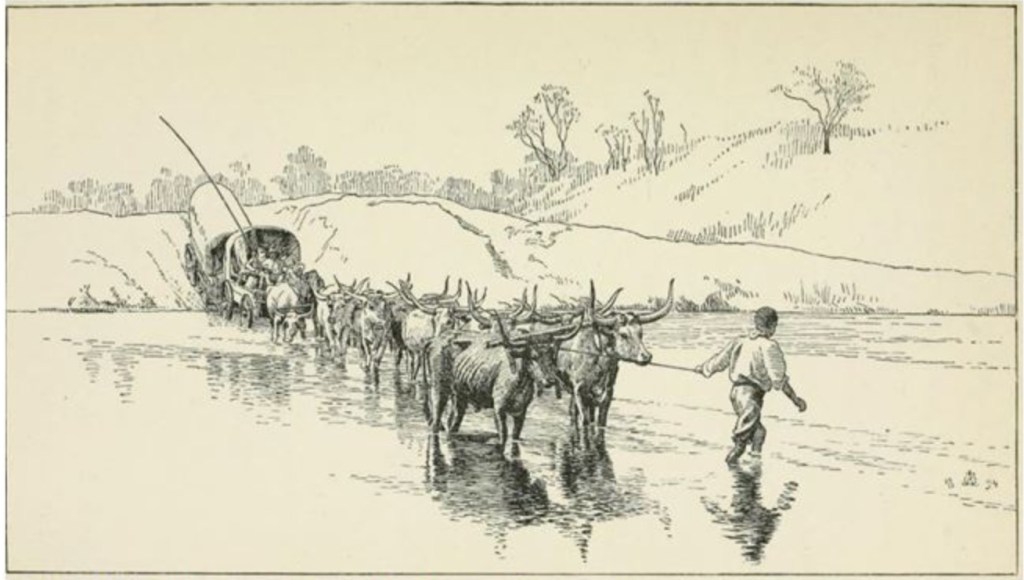
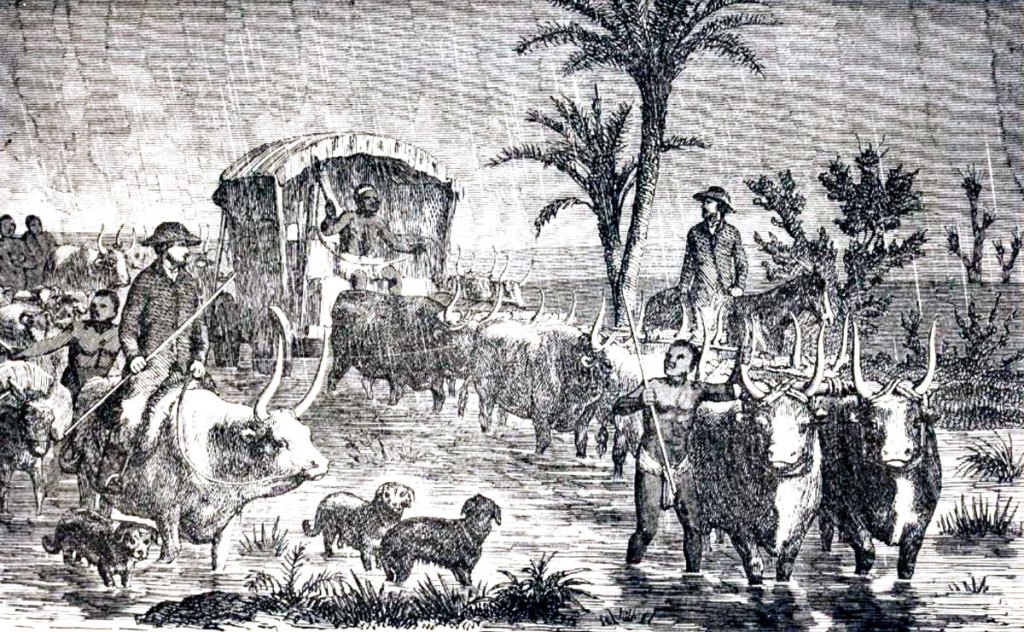
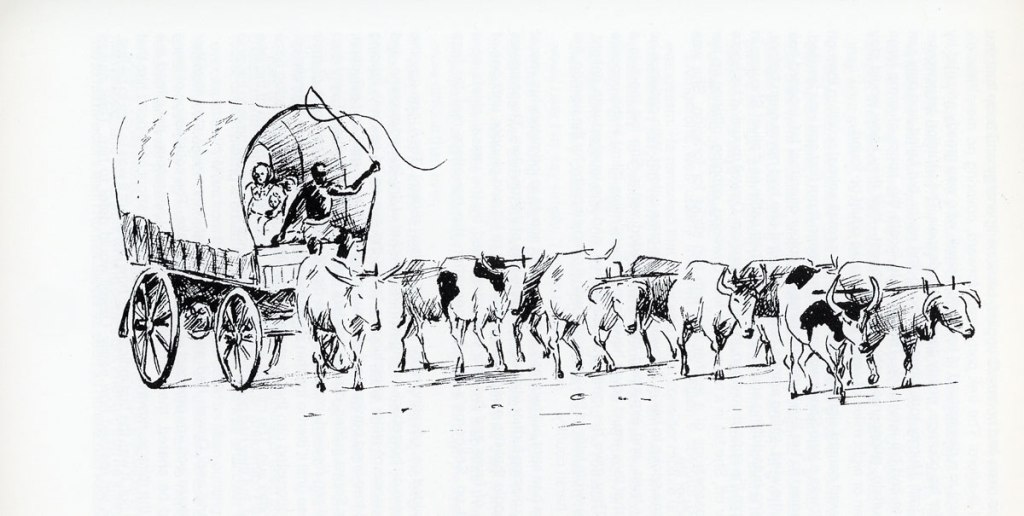
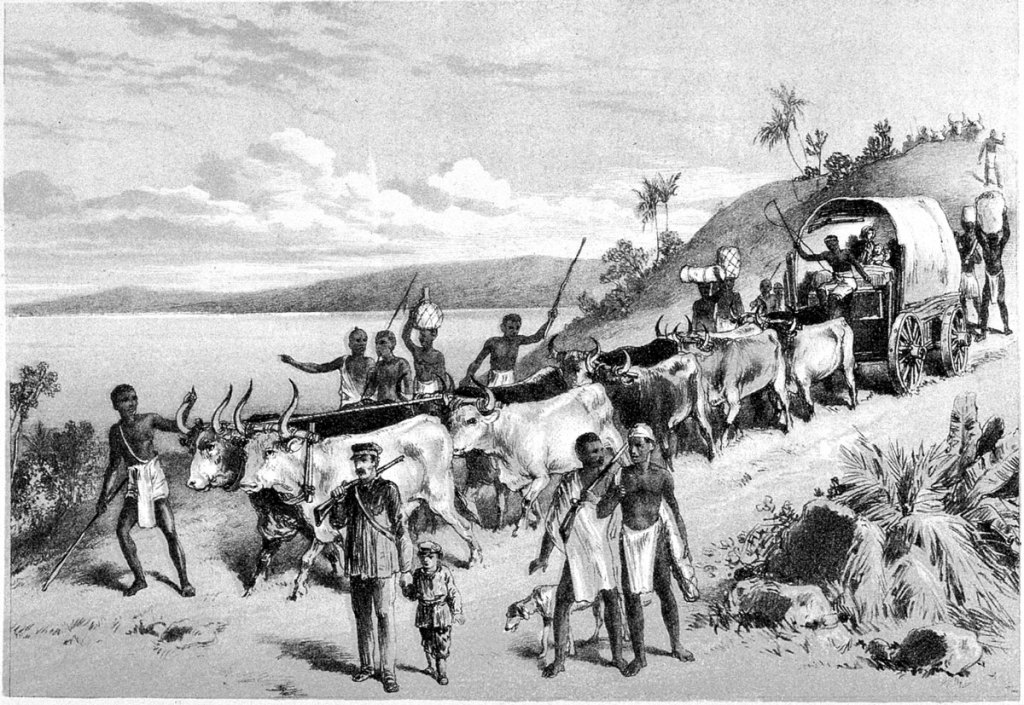
Setting out on February 10th 1849 Oswell took his expedition party by ship to Port Elizabeth. The expedition then headed inland sixty miles to Mauritzburg, it would have made a grand sight with 80 oxen taking turns to pull two wagons, accompanied by 20 ponies and horses, a white man and ten drivers, servants and herdsmen including George Fleming the cook. By April they were in Colesburg where they waited four weeks for Mungo Murray, before pushing on to Kolobeng.
Departure
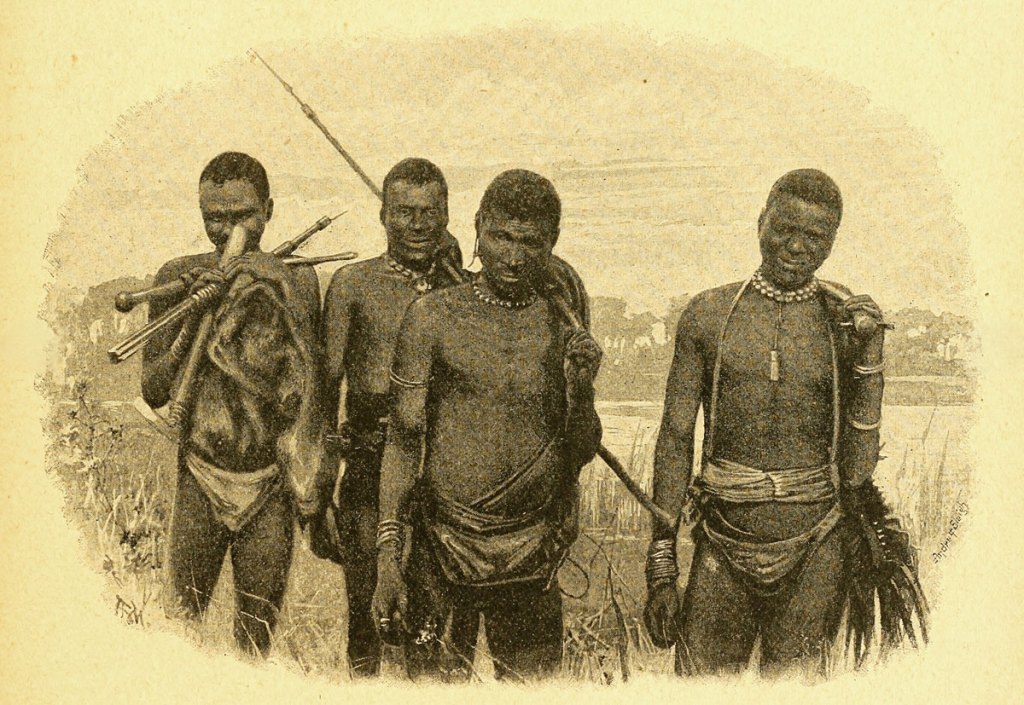
On May 26th 1849 Oswell and Murray arrived at Kolobeng along with the cook, drivers, gun bearers and servants shown to the right plus two other unnamed men.
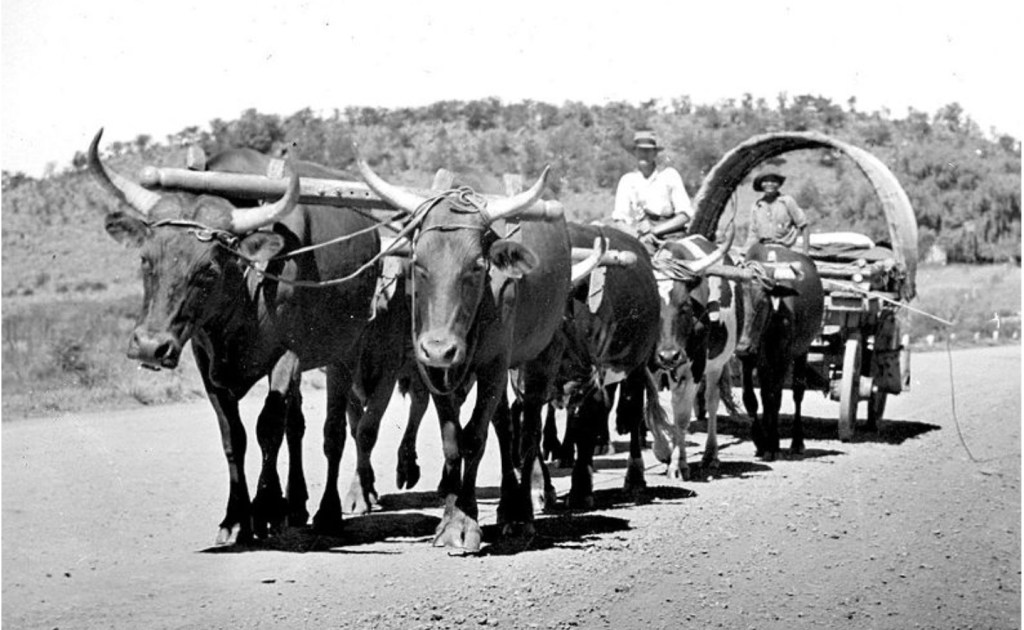
Their supplies were loaded on two wagons with 80 oxen to draw them. There were 20 horses and a number of dogs.
They met Livingstone, Wilson and 30 Bakwena men, including two who had reached the lake sometime in the past, two days north of Kolobeng. The expedition party was now complete and they headed for the Lake.
The Trek
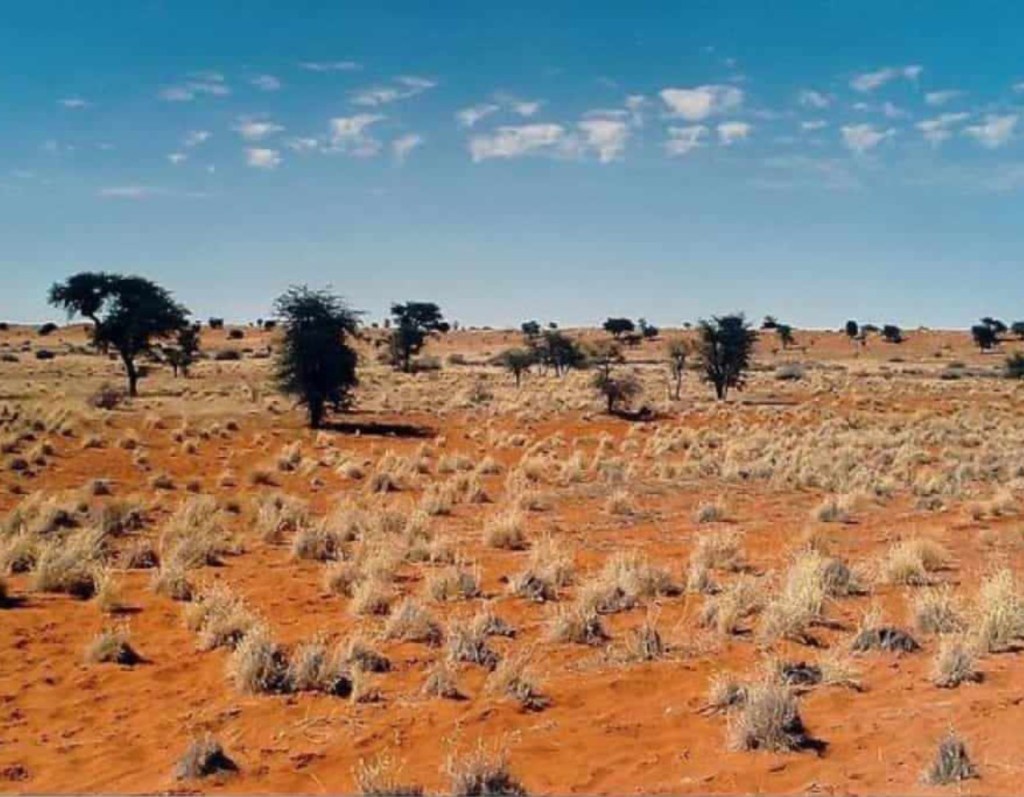
The Kalahari, The Thirstlands is a semi-arid, sandy savannah that stretches for 900,000 square kilometres across 80% of Botswana, parts of Namibia and parts of South Africa.
Livingstone described the land:
“The great Kalahari Desert. The space from the Orange River in the south, lat. 29°, to Lake Ngami in the north, and from about 24° east long. to near the west coast, has been called a desert because, though intersected by the beds of ancient rivers, it contains no running water, and very little in wells.
Far from being destitute of vegetation, it is covered with grass and creeping plants; and there are large patches of bushes and even trees. It is remarkably flat, and prodigious herds of antelopes, which require little or no water, roam over the trackless plains.” 44
Livingstone knew that a direct route across the desert to the lake was hopeless and that the only possible way was to skirt the edge of the Kalahari. They had hoped to meet people along the way who would help them find water but Chief Secomi of the Bangwato people controlled the ivory trade with the people who hunted the elephant rich lands of the Okavango Delta. He knew that his monopoly was lost if Europeans reached the lake so he instructed his people and the San tribesmen who lived in the Kalahari to avoid contact with the expedition.
The first part of the trek was arduous but they moved between known water sources and slowly moved north. When they reached Serotli which is near modern day Serowe, they had expected to find abundant water but there were only a few muddy ponds where buffalo and rhino had wallowed. This was thought to be the last water for seventy miles.
Their guide, Ramotbi, showed them how to dig wells and at about two metres they found enough water for the horses and men but not enough for the oxen. These poor beasts were sent back to the previous water hole at Lobotani where they were able to drink for the first time in four days. The wells slowly filled and the oxen were brought back up.
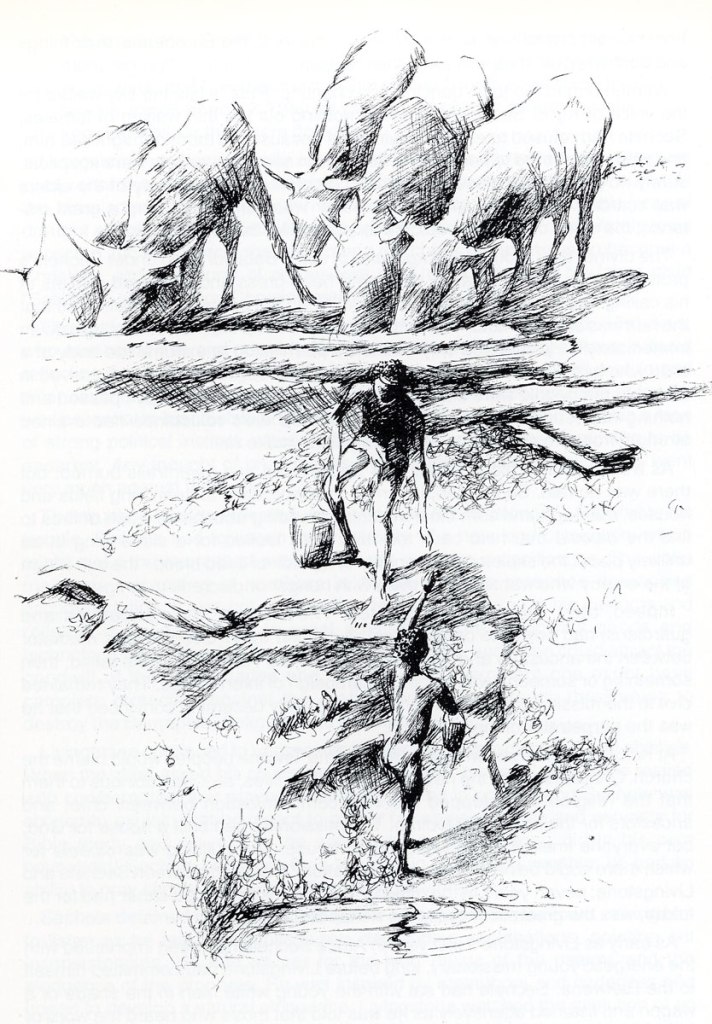
Once they had as much water as they could carry on the wagons they continued to the north travelling in the comparative cool of early mornings and late afternoons. This part of the Kalahari is mostly soft white sand through which the oxen struggled to haul the heavy wagons. After two days and nights they had only travelled 25 miles from Serotli and at that rate their water would run out long before they reached the next supply.
It was around this time that there are two stories about finding water which must be the same event. As two views of a single occurrence it is an example of Livingstone’s struggle with sharing credit.
Oswell tells a long story of how he volunteered to ride ahead with John Thomas and some other, unnamed, men from his team to search for water. Twelve miles ahead of the main column they saw movement in the long grass and thinking it might be a lion that might lead them to water they followed and were surprised when an elderly women broke cover and tried to run from them. The mounted Oswell easily cut her off. She was one of the San people eeking out a living in the Kalahari and had never before see either a white man or a horse.
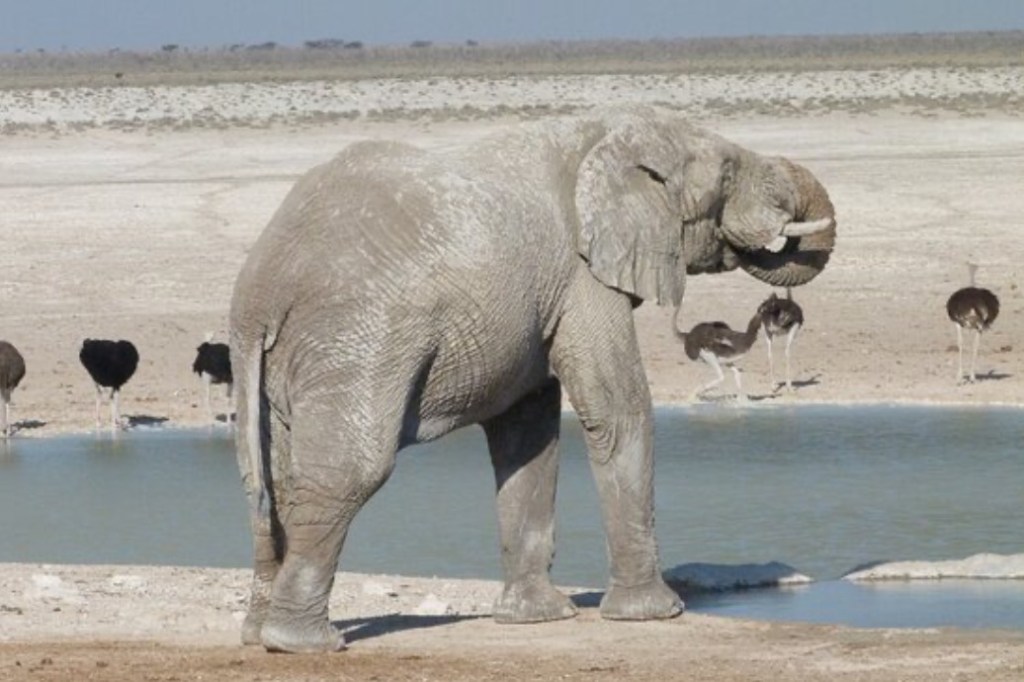
In return for some beads she led them to a place “where the elephants drink” which, at first Oswell thought was lake Ngami but it was the Ntsokotsa Pan, salt flats, which Oswell said were fifteen miles long and four miles wide.
“The low, slanting desert sun reflecting off the white salt incrustations creates a perfect illusion of rippling water”
On the edge of the pan the old women showed them a spring and they brought up the oxen to drink. 48
Livingstone’s account is far shorter:
“Mr. Oswell happened to spy a Bushwoman running away in a bent position to escape observation. He took her for a lion, and galloped up to her. She thought herself captured, and offered to deliver up her property, which consisted of a few traps made of cords. When I explained that we only wanted water, and would pay her if she led us to it, she walked briskly before our horses for eight miles, and brought us to Nchokotsa. 49
After Nchokotsa the journey became easier as, on the 4th July, they reach the Zouga River (Boteti River) which flowed from Lake Ngami. Oswell had more to say about this part of the journey as they were now surrounded by the wildlife that concentrated near water. At one point:
“I came upon at least 400 elephants standing drowsily in the shade of the detached clumps of mimosa trees. Such a sight I had never seen before and never saw again. As far as the eye could reach, in fairly open country, there was nothing but elephants. I do not mean in serried masses, but in small separate groups.” 50
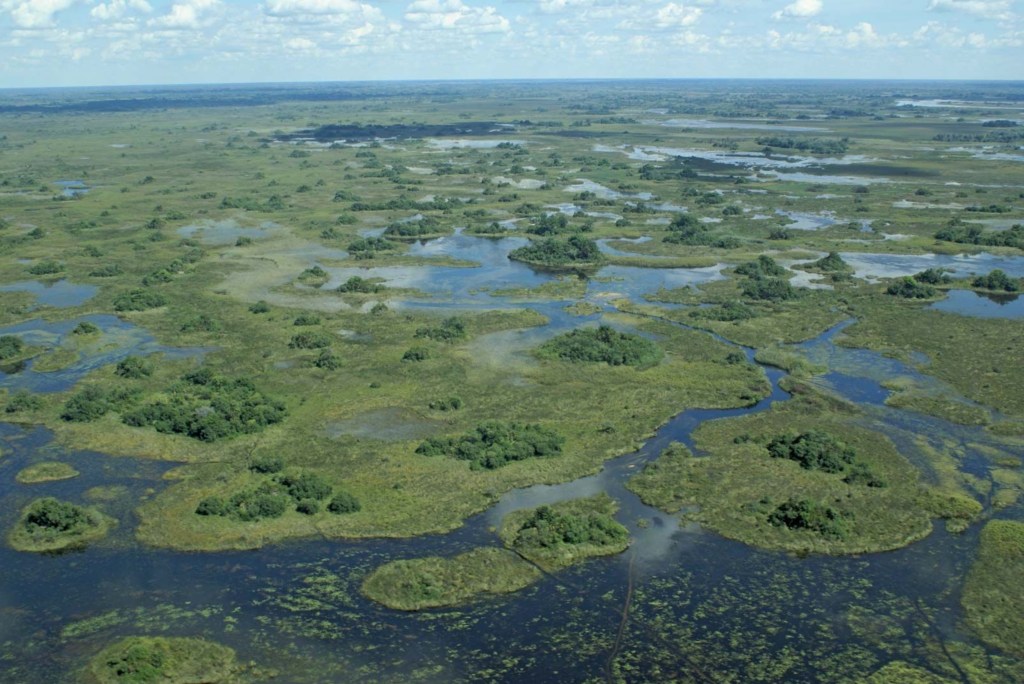
Following the river and heading northeast Oswell says:
“……. holding up the course of the stream for two hundred and eighty miles, and meeting with no difficulties to speak of, save from the denseness of the bush and trees in particular tracts, through which we had to cut our way, we at length reached the object of our expedition, and were fully repaid.” 52
The Lake
On the 1st August 1849, they reached Lake Ngami.
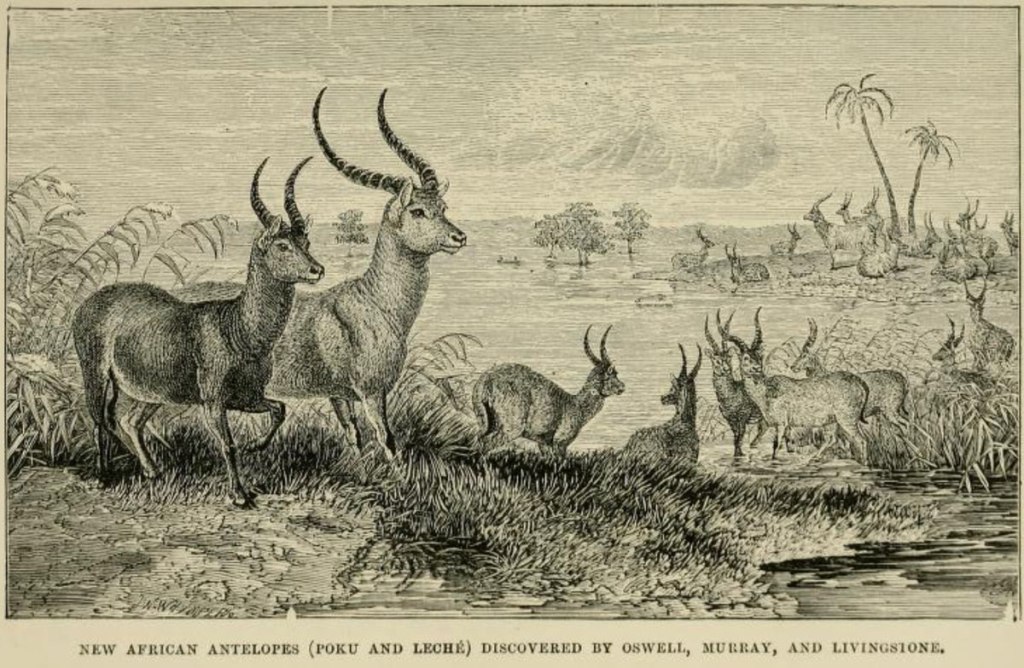
Here, on the edge of the Okavango delta, Livingstone, Murray, Oswell, Wilson, George Fleming, John Thomas and the forty odd men that were with them, were in one of the most beautiful, wildlife rich and bio diverse places in Africa.
They saw types of antelope that no European had previously described and huge herds of elephants who visited the lake in the early evening to drink, bathe and play. Buffalo and rhinoceros were abundant along with other game. Great shoals of fish were seen to be the main protein source for the people living around the lake who also hunted the hippos that wallowed in its shallow waters.
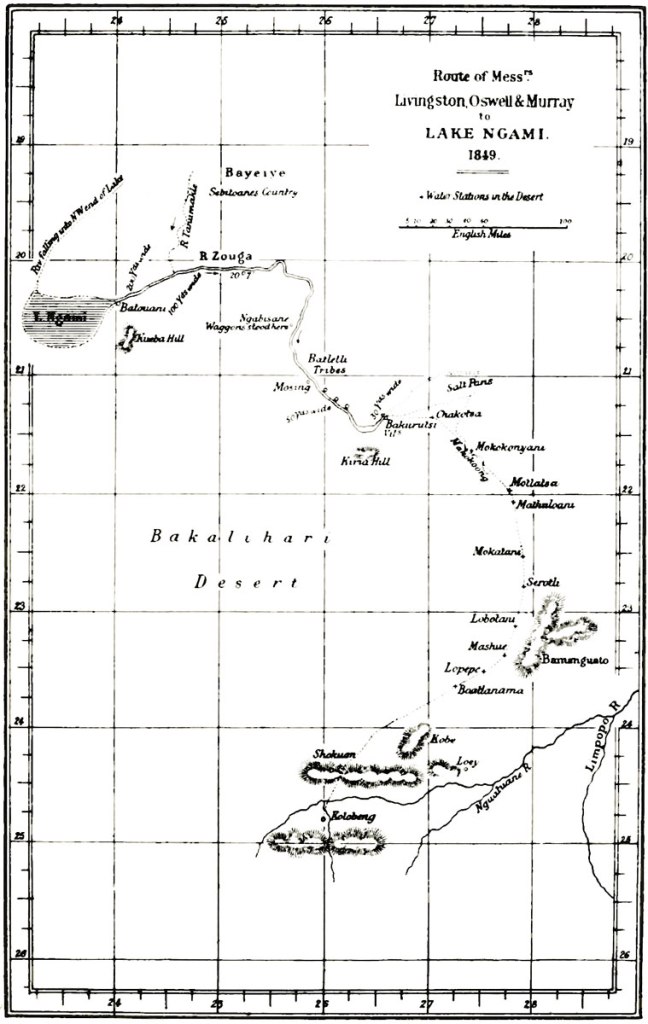
By finding a 600 mile route to the lake and by mapping the water holes and describing where and how to find water the expedition had opened a viable trade route north of the Kalahari Desert.
Left: Oswell’s map of their journey showing the water stations. 54
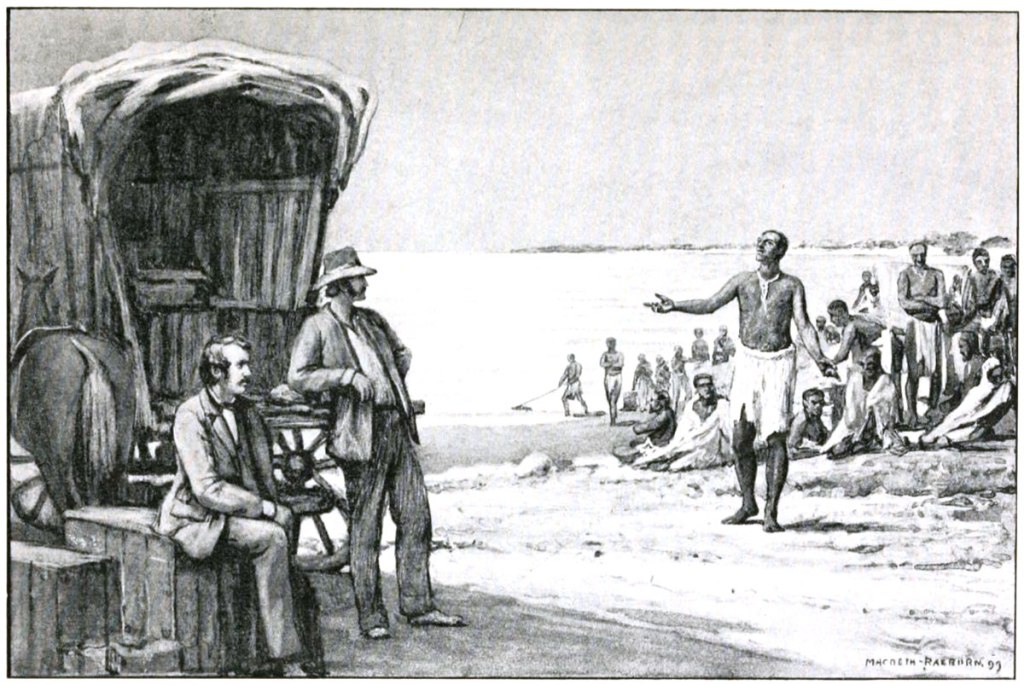
Emboldened by their discovery of a route to the lake Oswell and Livingstone decided to try and cross the Zouga (Boteti River) and head north in an attempt to meet Sebetwane, the Makololo King. Their followers were unenthusiastic about this idea and were keen to return to the Cape but Oswell called a meeting and spoke to the group. He explained that the Europeans wanted to explore further north but, if the Africans wished to leave, they would given them a wagon and supplies to return to Cape Town.
“I paused for a moment, and then added that though we could not ask them to accompany us, yet if any one of them was willing to do so, we should be very glad. I rather enlarged upon our ignorance of the country in advance, for we did not wish to influence them unduly to join us.”
John Thomas stepped forward and proclaimed:
“What you eat, I can eat; where you sleep, I can sleep; where you go, I will go; I will come with you.”
The cry went up that they would all go and Oswell makes the point that seems quite remarkable for a wealthy colonial Englishmen, a true child of empire half way through the nineteenth century.
“Do you think after that it was much matter to us whether our brother was black or white ?’”
As it turned out they were unable to find a way to cross the Zouga as there was no timber to make adequate rafts and they had to settle for a return trip via the water stations that had been identified on their outwards journey.
Livingstone arrived back at Kolobeng by October 10th 1849.
William Oswell was in Cape Town by the end of the year and wrote letters describing his journey on January 10th and 16th. Fleming, Thomas and company were paid off at the Cape.
Oswell’s Fourth Expedition 1850
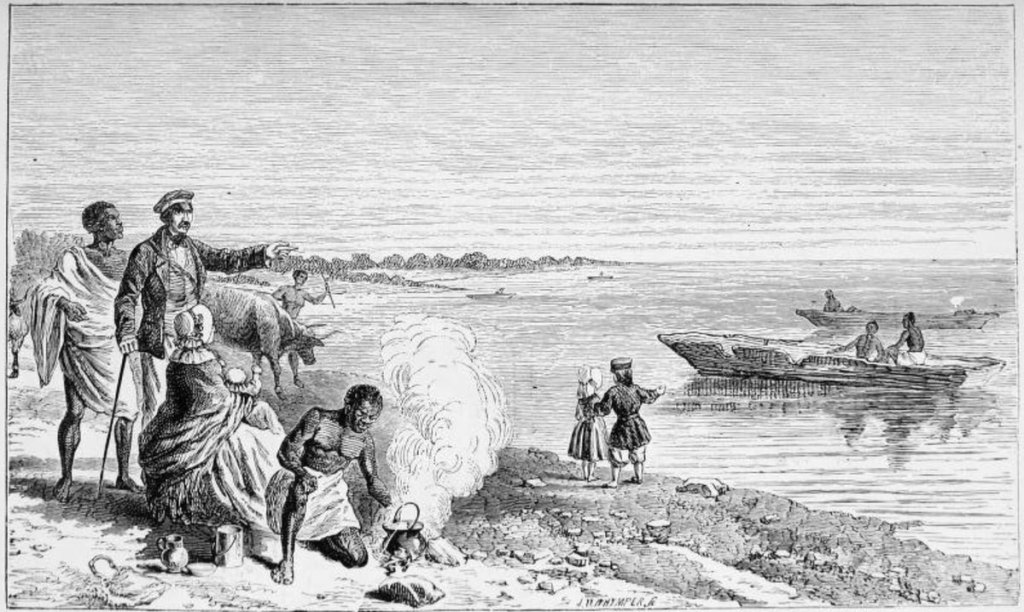
Oswell and Livingstone had planned to meet again in 1850 and cross the Zouga. Oswell was to bring a boat. However, as it turned out Livingstone was desperate to be the first European to meet King Sebetwane and had set out, with his wife and children a month before Oswell reached Kolobeng. The boat was also a failure as the heat and travel from the Cape had warped it beyond repair.
Oswell cut his losses and went hunting along the Zouga River. He mentions John Thomas so we know he was there but we can only guess whether he had his normal team including George Fleming along with him.
Livingstone Revisits the Lake in 1850
The 1851 Expedition to King Sebetwane
In. 1851 Oswell rounded up his normal crew at Cape Town and headed to Kolobeng to meet Livingstone. He admits to his cousin, Louisa Cotton, that he is primarily motivated by wanderlust but he is conscious that Sebetwane is slave trading with agents of the Portuguese and hopes that opening a trade route from the south will help by offering alternatives to this trade.
Once again it is interesting to compare Oswell and Livingstone’s accounts of this expedition. Livingstone had long desired to meet Sebetwane and hoped to find the site of a new permanent mission in the lands of the Makololo in what is now Zambia. He had hoped to reach the Makololo in 1850 but his children and then his servants had gone down with fever which forced him to give up his attempt.
Livingstone skims over the start of the 1851 expedition, he jumps from explaining that Sebetwane was keen to meet him and had sent gifts of cattle to Sechele to saying they set out on the third attempt to reach the Makololo.
Oswell presents a quite different picture; he suggests this is very much his expedition but one that he hoped Livingstone would join. However, when he reached Kolobeng he found that there were two obstacles that prevented the Livingstone family from doing so.
The first problem was their lack of a suitable wagon and their second an unwillingness to expose their children to the lack of water they would inevitably experience on the first three hundred miles of the journey. Oswell resolved the first problem by presenting them with a new wagon and the second by travelling several day’s marches ahead of the Livingstones to enable him to clear the old wells or dig new ones before the family arrived. Livingstone gratefully accepted these solutions and left Kolobeng with his family in his new wagon on 24th April 1851.
He put our old friend, his “excellent West Indian chef”, George Fleming, under Mary Livingstone’s supervision 58 so we know that George wasn’t part of the well clearing and well digging operation.
Livingstone’s journal records the many water stations where Oswell’s men had dug out the old wells and ensured that the expedition’s people and oxen remained hydrated. On the 8th May they were at Sekhomi, on the 14th, Kanne, on the 17th they were at Nkoa-ana where:
“Mr. Oswell’s men opened another well which from long disuse had become filled up. . . . This well on being re-opened afforded an abundant supply for all our cattle.’” 60
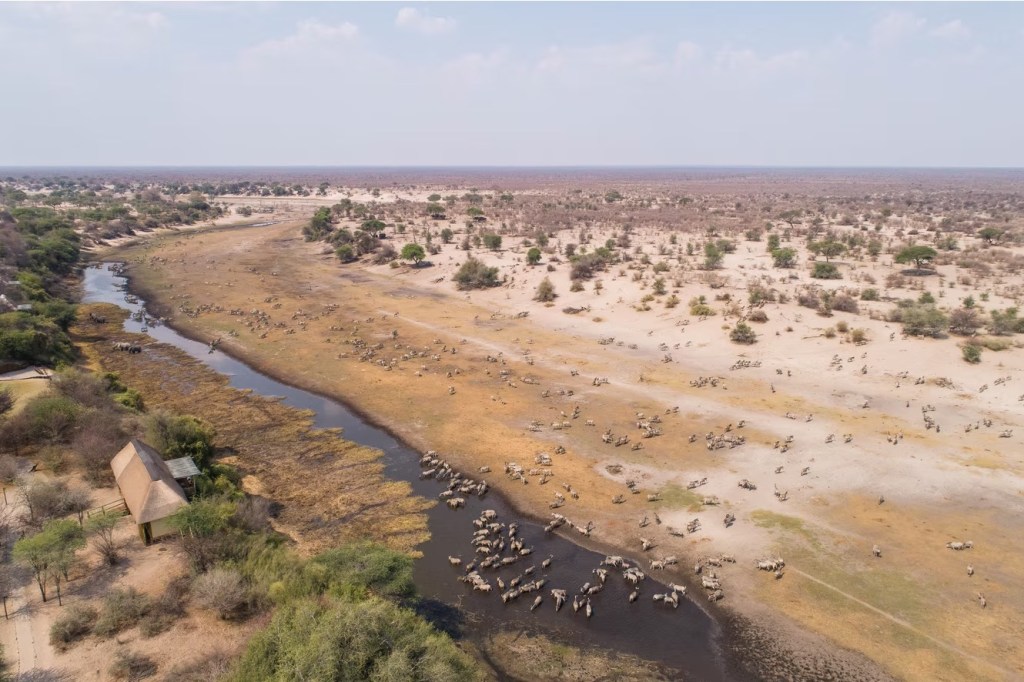
They crossed the dry bed of the Zouga River and passed the Nchokotsa salt pan to reach Koobe on the 27th May where they found several wells of fresh water and plenty of game. And, so on into June the expedition slowly makes it way north across crusted salt pans and into the Matlomaganyana country (Matlamanyane in north-eastern Botswana) a place where a chain of small limestone pools fed by underground springs sustain a sizeable San people and wildlife population.
“The people of Horoye, and indeed all the Bushmen (San), were strong well-fed looking men. The game abounds and they are reported to follow it in its migrations, and live on the zebras, gnus, etc., as if they were their domestic cattle.” 61
There is an insight into the organisation of the trek in Oswell’s memoir:
“I had the management of trekking and the cattle, after he (Livingstone), with his great knowledge of the people and their language, had obtained all the information he could about the waters and the distances between them. This worked well.” 62
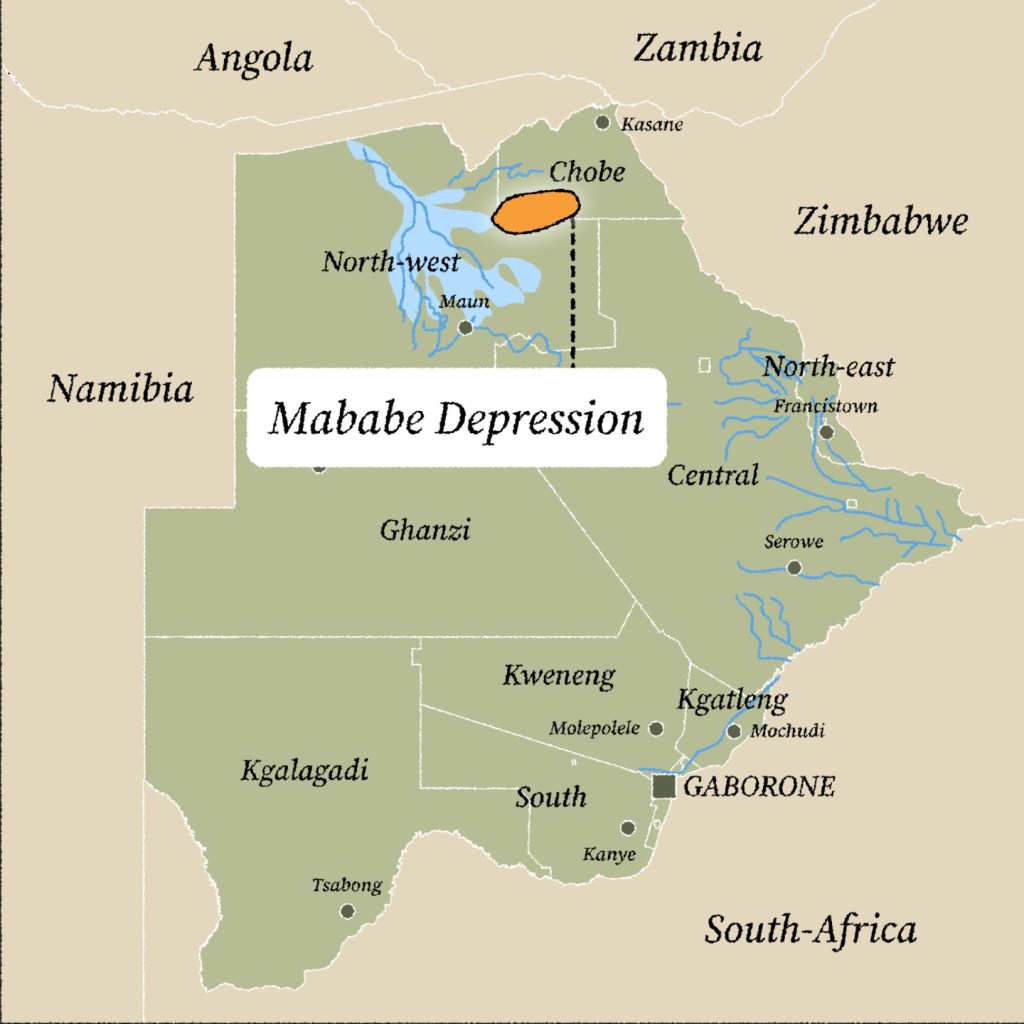
Crossing the Mababe Depression they became desperately short of water and by the time they reached the Mababe River Mary Livingstone was in tears fearing that her children would die of thirst. Robert, Agnes and Thomas were six, four and three in 1851 and in June Mary was about six month’s pregnant with William; it is hard to understand Livingstone’s willingness to subject them to the rigours of African trekking.
The previous year their little sister Elizabeth had died when just 6 weeks old and her mother had probably suffered a stroke that was probably brought on by a malarial infection caught at Lake Ngami in 1850. Livingstone’s logic was that he was setting out to establish a permanent mission among the Makololo in the region of the Zambezi River and taking his family with him saved a journey back to collect them.
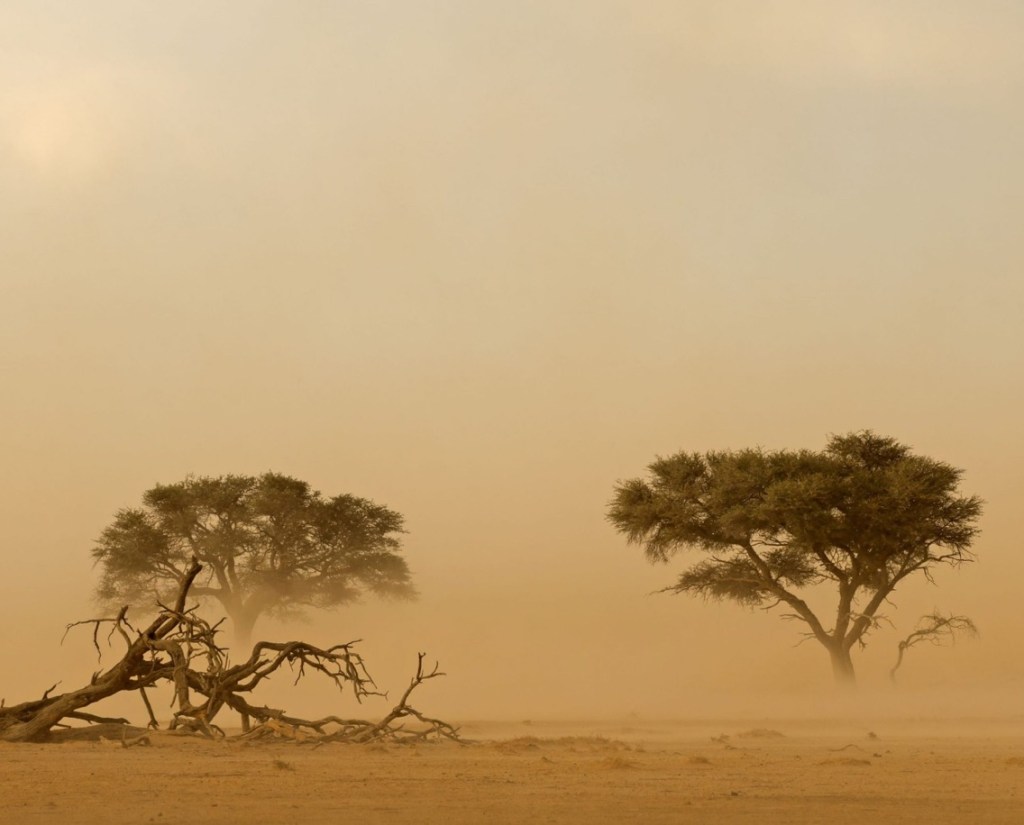
Mary Livingstone’s mother, Mary Moffat, herself a missionary’s wife at Kuruman was in no doubt that Livingstone was again putting his family’s lives at risk. She wrote to him:
“Was it not enough that you lost one lovely babe and scarcely saved the others, while the mother came home threatened with paralysis? And will you again expose her and them in those sickly regions on an exploring expedition? All the world will condemn the cruelty of the thing, to say nothing of the indecorousness of it. A pregnant women with three little children trailing about with a company of the other sex, through the wilds of Africa, among savage men and breasts!” 64
With the adults and children dying from thirst and the water barrels empty the oxen were released in the hope that they would find water. Livingstone and Oswell waited with Mary and the children while the rest of the men followed the oxen.
After a long wait one of the men reappeared with a bottle of filthy water which saved them. Livingstone is not at all concerned that this might have a long term detrimental effect on his young children or pregnant wife:
“We never need any spirits to qualify it or prevent an immense draught of it from doing us harm. I have drunk water swarming with insects, thick with mud and putrid from rhinoceros urine and buffaloes’ dung, and no stinted draughts of it either, yet never felt any inconvenience from it.” 65
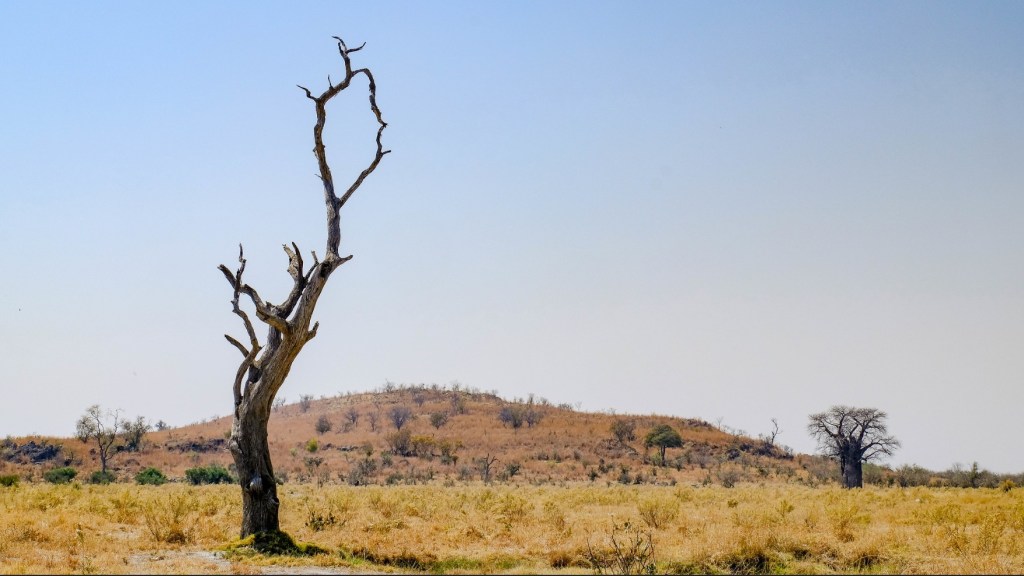
They had trekked across the wilderness of the Mababe Depression and by luck rather than judgement their animals had found a small river. A stroke of luck that saved all of their lives.
They reached the Chobe River on the 18th June and soon met a messenger from Sebetwane who told them the king was thirty miles downstream. On the 21st June they took the oxen and horses to the north bank to protect them from the Tsetse fly and made a camp on the south bank for Mary and the Children. It seems likely that George Fleming stayed with the family while Oswell and Livingstone travelled downstream by canoe to meet the King. (For the story of that meeting and how Sebetwane had come to rule a Zambian kingdom see The-Makololo-Zambian-Kingdom)
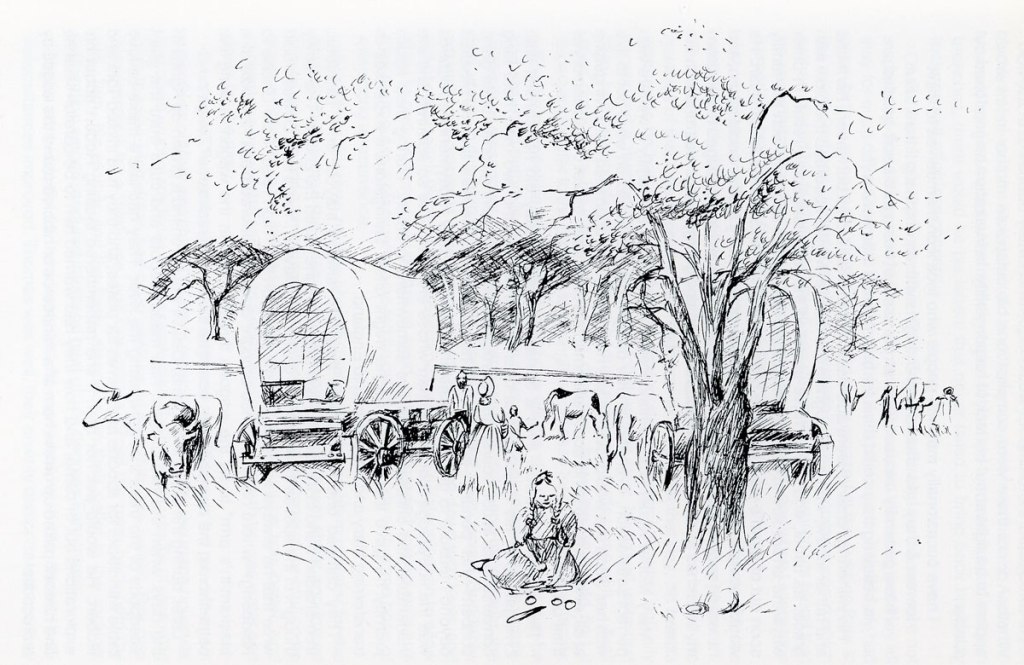
Livingstone had, at last, realised that his family cannot accompany him if he to keep travelling across unmapped Africa and he makes a plan for the family to travel to England and wait there for him. But first, they must travel back from the Chobe River to Cape Town. William Cotton Oswell who had funded this and the previous expeditions offered to pay for the family’s passage to England.
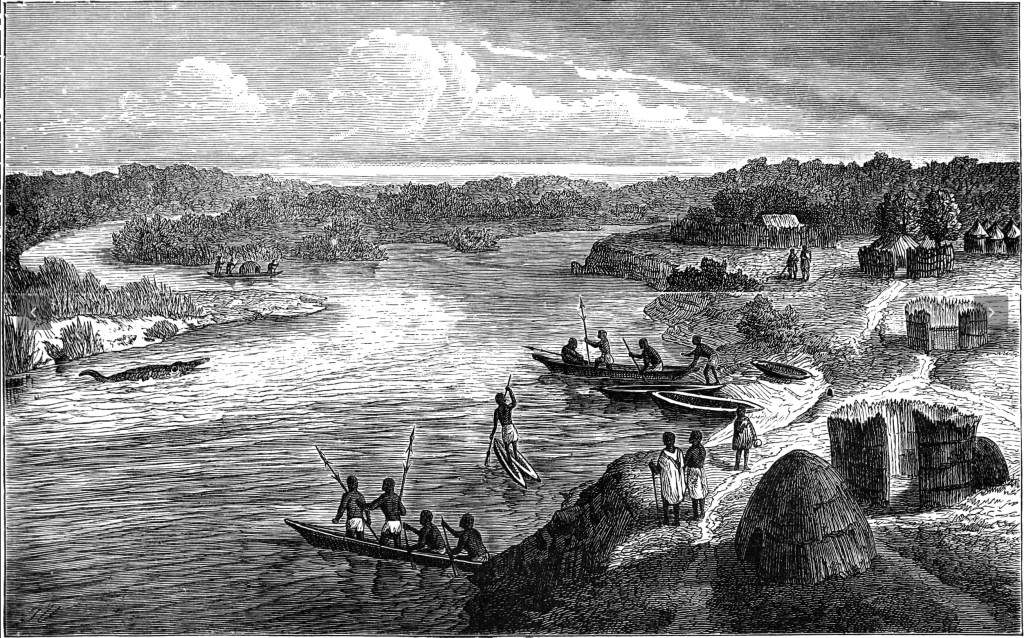
In the meantime, whilst still in Linyanti Livingstone and Oswell rode out to explore the country to the northeast and reached Sesheke, a town on the Zambezi River. Livingstone is excited to have found the Zambezi in the centre of Africa.
The “Discovery” of Victoria Falls, Four Years Before it was “Discovered”
Nearly everywhere you look acquired wisdom will tell you that the first non-African to see Mosi-oa-Tunya (Victoria Falls) was David Livingstone on 16th November 1855.
Despite the Portuguese being established on the Zambezi since at least the 1530’s it is generally agreed that they never visited the falls. 69 However, it remains highly unlikely that the Scottish doctor was the first European or first non-African to reach this part of the Zambezi River.
Livingstone decided to stay at Sesheke but Oswell wanted to explore the course of the Zambezi River to the east and we can be reasonable sure that Fleming, Thomas and others of his team travelled with him. Oswell never wrote an account of what they found on this side-expedition and his published letters do not include any mention of what he saw but there are three pieces of evidence that he and therefore Fleming came close enough to see the plume of spray rising from Mosi-oa-Tunya (Victoria Falls) or might even have been close enough to see the greatest waterfall in Africa.
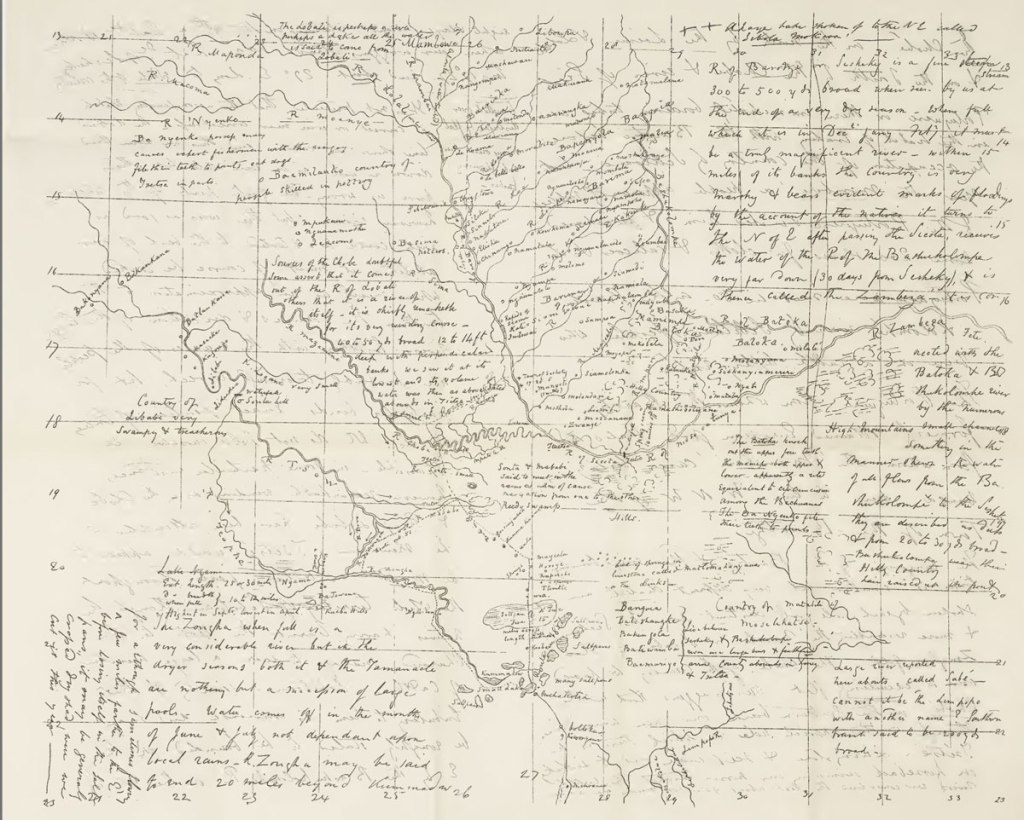
The first evidence is on the hand-drawn map that Oswell sent to his old friend Frank Vardon from Colesberg in January 1852 when he was on his way back to Cape Town. The map is accompanied by a letter which is only partially reproduced in the biography written by his son.
The map shows the route the expedition took from Kolobeng to Linyanti and of his and Livingstone’s trip to Sesheke which he labels as “Sechety” on the map. It also shows the course of the Zambezi both east and west which must have been compiled from a combination of intelligence gained from their hosts and their own observations.
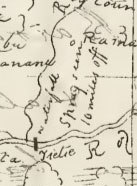
However, In the approximate centre of the map a black vertical line marks a “waterfall” on the Zambezi and just to the right he wrote:
“Spray seen 10 miles off.” 70
Historians usually take this to mean that he saw this spray with his own eyes.
The second piece of evidence is in Vardon’s reply to Oswell’s letter. He writes:
“What a river you discovered ! and as for the cataract of Mosio-atunya (Mosi-oa-Tunya) I’ve been thinking of it ever since !”
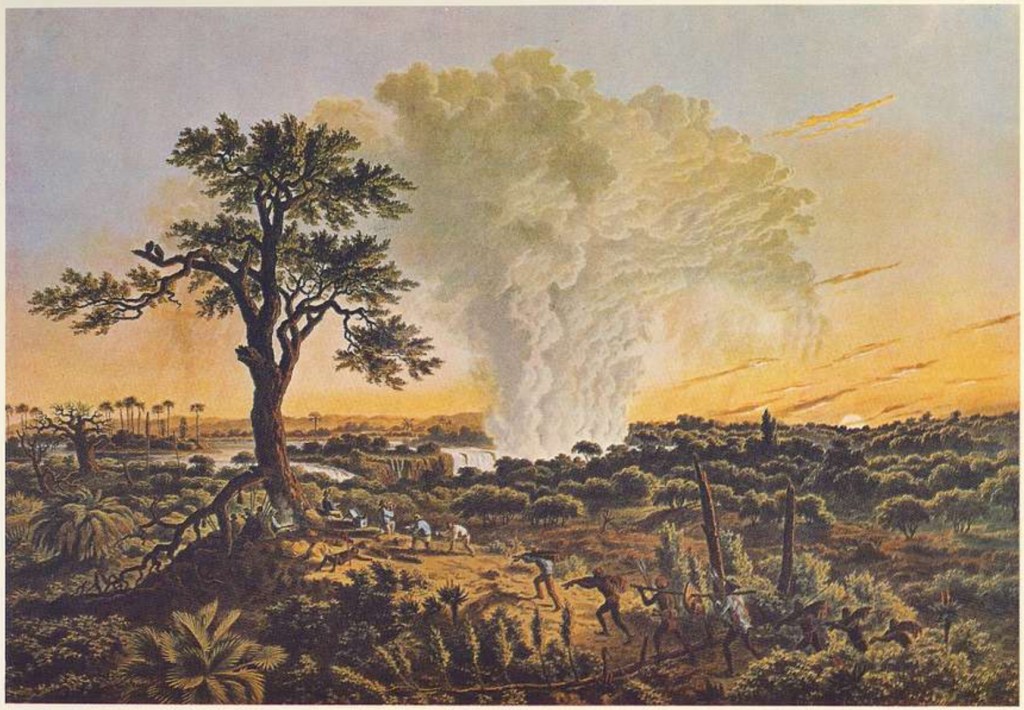
painted by Thomas Baines in 1865 71
Oswell must have mentioned Mosi-oa-Tunya in his letter to Vardon in colourful enough terms to get that old-Africa-hand excited and it seems unlikely that this could have just been a description of the spray seen from a distance.
The third piece of evidence is that, in 1852 a year after Oswell and Fleming had been on the Zambezi, an Irishman called William Desborough Cooley wrote “Inner Africa Laid Open”, an attempt to document all the lines of communication, that is travel routes, across the interior of Africa.
He had never been to Africa but he adequately described the falls, Jeff Ramsey points out:
“Borrowing from Oswell, Cooley’s text notes that at the Falls the water “forces its way in a contracted channel through some rocky hills and is at length precipitated with such a noise and vapour as to procure for the spot the name Mosiwathunya, or Smoke-sounds (roaring vapours).” 72
For Oswell to have provided such information he would have to reached the falls themselves.
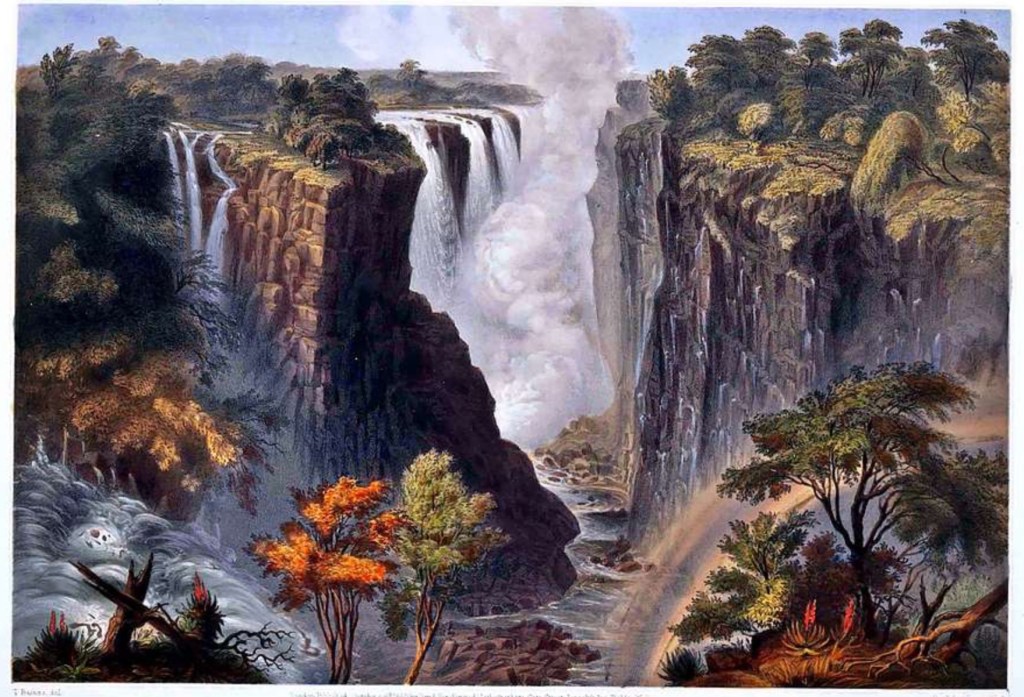
And, lastly it is hard to believe that William Cotton Oswell, the Nimrod of Africa, the alleged greatest hunter of his age , the man who had hunted and explored huge tracts of the unmapped lands that lay between the Cape Colony and the Zambezi River, got to within ten miles of a massive plume of spray rising over 1,500 feet in the air and did not attempt to get any closer to see what caused it.
Based on the available evidence we cannot be certain whether Fleming “just” saw the huge plume of spray rising from Mosi-oa-Tunya or whether he stood, with his friend Oswell, on the banks of the Zambezi and observed one of the great wonders of the natural world. Either way they were certainly the first two people, who had not been born in Africa, to see it and about four years before Livingstone claimed that honour.
Return from the Makololo
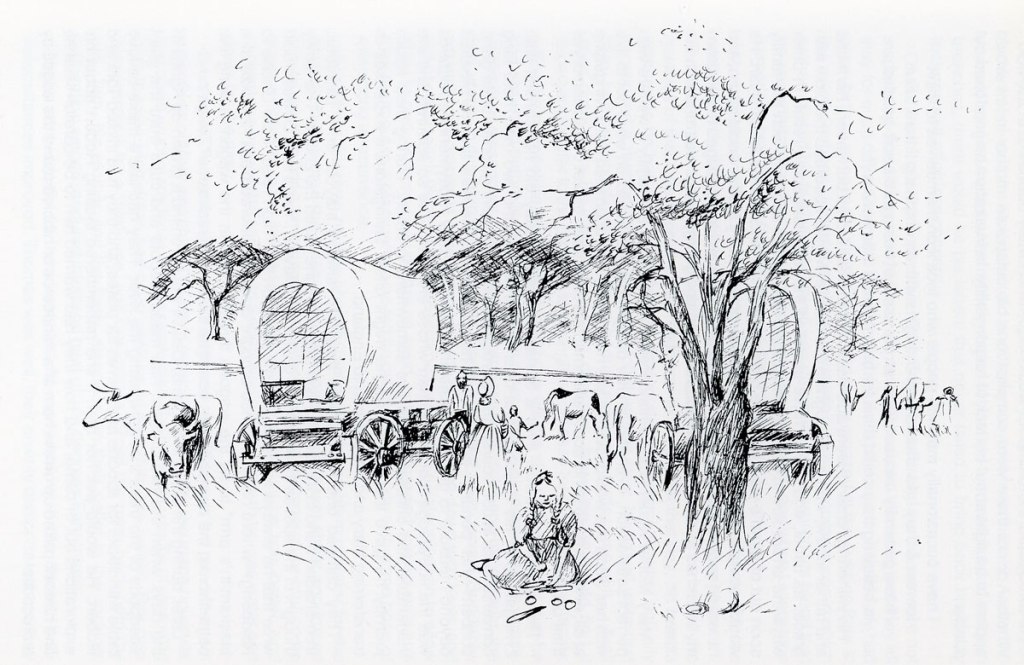
Following the death of King Sebetwane it was August before they were allowed to leave the Makololo kingdom. They chose a route that avoided the horrors of the Mababe Depression and took them back to the Boteti River or as they called it the Zouga. In an encampment on the banks of this river Livingstone’s third son was born on September 15th and named William Oswell but nicknamed “Zouga”.
The journey back to Kolobeng was eventful and must have been stressful for all concerned. The children took turns to have fevers that all but killed them and Mary was once again semi paralysed by child birth. Livingstone, as usual, brushed such inconveniences aside telling his father-in-law that Thomas had suffered from “a touch of fever”. One can only wonder whether Oswell, Thomas and Fleming were relieved to leave the Livingstones at Kolobeng and ride on to Cape Town.
Once again the loyal men who had followed Oswell back and forth across Africa were paid off. As we will see later George Fleming was to reappear as a trader but John Thomas’ story is even more surprising; Oswell wrote:
“I told John in part how I valued his services, and asked him if I could in any way repay my debt of gratitude. I had taught him to read in the Bush, but that was the only good I had ever done him.
His answer came after some hesitation. He had heard so much of England that he should like of all things to go with me there. Two days later we were on board ship together.
He, as usual, was everything to everybody, helping the steward, attending the sick ladies, nursing the babies, the idol of the sailors, to whom he told stories of bush life, the adored of the nurses ; for John with all his virtues was a flirt, the admirer and admired of all womankind. 75
John Thomas and a Final Word on Oswell
John Thomas sailed to England with Oswell and became his brother’s coachman:
“I left John in London and went down to my brother’s. He hesitated about my henchman, thinking a real, live black man would hardly suit the household of a country clergyman. But his coachman fell sick.
Could John drive ? I should think so, he was the best eight-in-hander in Cape Town ! Down he came, and in half an hour was perfectly established in the family. My brother declared he never had such a coachman, and was very kind to him.” 76
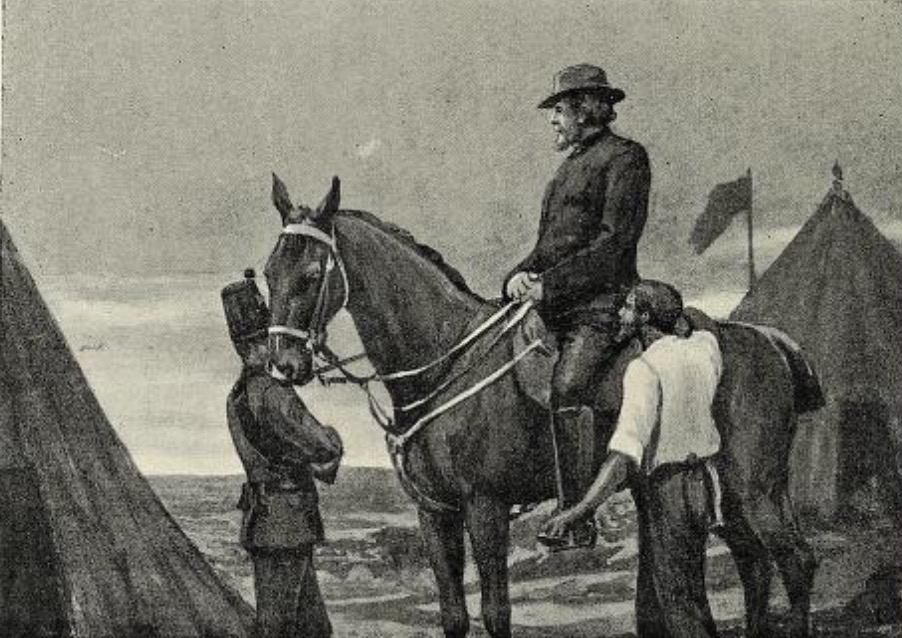
Unfortunately Oswell, a modest man, chose not to write a book about his adventures and we are reliant on those of his letters that his son William Edward Oswell published in 1900 and an extended essay he wrote about his hunting adventures.
He was a remarkable man and his attitude toward his African servants shows him to be kind and without any of the prejudices we might expect from a privileged, Victorian gentlemen trained by the East India Company.
He was a hunter and some of his wealth no doubt came from the prodigious number of elephants he slaughtered for their ivory but he was remorseful in later life:
“I am sorry now for all the fine beasts I have killed; but I was young then, there was excitement in the work, I had large numbers of men to feed, and if these are not considered sound excuses for slaughter, the regret is lightened by the knowledge that every animal, save three elephants, was eaten by man.”
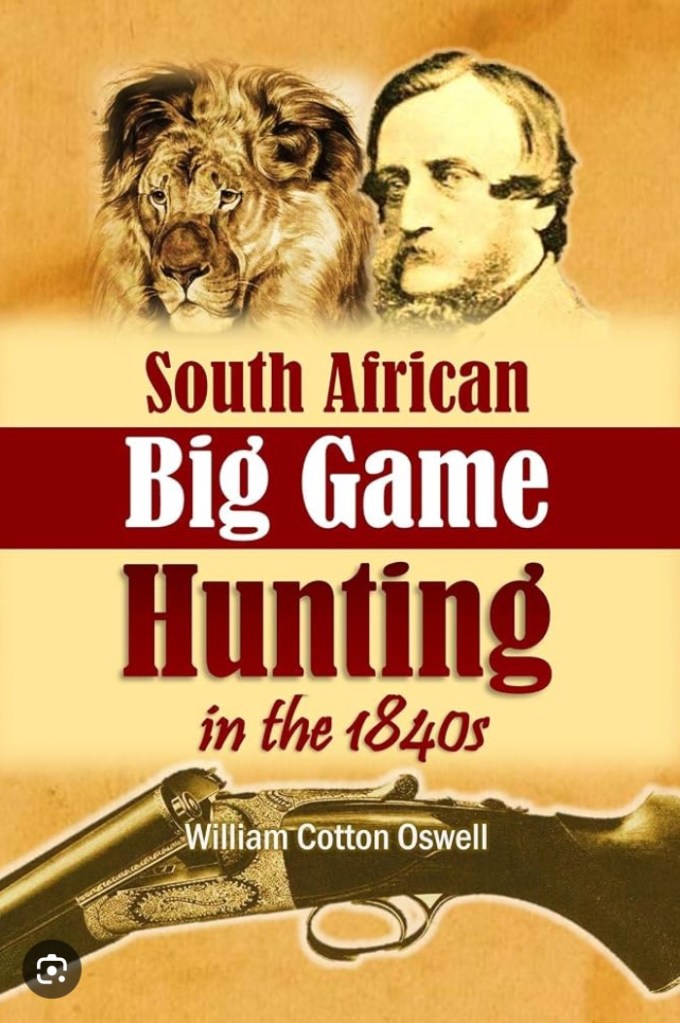
He should have the last word:
“I spent five years in Africa. I was never ill for a single day – laid up occasionally after an accident, but that was all. I had the best of companions Murray, Yardon, Livingstone and capital servants, who stuck with me throughout.”
Cape Town to Kuruman
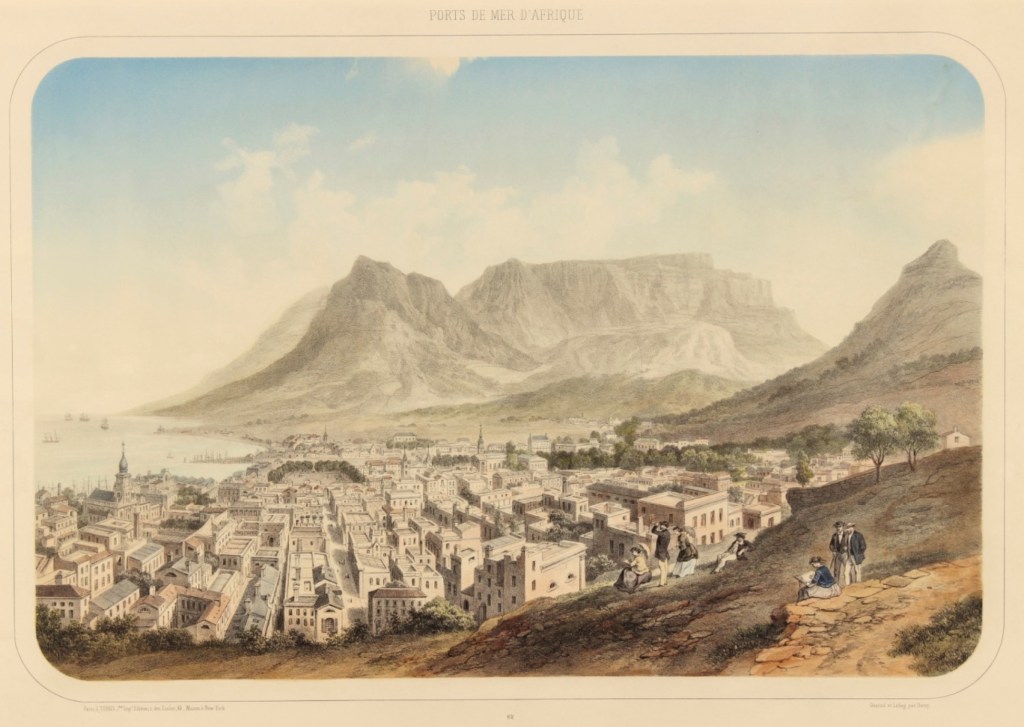
Livingstone was in Cape Town in 1852 to see his family onto the ship headed for England. He wrote to William Oswell on the 27th April mentioning George Fleming and suggesting that he expected Oswell to be joining him somewhere on the Zambezi.
It is clear that Livingstone now plans to reach either the west or east coast of Africa starting out from Linyanti:
“Your cook George Fleming proposes to go up country on his own account some months hence. Mr. Rutherford seems to approve of the plan and so I think will give him goods to trade with. … If you wish it I might detain George for you supposing you came from the West. I shall certainly try either the East or the West coast.
George Fleming, ex-chef and now trader driving his own wagon, had only returned with Oswell on March 16th 1852 and in June he left Cape Town with David Livingstone for Kuruman. They were following the well trodden road to the edge of the Kalahari Desert via Griqua Town in what is now the Northern Cape province of South Africa.
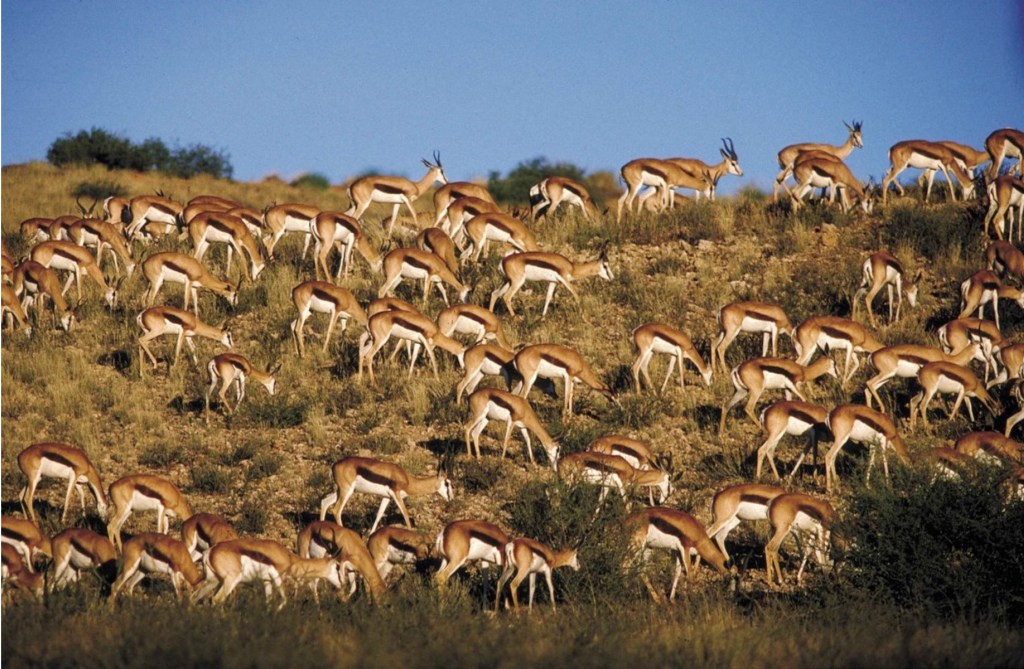
The beginning of that journey involves passing through the Cape Colony with its isolated farms and small settlements. Fleming had passed this way before but on this journey he witnessed events that were soon to become rare and then disappear altogether. South of the Orange river they observed the migration of, what Livingstone suggested, were forty thousand springboks coming out of the Kalahari Desert and crossing into the Colony where they would compete for grazing with sheep on farms in the Great Karoo region.
This migration was known as the trekbokken and was last seen in 1896-97. It had once involved millions of springbok and even one of the last trekbokken recorded at Karree Kloof on the Orange River comprised a herd that was reported to be fifteen miles wide and stretching for over a hundred miles.
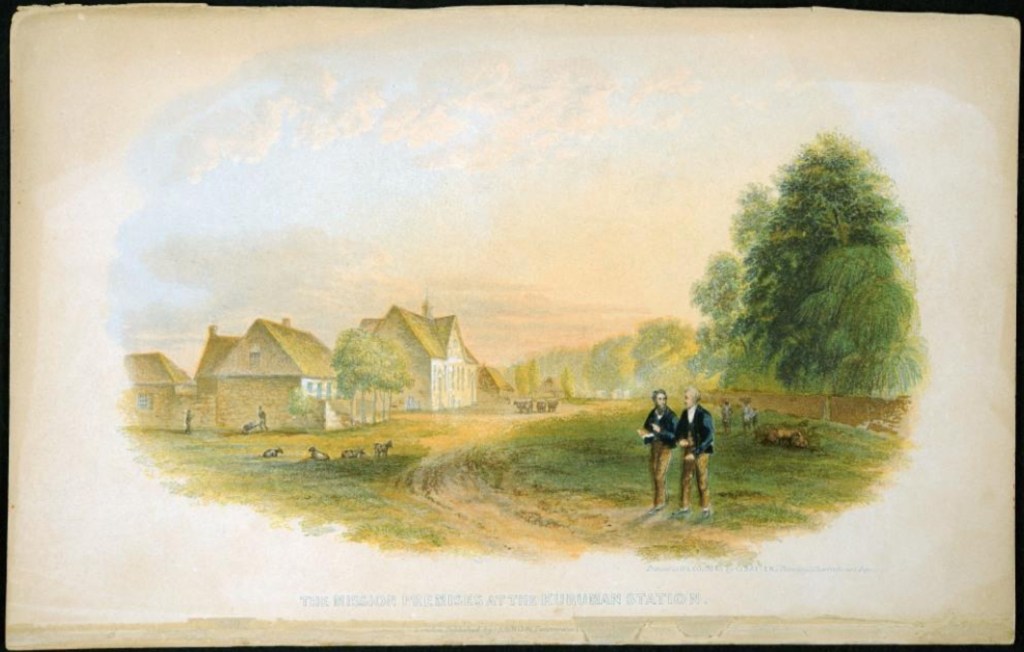
Livingstone reached Kuruman in late August about ten days before Fleming
Their ultimate destination was the Makololo capital of Linyanti in the Caprivi Strip in Northern Namibia, a journey of around 1,500 kilometres. The place they had both visited the previous year with Oswell and Livingstone’s family.
At Kuruman where his father-in-law Robert Moffat was the missionary Livingstone was shown a letter from his friend Kgosi (king) Sechele of the Batswana people that had been delivered to Moffat by Masebele, one of Scechele’s wives. Sechele reported that he was “undone by the Boers” for refusing to be subjected by them. The letter described the Battle of Dimawe and reported that David and Mary’s home at Kolobeng had been looted by the Boers.
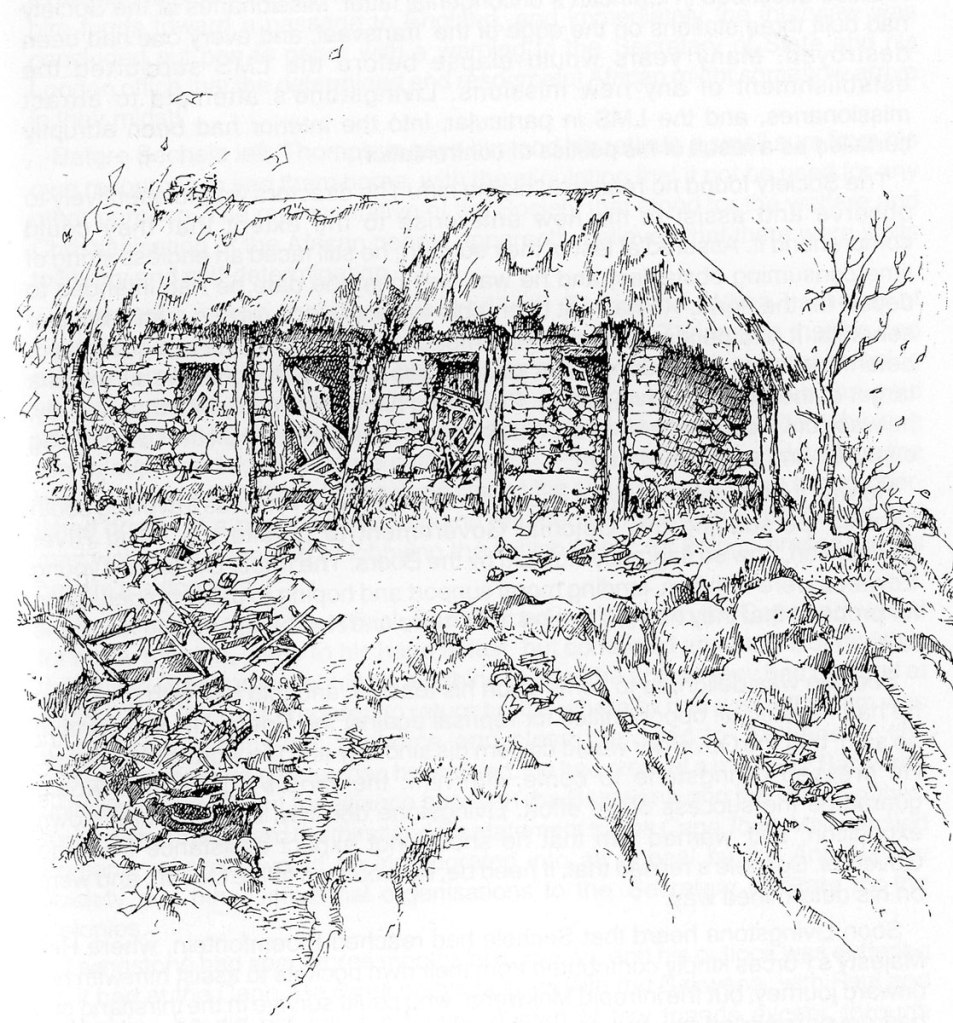
Livingstone and Fleming’s departure from Kuruman was initially delayed by a broken wagon wheel but as news of the Boer’s attack on Sechele spread and a narrative developed that blamed Livingstone for “teaching (Sechele’s people) to kill Boers” they found it impossible to hire wagon drivers for the journey. Eventually Livingstone and Fleming each found three men willing to join them and they set forth on November 20th 1852.
At Motito they met Sechele coming south. He told them that he was determined to take passage to England to tell Queen Victoria about the transgressions of the Boers.
For an account of the Batswana-Boer War and the looting of Livingstone’s home at Kolobeng see Appendix I below.
On Towards Linyanti
Dithubaruba
Livingstone and Fleming proceeded north accompanied by the six men they had hired; we know little of these fellows other than Livingstone’s comment:
“Our servants were the worst possible specimens of those who imbibe the vices without the virtues of Europeans, but we had no choice, and were glad to get away on any terms.” 83
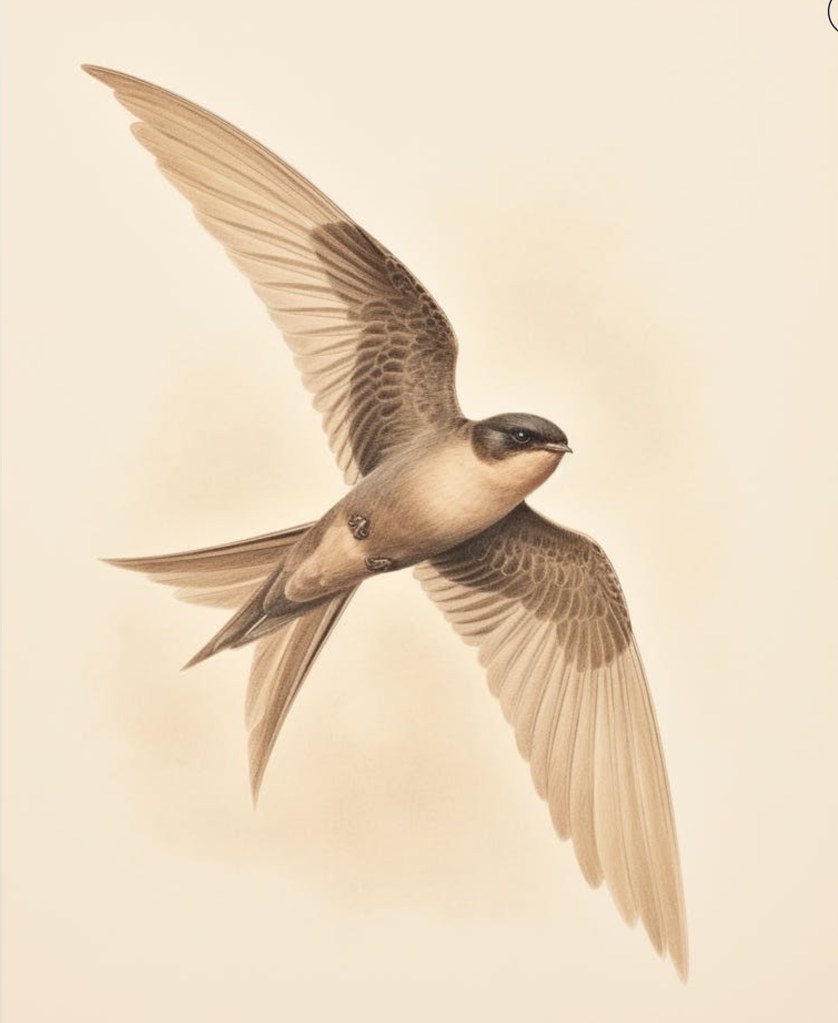
They skirted the Kalahari whilst noticing that abundant rainfall that year had resulted in vast quantities of melons that, in the absence of water, could sustain the oxen who hauled the wagons. They saw thousands of common swifts (Apus apus) flying north and Livingstone wondered if these were European swifts migrating back to the northern hemisphere. 84
They reached Dithubaruba (Litubaruba) on the last day of 1852 to find Sechele’s people in dire straits as a result of the Boer raids and the Batswana-Boer War (see below). Their cattle and grain had been stolen and they were now starving.
The Boers feared a major attack by Sechele and whilst Livingstone and Fleming were there a delegation arrived to negotiate with the Batswana. It transpired that the Boer leader, Shultz, had taken Sechele’s children as domestic slaves and the Bakwena had insisted that they should be returned if there was to be any kind of peace.
There was much weeping when this delegation returned Sechele’s son Khari to his mother. However, Livingstone’s suggests that many others, “scores”, remained enslaved.
Livingstone remarks:
“The Boers know from experience that adult captives may as well be left alone, for escape is so easy in a wild country that no fugitive-slave-law can come into operation; they therefore adopt the system of seizing only the youngest children, in order that these may forget their parents and remain in perpetual bondage. I have seen mere infants in their houses repeatedly.”
If we are correct in thinking that Fleming had escaped from slavery in the United States, we can only guess at the thoughts that went through his mind as he witnessed these scenes.
The Kalahari and Beyond
An unspecified number of Batswana men and boys accompanied Livingstone and Fleming beyond Dithubaruba. They continued north and despite this now being a known trail it remained hazardous. Livingstone’s narrative is punctuated with the wells they visited and descriptions of the long periods when the oxen had to survive without water. He reported that the rainy season was late and the temperature had risen alarmingly.
Near the salt pan at Nchokotsa a thermometer placed two inches below soil level read 128o Fahrenheit (Over 55o Centigrade); the water there was undrinkable as it was full of ammonia and salt. They continued north digging wells that filled so slowly they had to wait one or two days for an adequate supply.
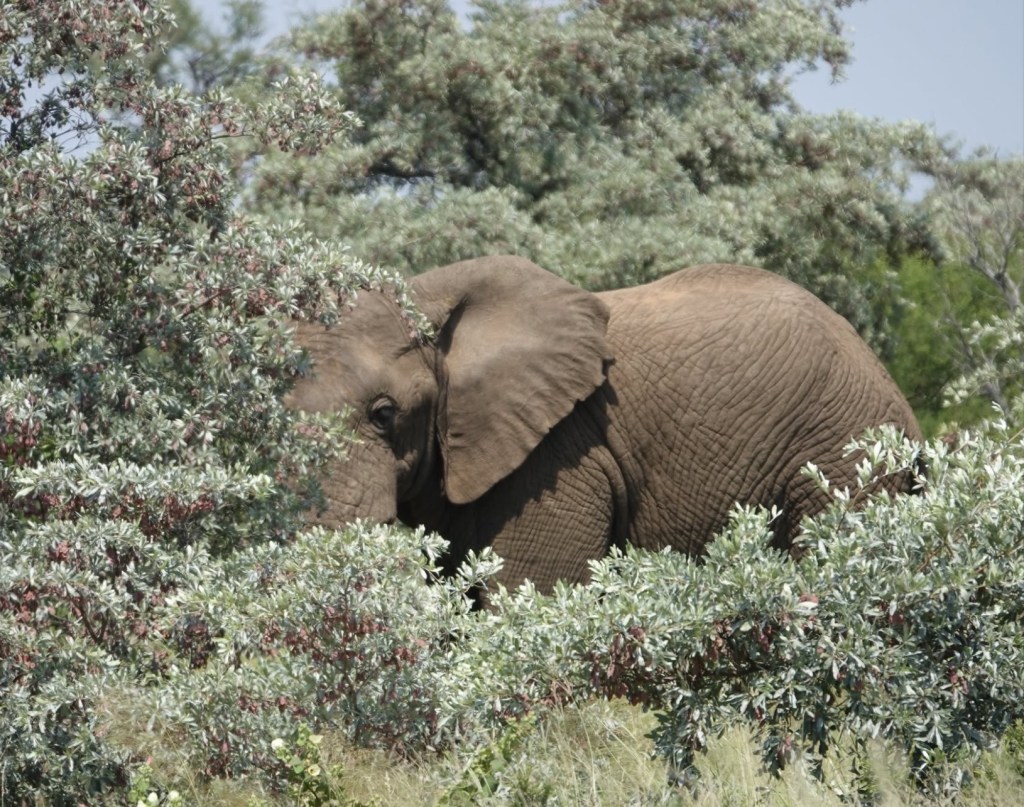
By March 1st, four months after leaving Kuruman, they were north of the Khama Khama Pan in northeastern Botswana where the water in the infrequent water holes had simmered at 100o Fahrenheit (Approximately 38o Centigrade). They were hacking their way through “mohonono-bush” (Terminalia sericea or Mogonono or Silver Cluster-leaf tree) which was, and is, much loved by elephants. At last the rains had arrived but with them came swarms of mosquitoes and the whole party bar Livingstone and one boy succumbed to malaria, what Livingstone called “African Fever”. The boy managed their forty oxen including bringing them back after a hyena had caused a stampede. Livingstone treated his patients.
Still suffering from the lingering effects of the fever they continued to fight their way through deep forest clearing the path of the wagons with axes. George Fleming was too weak to drive his wagon and Livingstone left him half a cask of water and carried on ahead to find more water. It is interesting to read that they were cutting their way through the bush in torrential rain whilst searching for a water hole; this perhaps shows just how much water was needed to keep forty oxen alive and well.
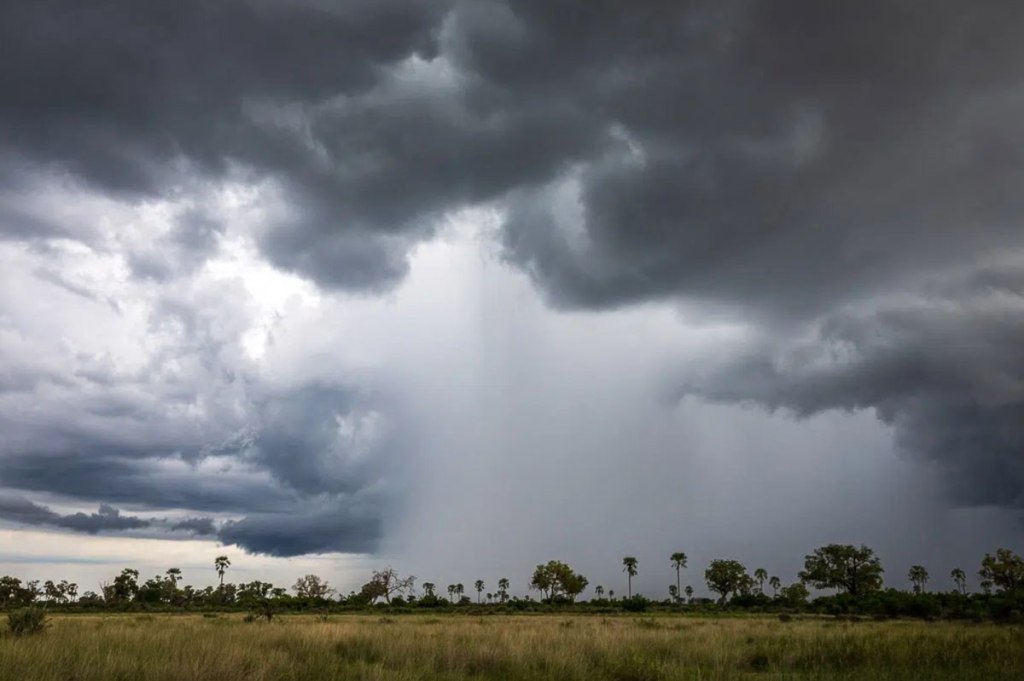
San people showed them the route to a waterhole and Fleming found enough energy to catch up. They were soon in the region of the Linyanti/Chobe River systems where the rainy season creates seasonal flood channels that flow into the Mababe Depression. They reached one such channel, the “Sanshureh River” south of the Chobe River which due to shifting river courses no longer exists but in 1853 it created an impassable barrier.
For a while the San help them look for a way to cross the flooded channel but eventually they slip away and Livingstone decides to cross using a pontoon and try and find a route over which he bring up the wagons and reach the Chobe River. They climbed trees to spy ahead and saw the wide expanse of the Chobe floodplain and the river itself. They trek across the sodden floodplain covered in razor-sharp reeds and across islands covered in thorn bushes that shred George Fleming’s leather trousers.
They refloated their pontoon in the main stream of the Chobe and reached the Makololo village of Moremi on Mahonta Island. A survey in 1946 stated:
“When Livingstone was attempting to find the Chobe channel from the Sanshureh arm in 1853, he ultimately discovered an inlet and after paddling “from midday till sunset” he located the island Mahonta, on which a Makololo village Moremi was situated ……. It is clear from the accompanying map that Mahonta is now in camelthorn (Acacia giraf}ae) country and far from the Chobe.” 86
Moremi was known to Livingstone from his previous visit to the Makololo and he organised his men to help recover the expedition’s wagons by breaking them down and bringing them across the river in pieces. Ten oxen had been lost to Tsetse fly whilst waiting.
By May 2nd 1853, thirteen months after leaving Cape Town, they were entering Linyanti, the capital town of the Makololo, where “between six and seven thousand” people greeted them. For more about the Makoloko and Linyanti take a look at The Makololo and their African Kingdom.
Once they reached Linyanti there is little mention of Fleming. Livingstone mentions that he traded with the Makololo:
“It was pleasant to look back on the long extended line of our attendants, as it twisted and bent according to the curves of the footpath, or in and out behind the mounds. Some had caps made of lions’ manes; others, the white ends of ox-tails on their heads, or great bunches of black ostrich-feathers, which waved in the wind. Many wore red tunics, or various-coloured prints, which the chief had bought from Fleming.”
After five months with the Makololo Fleming returned to the south accompanied by the three men Livingstone had hired in Kuruman in November of 1852.
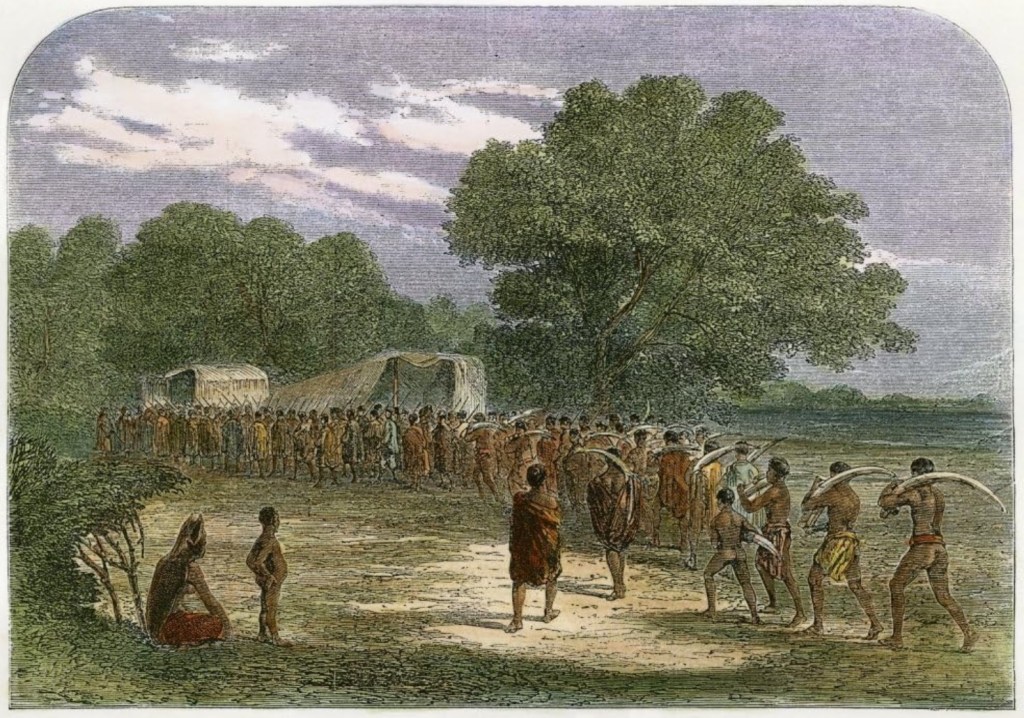
According to Livingstone his trading mission had not been successful as the goods he had carried north had not appealed to the Makololo but he departed with a wagon load of ivory which Livingstone thought would more than recompense him for the cost and effort of the journey. Fleming sold the ivory in Grahamstown.
One Last Mission in 1856
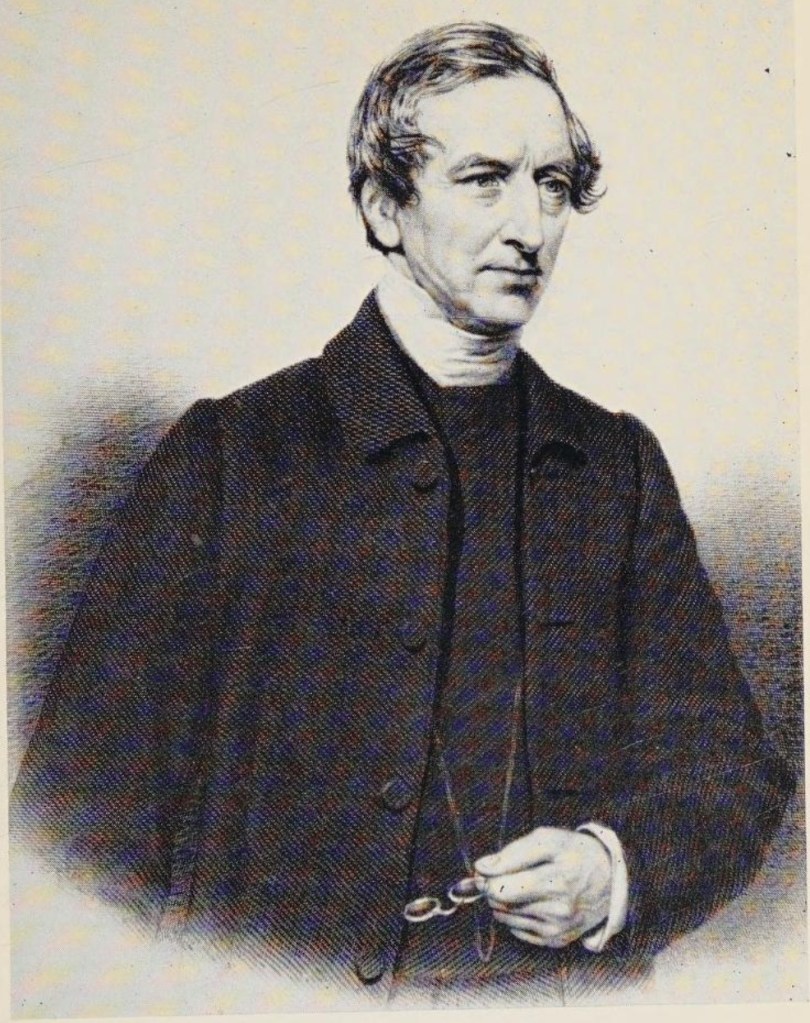
By 2nd March 1856 David Livingstone had reached the Portuguese trading post of Tete on the Zambezi River as he entered the last stages of his epic trans African march. He wrote letters to Arthur Tidman (see left 88) and William Thompson. Tidman was the Foreign Secretary to the London Missionary Society (LMS) and Thompson was its agent for southern Africa based in Cape Town.
He reported that he was now on foot as all his oxen had succumbed to tsetse fly and he was too poor to buy a canoe.
His plan was to rest for a few days and then travel down river to Quelimane on the Indian Ocean coast. However, later correspondence between Livingstone and Thompson shows that he had not clearly relayed this plan and Thompson may have thought him stranded at Tete.
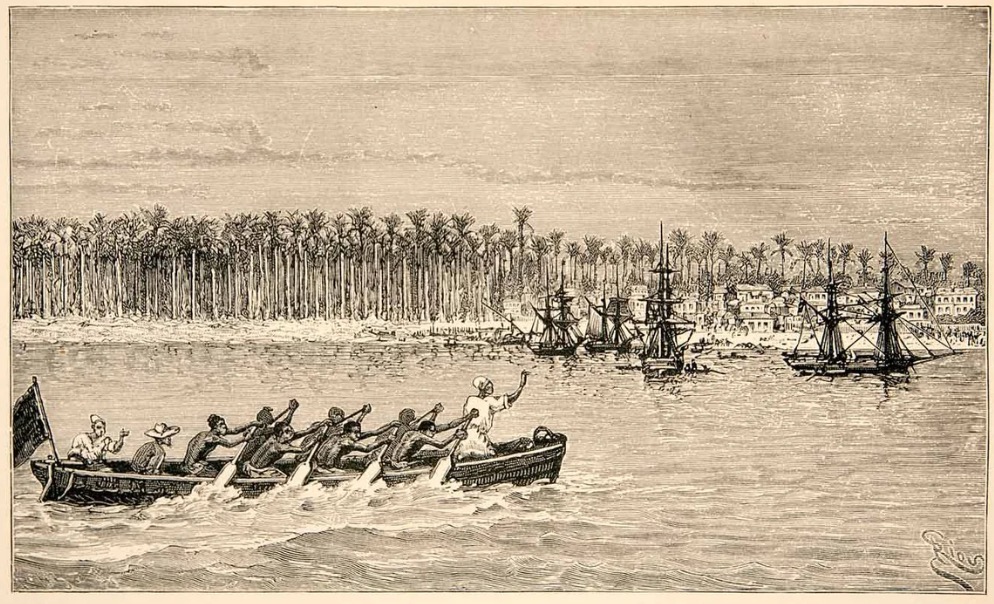
With the cooperation of the same Mr Rutherford who had financed George Fleming’s trading enterprise to the Makololo Thompson hired George Fleming on the 3rd June 1856 and subsequently loaded him aboard the HMS Frolic with money and supplies for Livingstone.
As Thompson was uncertain of Livingstone’s location he instructed Fleming to use the supplies to launch a rescue mission up the Zambezi if Livingstone was not at Quelimane.
Schapera seems to have had sight of the formal agreement between Thompson and Fleming as he notes:
“Clause I of the agreement reads: ‘Mr Fleming under4takes to proceed to Quilimane in H.M. Sloop of War the “Frolic”, and to render any assistance that may be in his power to the Commander during his stay on board that vessel, and to the Revd. Dr. Livingstone whenever he may find him, placing himself entirely under the direction of that gentleman to serve him in any capacity he may desire.
The agreement specified (Clause 8) that Thompson would pay Fleming the sum of ten (£10) pounds sterling a month, reckoning from the 1st June 1856, and ten pounds for an outfit.” 90
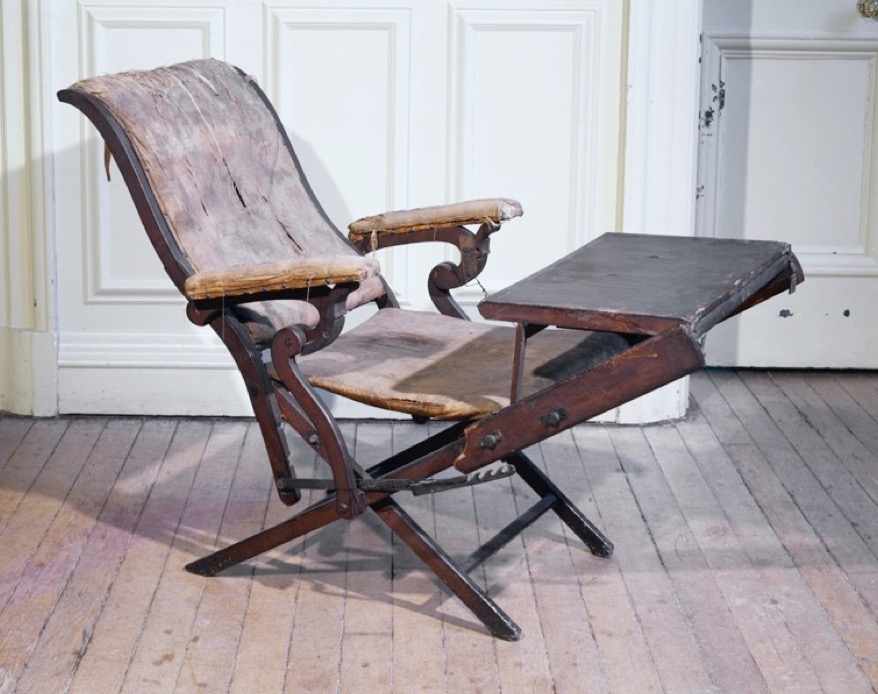
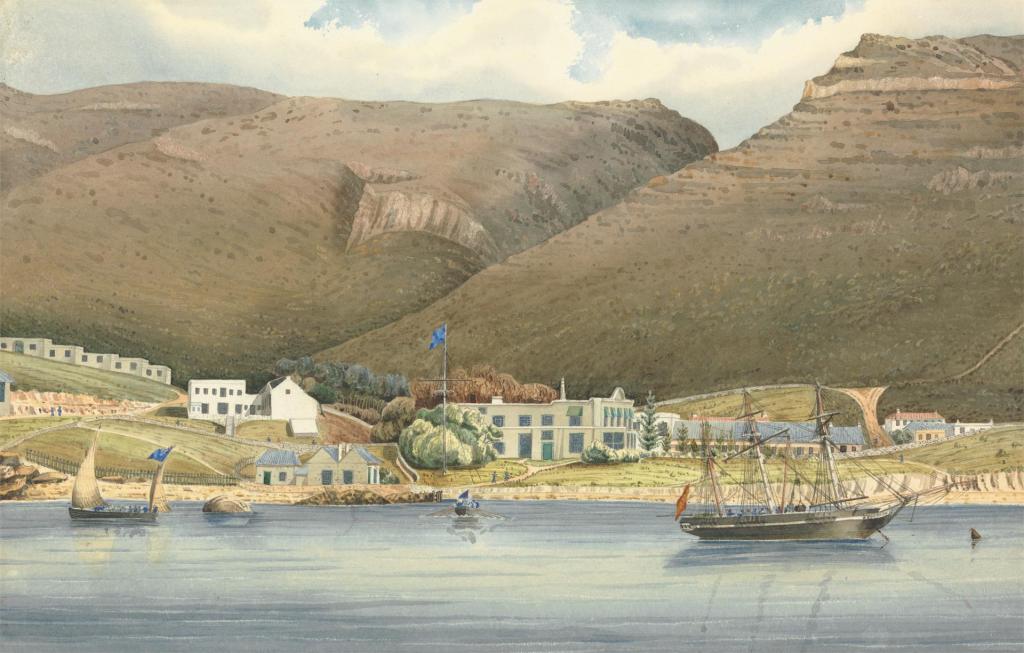
Unbeknownst to Thompson, Livingstone had reached Quelimane on May 20th 1856 having left Tete on the 22nd April. He settled down to rest at the house of General Galdino José Nunes, a Portuguese official, whom Livingstone described as being:
“One of the best men in the country.”92
On the 10th of July Her Majesty’s Sloop of War Frolic arrived at Quelimane commanded by, the wonderfully named, Lumley Woodyear Peyton. On board was George Fleming with the letters and supplies sent by Thompson. He also delivered fifty sovereigns (face value of £1 with a. spending power of £135 today), 500 Spanish dollars (the famous “pieces of eight”), a desk, a work box and several pieces of clothing. 93
HMS Frolic subsequently took Livingstone to Mauritius where he arrived on the 12th August. His plan was to take passage to England.
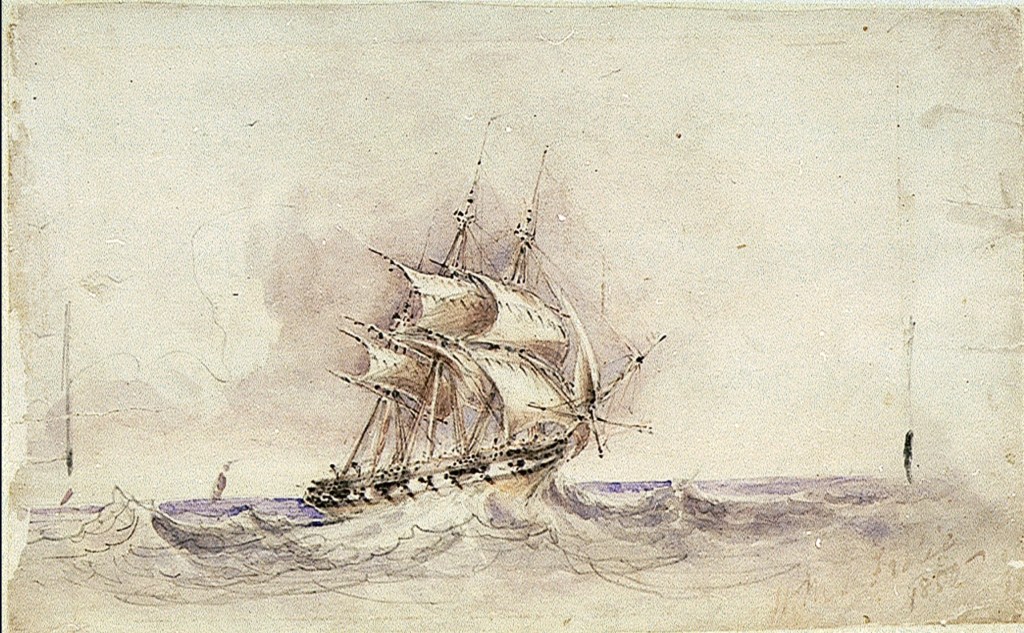
Livingstone wrote to Thompson on the 12th whilst still onboard Frolic with instructions regarding Fleming’s remuneration when he reached the Cape:
“Respecting George Fleming, I suppose it will be best to settle with him in Cape Town, for besides not having more money than I may need, supposing I get not a free passage, the agreement does not specify what was to be given, supposing he was required to do no more than has happened.
Here he has able seaman’s pay as Captain’s servant. He serves me too…… Whatever you think proper to give, please put it to my account.”
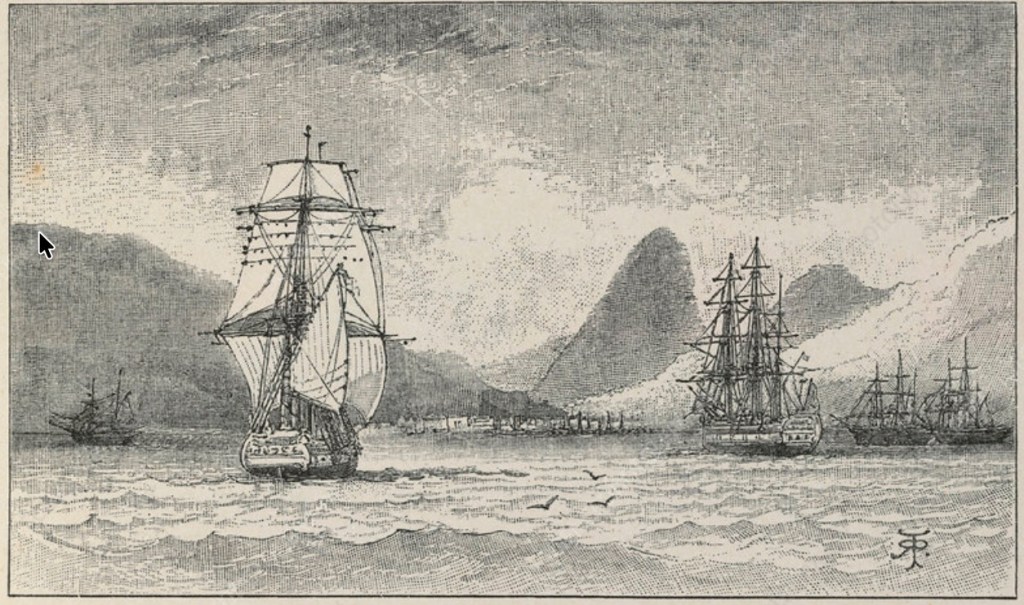
Before he leaves Mauritius in September he writes again to Thompson about Fleming and by now the relationship seems to have soured to some degree.
Since Quelimane he has been paid £2 a month as the Captain’s servant but he is insisting that he is still owed £10 a month until he is returned to the Cape. Livingstone appears to have moved quite a long way from “Whatever you think proper to give, please put it to my account.” as he now writes:
“…. he sticks to the £10 per month as the part most agreeable to his ideas of the proper fulfilment of his duties.”
Fleming clearly believes he had an agreement that paid him £10 a month from 1st June until he was delivered back to Cape Town. If Frolic left Mauritius around 22nd September she would not have reached Cape Town until around the middle of October. So, Fleming expected to be paid £45 or £50 depending on how the agreement treated part months.
It is possible that Livingstone now realised that, by keeping Fleming with him after Quelimane, which he might have done to avoid paying for a passage back to Cape Town, he has ended up with a large bill. Remember that his missionary stipend was £100 a year.
Livingstone was a complex and often contradictory character who often struggled to maintain long term relationships.
“John Kirk joined Livingstone on his Zambezi expedition but became furious with Livingstone’s leadership, throwing a copy of Livingstone’s Missionary Travels into the river.” 97
Frustrated with George Fleming’s insistence on being paid what he believes he is owed Livingstone starts to assassinate the character of the man he has travelled with for thousands and thousands of tough miles and not unusually firmly lays the blame for the situation elsewhere:
“It is unfortunate that Fleming was engaged at all, as he is a most unlikely person to go anywhere in the face of danger; but us you could not know, and I should probably have been much mislead in respect to his travelling abilities as you, but for my intercourse with him in the way to Linyanti. He requires one on whom he can lean; deprived of that, he has no self-reliance whatever.” 98
It could be pointed out that this man with poor “travelling abilities” was hired four times by William Cotton Oswell, a man noted for his leadership qualities, and able to make his own way back from Linyanti to Grahamstown, a journey of 2,250 kilometres.
Right: Livingstone with his sextant. 99
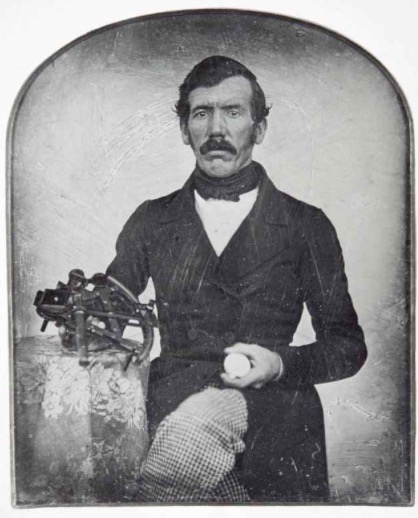
Sadly the last written references to George Fleming are that Livingstone believes he owes someone ten shillings for doing the doctor’s washing and that he “smashed” his sextant when packing it.
Remembering George Fleming
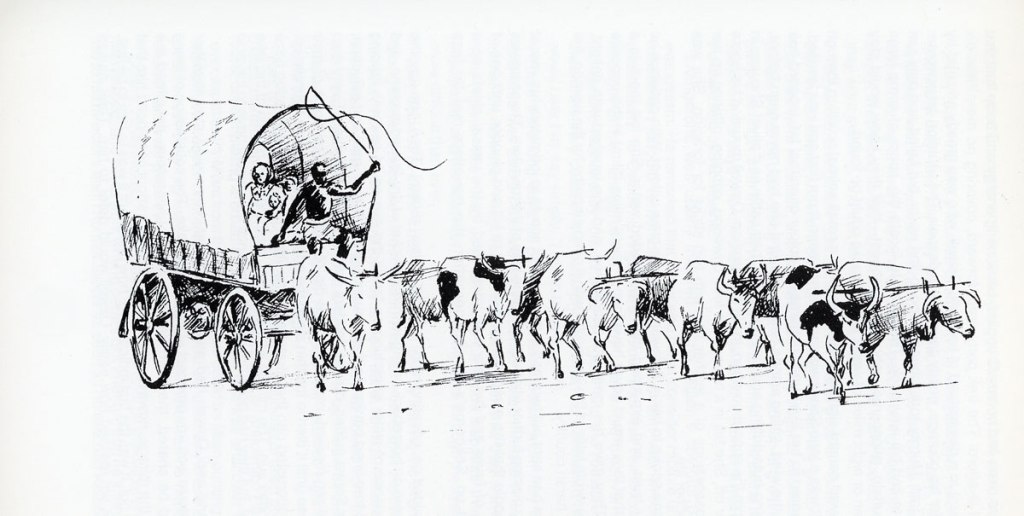
It is better to remember him as the excellent cook who drove his wagon from the southern coast of Africa to the Limpopo twice, to lake Ngami, to the Boteti River, and to Linyanti twice.
Search the internet for the first American to visit Mosi-oa-Tunya and the answers are unusually vague, it even have been Teddy Roosevelt in 1909. It is highly unlikely to tell you that the first American to see Mosi-oa-Tunya was a black cook, an ex-slave, travelling with a British hunter and a significant number of Africans in 1851 and not only that but he and the hunter were the first two non Africans to see the falls.
Later Life
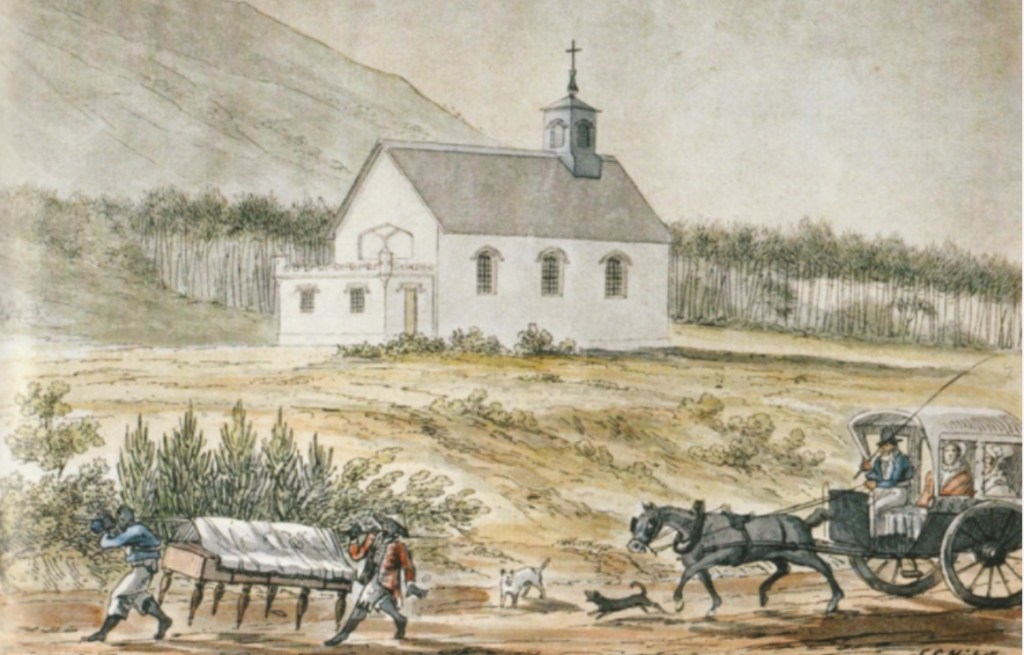
In 1839 George Fleming married Francis Johanna Lendert or Lindert at St Paul’s Church, Rondebosch, Cape Town. She died in 1865 and is buried at St. Paul’s; George died in 1879 in the house of a Mr. Charles Claremont where he appears to have been employed as a “gentlemen’s attendant”. His burial service was held at St. Paul’s so he may be buried in the same grave. 101
Appendix I – The Batswana-Boer War
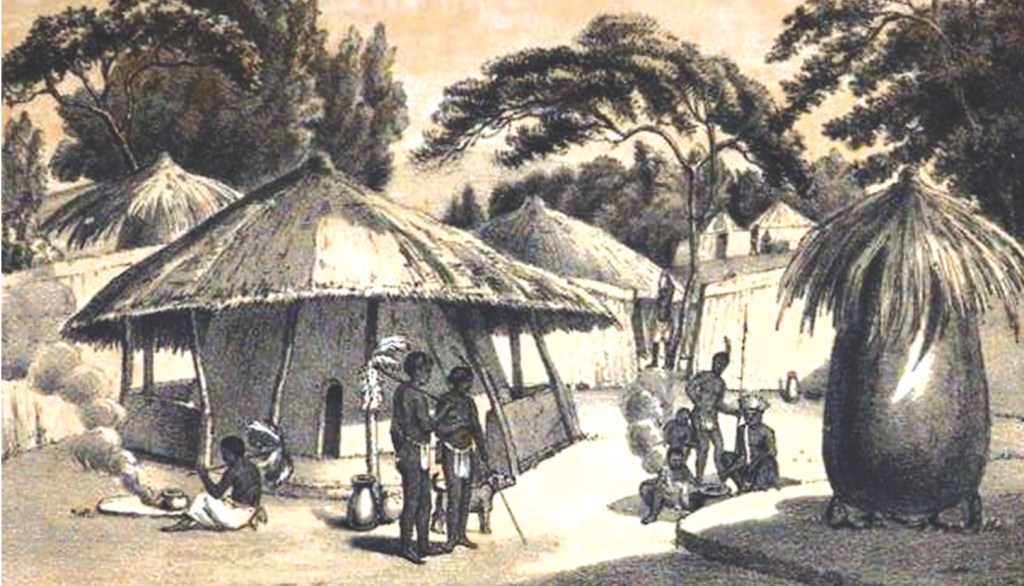
The Sand River Convention in January 1852 had seen the British government recognise the independence of the Boers who had settled in the Transvaal. The South Africa Republic, as it was to be known, pledged to support free trade and suppress slavery; in return the British banned arms and ammunition sales to black African chiefdoms.
Tension between the indigenous population and the Boer farmers had been building for many years. The Boers had long claimed the area between the Vaal and Limpopo Rivers and from the Drakensberg Mountains to the Kalahari Desert. Their need for land grew exponentially; birth rates were high with girls marrying young and continuing to bear children into their forties producing large families of six to eight children who thrived on a healthy outdoor lifestyle fuelled by a diet of home grown produce.
Tradition demanded that sons were given their own farms of more that 12,000 acres when they married and fathers had no qualms about taking more and more land from the indigenous population given their belief that the black man was a descendant of Ham, the son of Noah whose offspring had been cursed into slavery for eternity. 103
“Africans who did not resist the seizure of their land were often allowed to stay with their crops and herds. Others were driven off by men who rode up to their homes on horses, seized grain, slaughtered sheep and drove off their cattle. Chiefs on adjacent land were ordered to provide labour for Boer planting or harvesting, and their labourers, both. men and women were, were forced to leave their planting work to work on Boer farms for days or weeks without pay.” 104
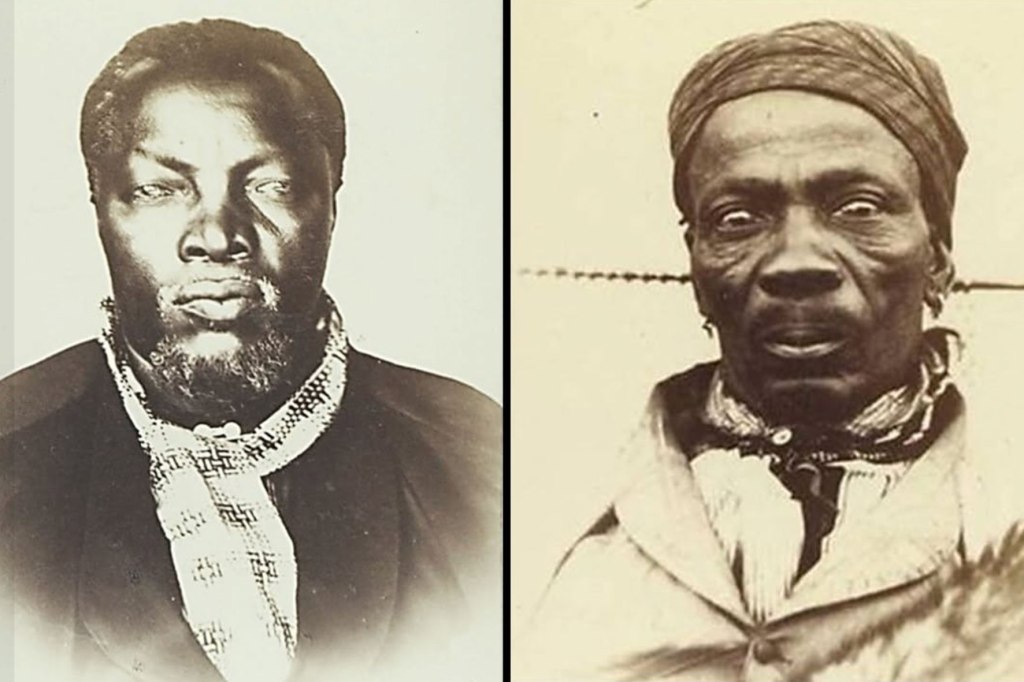
When confronted with mounted men armed with guns most clans accepted this situation. However, two important Kgosi (kings), Mosielele and Livingstone’s friend Sechele who chiefdoms were on the borders of modern day Botswana and South Africa consistently refused to comply.
Sechele had been acquiring guns for years, including a small number from Livingstone, and using ivory, feathers and skins as currency he and his warriors had purchased more from the European traders who reached Kolobeng and nearby farmers. Livingstone had told the Boers that Sechele was armed and dangerous, a strategy that backfired as it eventually incentivised the Boers to attempt to destroy him.
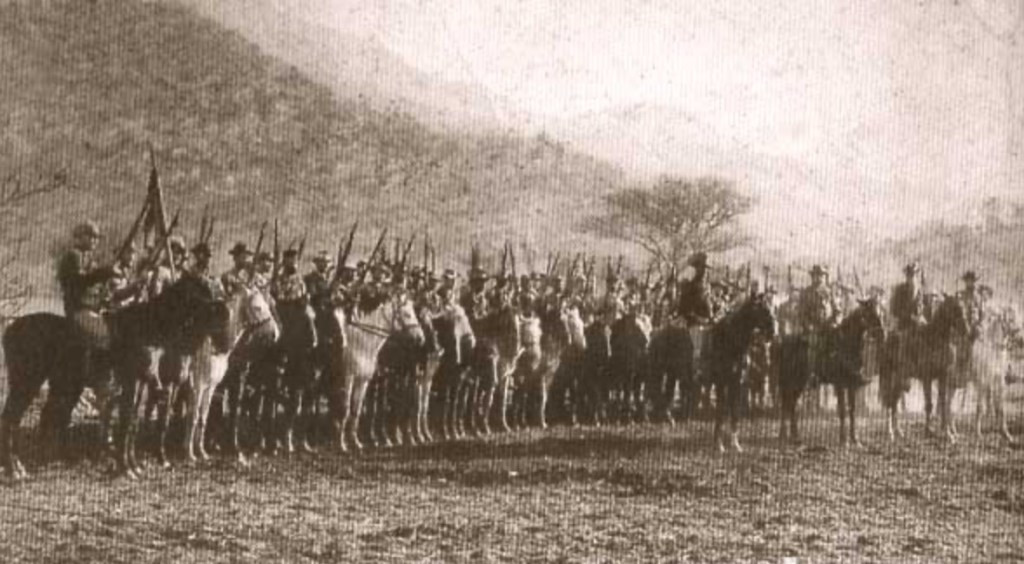
After the two Kgosi had refused to meet and submit to the authority of the Boers Pieter Scholtz, the military commandant of the Marico district assembled a huge commando of 430 mounted Boers and at least as many Tswana auxiliaries. They attacked Mosielele’s settlement of Mabotsa on 17th August but Mosielele and most of his people had already fled to join Sechele. Scholtz was furious and shot down 17 tribesmen who had not left with Mosielele but who now tried to escape the Boer commando.
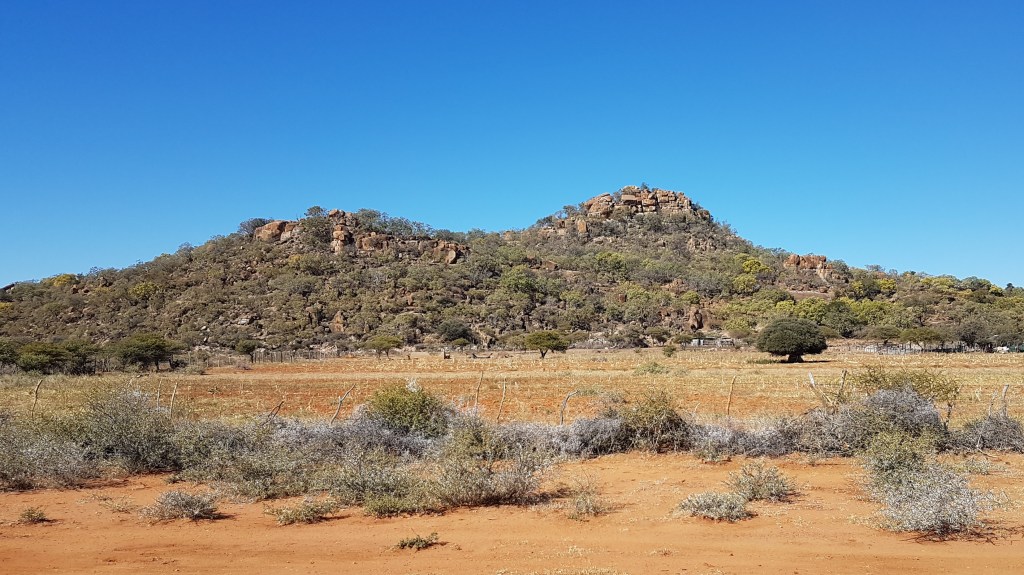
The attackers advanced to meet Sechele, who was now the commander of a combined force of several clans, at Dimawe, a village built on the slopes of a rocky hill in, what is now, southeastern Botswana.
After a pause to recognise the sabbath the Boers attacked the Bakwena positions to begin a six hour long battle that left over sixty of Sechele’s people dead along with an unknown number of casualties amongst his allies.
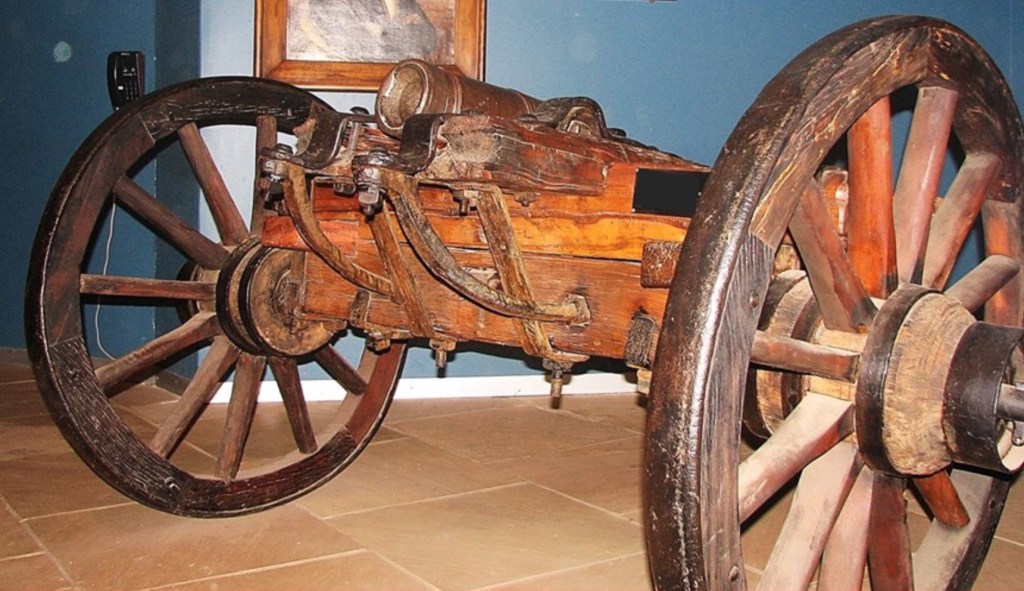
The Boers only reported six deaths but an unknown number of black servants and auxiliaries had also died and it was alleged that the auxiliaries had been used as human shields. 109 Later reports suggested that at least 30 Boers had died at Dimawe.
By nightfall the village was burning and Sechele’s allies’ positions had been overrun but Sechele was able to withdraw in good order to regroup at Dithubaruba.
Over the next three days the Boers looted a thousand cattle, eleven horses and hundreds of sheep and goats, forty-eight guns and hundreds of pounds of ivory. One of the two wagons they found belonged to a white trader who had left this and eighty draught oxen with Sechele for safe keeping; the Boers took these along with everything else.
Scholtz attempted to carry out reprisal raids on nearby villages but the population had dispersed and the Boers realised that the raid had failed in its objective to make their territory safer. The Batswana had not only defied them but had fought Scholtz’ commando to a standstill and were now emboldened and angry.
The Boers needed a scapegoat and Livingstone, whose mission at Kolobeng was nearby was the ideal candidate. They argued that it was the Scottish missionary who had not only encouraged the Batswana to fight but who had trained them and provided them with firearms. Scholtz sent a patrol with four empty wagons to the deserted mission and they returned with two rifles and
“…. so many gun mechanisms and tools that the place resembled, not a mission, but a small arms factory with more gunsmith’s tools than bibles.”
The rest of the space in the wagons was filled with every item of furniture the Livingstone’s owned along with all the family’s possessions. The Boers justified the looting of a mission station on the basis that Livingstone had sold Sechele thirteen guns a few weeks before the battle. Livingstone had been nowhere near Kolobeng or Sechele and the Batswana for the previous nine months.
Livingstone realised that the many delays he had suffered on his journey to Kolobeng from the Cape had probably saved the lives of his men including George Fleming.
James Chapman, a hunter returning to the Cape from Ngamiland reached Kolobeng after the Boers had left. He not only recorded that all the furniture, tools, corn mill and the contents of the kitchen, larder and storeroom had gone but the valley was white with the pages of the Setswana bibles and religious tracts that had been torn to pieces. After Kolobeng he visited Dimawe where he saw the houses and fields burnt black to the ground and strewn with bones and graves. 111
The Boer commando had left along with the huge amount of livestock, and eighty wagons filled with equipment, grain and valuables. There was still there was enough grain to need a further twelve wagons.
They enslaved 200 women and 400 children including, Mokgokong, one of Sechele’s wives and his son Kgari and when they withdrew they left 4,000 Bakwena and the same number of Bakaa and Bakgatia without food or shelter.
Sechele and the Bakwena harassed the Boers in guerrilla-style, hit and run attacks as they withdrew and an order went out to kill any Boers on sight. They raided farms and stole cattle
The Boers living in the Marico district were frightened and stayed in their laagers fearing reprisals if they worked in the open on their farms.
In December 1852, four months after the Battle of Dimawe, Livingstone and Fleming reached Kgosi (King) Sechele’s Tswana capital at Litubaruba or Dithubaruba.
The Boers were still feared a major attack by Sechele attacks and arrived to negotiate with the Batswana whilst Livingstone and Fleming were present. It transpired that the Boer leader, Shultz, had taken Sechele’s children as domestic slaves and the Bakwena insisted that they should be returned; there was much weeping when Sechele’s son Khari was returned to his mother. Livingstone’s text suggests that many others “scores” remained enslaved.
Livingstone remarks:
“The Boers know from experience that adult captives may as well be left alone, for escape is so easy in a wild country that no fugitive-slave-law can come into operation; they therefore adopt the system of seizing only the youngest children, in order that these may forget their parents and remain in perpetual bondage. I have seen mere infants in their houses repeatedly.”
If we are correct in thinking that Fleming had escaped from slavery in the United States, we can only guess at the thoughts that went through his mind as he witnessed these scenes.
Footnotes
- Most sources give Paul Belloni Du Chaillu, a French American, the credit of being the first American to penetrate the interior of Africa but his first expedition to what is now Gabon was not until 1855, six years after Fleming had accompanied Oswell and Livingstone to Lake Ngami. ↩︎
- David Chamberlin Editor (1969) Some Letters from Livingstone, 1840 -1872. New York: Negro Universities Press. Chamberlin-1969 ↩︎
- Jeff Ramsey (2019) The Botswana Society Facebook “George Fleming – The African American who listed Sebetwane and Became the First Cape Trader North of the Zambezi. Ramsey-2019 ↩︎
- Janet Wagner Parsons (1997) The Livingstone’s at Kolobeng 1847-1852. Gaborone: The Botswana Society and Pula Press ↩︎
- Mosi-oa-Tunya (The Smoke that Thunders) is the Lozi language name for the great waterfall on the Zambia Zimbabwe border that Livingstone called The Victoria Falls. The Tonga people, who also live along the Zambezi River call it Shungu Namutitima (Boiling Water) ↩︎
- D’Amour Museum of Fine Arts – American Whaler, Nathaniel Currier Springfields-Whaler ↩︎
- Bathsheba Demuth. Harvesting Light: New England Whaling in the Nineteenth Century. Demuth-Whalers ↩︎
- Skip Finley (2015) Black Whaling Captains Led the Way Finlay-2015 ↩︎
- Black History in the Last Frontier: Black Whalers in the North Pacific and Arctic Black-Whalers ↩︎
- William Edward Oswell (1900) William Cotton Oswell, hunter and explorer; the story of his life, with certain correspondence and extracts from the private journal of David Livingstone, hitherto unpublished. Vol I. New York: Doubleday, Page. Oswell-1900-I ↩︎
- William Cotton Oswell (1818 – 1893) born in Leytonstone, Essex and educated at Rugby School became a director of the Honourable East India Company. He was sent to South Africa for health reasons in the 1840s where he built a reputation as a hunter. After his adventures described here he returned to England and nursed his ailing brother. He subsequently travelled to France and from there volunteered to join the British Army as a civilian medical officer during the Crimean War. He retired ↩︎
- Wesley Richards (2022) William Cotton Oswell – Early Pioneer of the Safari Richards-2022 ↩︎
- William Edward Oswell (1900) Vol I ↩︎
- Jacqueline Banerjee. Rugby School in the Nineteenth Century Banerjee-Rugby ↩︎
- William Cotton Oswell (1894) South African Big Game Hunting in the 1840s. Republished from Badminton Library of Sports and Pastimes, Vol. 17 ↩︎
- Thomas Hughes (1896) Tom Brown’s Schooldays. London: Macmillan. Hughes-1896 ↩︎
- Rugby School Archives – School Registers 1675 to 1842 Rugby-School-1833 ↩︎
- Judith Listowe (1974) The Other Livingstone. Lewes: Julian Friedmann Publishers Ltd. Listowe-1974 ↩︎
- William Cotton Oswell (1894) ↩︎
- William Edward Oswell (1900) Vol I ↩︎
- William Cotton Oswell (1894) ↩︎
- William Edward Oswell (1900) Vol I ↩︎
- Roualeyn George Gordon-Cumming (1892) Five years’ hunting adventures in South Africa: being an account of sport with the lion, elephant ….. London, Simpkin, Marshall Cummings-1892 ↩︎
- William Edward Oswell (1900) Vol I ↩︎
- Roualeyn George Gordon-Cumming (1892) Five years’ hunting adventures in South Africa: being an account of sport with the lion, elephant ….. London, Simpkin, Marshall Cummings-1892 ↩︎
- William Edward Oswell (1900) Vol I ↩︎
- William “Bill” Buckley with record tusks from an elephant he shot weighing 145 & 137 pounds respectively, Lado Enclave, 1908. Picryl-Tusks ↩︎
- William Cotton Oswell (1894) ↩︎
- How the Ox-Wagon and transport-rider opened up this country Zim-Field-Guide_Ox-Wagon ↩︎
- George Seaver (1957) David Livingstone: His Life and Letters. New York: Harper & Brothers. Seaver-1957 ↩︎
- The History of Kuruman Roger-de-la-Harpe-2026 ↩︎
- David Livingstone (1857) Missionary Travels and Researches in South Africa. London: John Murray Livingstone-1857 ↩︎
- Carlo Pellegrini (1878) Sir Thomas Montague Steele National Portrait Gallery. Pellegrini-1878 ↩︎
- David Livingstone (1857) ↩︎
- His map from the 1851 Expedition to meet King Sebetwane showing the course of the Chobe and Zambezi Rivers was copied many times and formed the basis of African maps until 1857 when Livingstone returned from crossing Africa. ↩︎
- Wikimedia-1843_Map ↩︎
- I. Schapera (1959) David Livingstone: family Letters 1841 – 1856 Volume 1 1841 – 1848. London: Chatto and Windus. Schapera- 1959 ↩︎
- Graham Leslie McCallum (2016) The Cape Wagon – Form Follows Function McCallum-2016 ↩︎
- Judith Listowe (1974) The Other Livingstone. Lewes: Julian Friedmann Publishers Ltd. Listowe-1974 ↩︎
- William Edward Oswell (1900) Vol I ↩︎
- William Edward Oswell (1900) Vol I ↩︎
- William Edward Oswell (1900) Vol I ↩︎
- Janet Wagner Parsons (1997) The Livingstone’s at Kolobeng 1847-1852. Gaborone: The Botswana Society and Pula Press ↩︎
- David Livingstone (1857) Missionary Travels and Researches in South Africa. London: John Murray ↩︎
- Wikipedia-San-Hunters ↩︎
- Janet Wagner Parsons (1997) The Livingstone’s at Kolobeng 1847-1852. Gaborone: The Botswana Society and Pula Press ↩︎
- Etosha National Park Etosha ↩︎
- William Cotton Oswell (1894) South African Big Game Hunting in the 1840s. Republished from Badminton Library of Sports and Pastimes, Vol. 17 ↩︎
- David Livingstone (1857) Missionary Travels and Researches in South Africa. London: John Murray ↩︎
- William Cotton Oswell (1894) South African Big Game Hunting in the 1840s. Republished from Badminton Library of Sports and Pastimes, Vol. 17 ↩︎
- Lake Ngami Britannica-Lake-Ngami ↩︎
- William Edward Oswell (1900) Vol I ↩︎
- David Livingstone (1857) Missionary Travels and Researches in South Africa. London: John Murray ↩︎
- William Edward Oswell (1900) Vol I ↩︎
- William Edward Oswell (1900) Vol I ↩︎
- Janet Wagner Parsons (1997) The Livingstone’s at Kolobeng 1847-1852. Gaborone: The Botswana Society and Pula Press ↩︎
- Graham Leslie McCallum (2016) The Cape Wagon – Form Follows Function McCallum-2016 ↩︎
- Janet Wagner Parsons (1997) The Livingstone’s at Kolobeng 1847-1852. Gaborone: The Botswana Society and Pula Press ↩︎
- Botswana Safari Company Boteti-River ↩︎
- William Edward Oswell (1900) Vol I ↩︎
- William Edward Oswell (1900) Vol I ↩︎
- William Cotton Oswell (1894) South African Big Game Hunting in the 1840s. Republished from Badminton Library of Sports and Pastimes, Vol. 17 ↩︎
- African Overland Kalahari-Desert ↩︎
- Janet Wagner Parsons (1997) The Livingstone’s at Kolobeng 1847-1852. Gaborone: The Botswana Society and Pula Press ↩︎
- William Edward Oswell (1900) Vol I ↩︎
- The Mababe Depression Serana-Tang ↩︎
- Janet Wagner Parsons (1997) The Livingstone’s at Kolobeng 1847-1852. Gaborone: The Botswana Society and Pula Press ↩︎
- Emil Holub (1881) Seven Years in South Africa Holub-1881 ↩︎
- The Portuguese knew that there were cataracts on the Zambezi in the general area of the falls as shown by their early maps. But, Zumba, their nearest trading post, was roughly 1,000 kilometres away at the confluence of the Zambezi and Luangwa Rivers on, what is now, the Zambian Mozambique border. A handful of Portuguese merchants explored inland from Sena, Zumba and Tete but it seems that most of their trade with the interior was through middlemen. ↩︎
- William Edward Oswell (1900) Vol I ↩︎
- Thomas Baines (1865) Falls by Sunrise Baines-1865 ↩︎
- Jeff Ramsey () Livingstone was not the first European to see the Falls.Ramsey-Cooley ↩︎
- The Victoria Falls, Zambesi River, sketched on the spot (during the journey of J. Chapman & T. Baines). London: Day & Son, 1865 Baines-1865 ↩︎
- Janet Wagner Parsons (1997) The Livingstone’s at Kolobeng 1847-1852. Gaborone: The Botswana Society and Pula Press ↩︎
- William Edward Oswell (1900) Vol I ↩︎
- William Edward Oswell (1900) William Cotton Oswell, hunter and explorer : the story of his life with certain correspondance and extracts from the private journal of David Livingstone, hitherto unpublished. Vol. II New York: Doubleday, Page. Oswell-1900-II ↩︎
- William Edward Oswell (1900) Vol II ↩︎
- William Cotton Oswell (1894) ↩︎
- Citta Del Capo 1850 Cape-Town-1850 ↩︎
- David Johnson (2013) The Mighty Springbok Migration David-Johnson-2013 ↩︎
- Special Collections SOAS Library University of London (2014) The Life and Afterlife of David Livingstone: Kuruman Mission & the Moffat family SOAS-Kuruman ↩︎
- Janet Wagner Parsons (1997) The Livingstone’s at Kolobeng 1847-1852. Gaborone: The Botswana Society and Pula Press ↩︎
- David Livingstone (1857) Missionary Travels and Researches in South Africa. London: John Murray ↩︎
- David Livingstone (1857) ↩︎
- Chobe Rainy Season Passports-and-Pixels ↩︎
- Dr. H. H. Curson(1946) Notes on eastern Caprivi Strip Curson-1946 ↩︎
- Floods In Africa: A Growing Reality And How To Fight Them African-floods ↩︎
- I. Schapera (1961) Livingstone’s Missionary Correspondence 1841 – 1856. Berkeley and Los Angeles: University of California Press Schapera-1961 ↩︎
- 1893 Wood Engraving Quelimane Boat Oar Mozambique Africa Port Fleet Ship Quelimane ↩︎
- I. Schapera (1961) Livingstone’s Missionary Correspondence 1841 – 1856. Schapera-1961 ↩︎
- Natalie Cox (2016) Armchair Geography: Speculation, Synthesis, and the Culture of British Exploration, c.1830–c.1870 Cox-2016 ↩︎
- David Livingstone (1857) Missionary Travels and Researches in South Africa. London: John Murray ↩︎
- I. Schapera (1961) Livingstone’s Missionary Correspondence 1841 – 1856. Schapera-1961 ↩︎
- Royal Museums Greenwich – HMS Frolic 1850 RMG-Frolic ↩︎
- Port Louis, Mauritius, 1836 Mauritius ↩︎
- The Admiral House, Simon’s Town, Cape of Good Hope, 1844 Simons-Town-1844 ↩︎
- David Calhoun (2013) Profile in Faith David Livingstone (1813 – 1873)
“He lived and died for good.” Calhoun-2013 ↩︎ - I. Schapera (1961) Livingstone’s Missionary Correspondence 1841 – 1856. Schapera-1961 ↩︎
- The Life and Afterlife of David Livingstone: Map-making SOAS-2014 ↩︎
- S. J. de Klerk (2020) Visiting the historic St Paul’s Anglican Church and Graveyard de-Klerk-2020 ↩︎
- Jeff Ramsey (2019) The Botswana Society Facebook “George Fleming – The African American who listed Sebetwane and Became the First Cape Trader North of the Zambezi. Ramsey-2019 ↩︎
- Mark Anderson (2016) Great towns of the Tswana: challenge and triumph in precolonial South Africa Anderson-2016 ↩︎
- The story in the Old Testament involves Noah being seen naked by his son Ham. This, for some obscure reason, resulted in Noah cursing Ham’s son Canaan. “Cursed be Canaan; The lowest of slaves he will be to his brothers.” The curse was conveniently interpreted to mean that the descendants of Ham could be enslaved by the descendants of Noah’s other sons Shem and Japheth. A further leap not supported by the Bible’s text is that the descendants of Ham were marked out by being black. The Boers were far from being the only people to use the curse of Ham to justify the subjugation of black Africans. ↩︎
- Janet Wagner Parsons (1997) The Livingstone’s at Kolobeng 1847-1852. Gaborone: The Botswana Society and Pula Press ↩︎
- Jeff Ramsey (2024) Kgosi Sechele I (l) and Mosielele I (r). Both photos were taken in August 1865. Ramsey-2024 ↩︎
- Boer Commando Boer-Commando ↩︎
- Dimawe Hill in the Kweneng District, between Mmankgodi and Manyana, where a historical battle took place in 1852 Dimawe-Hill ↩︎
- Ou Grietje ↩︎
- Jeff Ramsey (1991) The Batswana-Boer War of 1852-53: How the Batswana Achieved Victory Ramsey-1991 ↩︎
- Janet Wagner Parsons (1997) The Livingstone’s at Kolobeng 1847-1852. Gaborone:The Botswana Society and Pula Press ↩︎
- Janet Wagner Parsons (1997) ↩︎
- A Tswana man holding an ostrich feather fan (‘Boosh-wana’), 1820
Samuel Daniell (1775 – 1811) Daniell-Tswana-Man-Ostrich-Feather ↩︎
Other Reading
- Jeff Ramsey (2014) BW Government Facebook “Builders of Botswana: The Self-Discovery of Ngamiland-Chobe. Ramsey-2014
- Jeff Ramsey (2019) The Botswana Society Facebook “George Fleming – The African American who listed Sebetwane and Became the First Cape Trader North of the Zambezi. Ramsey-2019
- J. Ramsey, B. Morton & T. Mgadia (1996) Building a Nation – A History of Botswana 1800-1910 Ramsey-1996
- J. Ramsey, B. Morton & T. Mgadia (1999) Building a Nation – A History of Botswana 1800-1910 – Revised Edition Ramsey-1999
- Jeff Ramsey (2013) David Livingstone and the Making of Modern Botswana: Portrait of a Young (ANGRY) Radical Ramsey-2013
- Tony Read (editor) (2007) Four Fathers of Big Game Hunting. Read Country Books

 Travelogues and Other Memories

,_North_Kalahari_Desert.jpg)


I would appreciate hearing your thoughts on this subject.